Proof of Reserves is crucial for ensuring the financial stability of crypto exchanges, but only 79 out of 166 have verified their assets.
In an industry still reeling from the shockwaves of major collapses like FTX, the method of Proof of Reserves (PoR) is gaining traction as a vital mechanism for crypto exchanges aiming to reassure users about their financial stability. Yet, the numbers are sobering: only about 79 out of 166 exchanges on CoinGecko have verified their reserves. This stark statistic underscores a critical blind spot for users who are trusting their assets with platforms that may lack the verified backing to withstand a rush of withdrawals.
Understanding Proof of Reserves
At its core, Proof of Reserves involves a transparent audit of an exchange's assets versus its liabilities. It's not merely a marketing tool; rather, it serves as a bulwark against insolvency for exchanges struggling to maintain user trust. Independent assessors come in to scrutinize reported assets and the controls over relevant wallets, ultimately providing a snapshot that should confirm whether an exchange has enough assets to meet its obligations to customers.
Since its inception in 2019, CoinGecko has sought to enhance this assessment method through a more nuanced Trust Score, monitoring not just reported trading volumes, but also liquidity, user security, and operational integrity. This multidimensional approach is crucial, especially in light of how simplistic metrics can obscure deeper vulnerabilities within exchanges.
The Mechanics of Proof of Reserves
PoR functions through dual pillars: proof of assets and proof of liabilities. Assets are verified by assessing the blockchain addresses controlled by the exchange, while liabilities can be represented using a sophisticated cryptographic structure called a Merkle tree. This tree organizes customer balances into hashes, culminating in a Merkle root that allows users to validate their own holdings without exposing the full dataset of every customer.
Through a verified Merkle proof, customers can confirm that their balances exist within the framework of liabilities, thereby offering a layer of assurance amidst skepticism. A healthy balance sheet can, theoretically, look something like this: reserves of $500 million against customer liabilities of $450 million translates into a robust reserve coverage of 111%. Such figures ought to provide confidence, but they require careful scrutiny.
How to Evaluate Exchange Reserves
To assess whether an exchange's PoR is reliable, users must start with some key queries:
- Which assets are included in the PoR assessment?
- Does the exchange actually control the wallet addresses reported?
- What specific customer liabilities are being evaluated?
- And critically, what level of reserve coverage does the exchange provide?
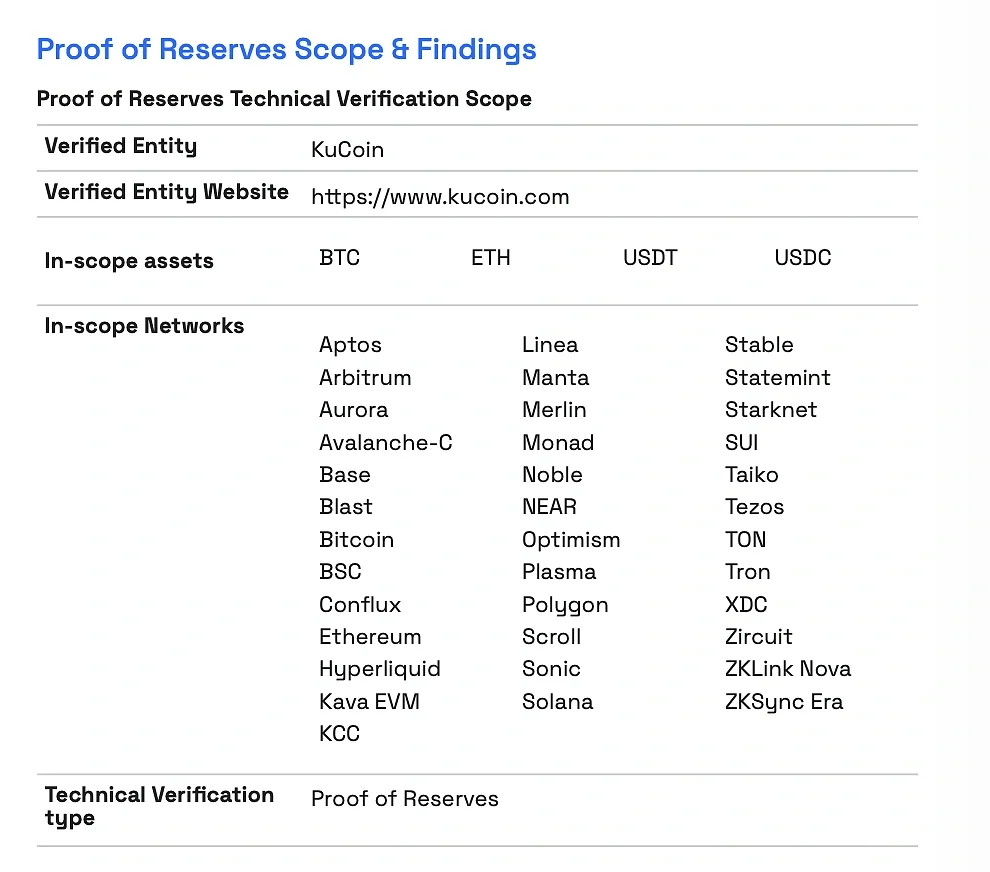
If we consider KuCoin’s recent PoR verification report published in August 2026, for example, the scope was limited to four specific assets—BTC, ETH, USDT, and USDC—and involved 38 different networks. While the exchange was able to provide evidence of control over the wallets, including cryptographic signatures and initiated transactions for verification, the restricted scope raises a fundamental issue: does this represent the entire financial picture? The answer is likely no, as it only reflects part of the assets available on the platform.
Implications of Reserve Approach
The manner in which exchanges structure their reserves can greatly influence their perceived stability. For instance, a 1:1 reserve model dictates that each asset held by customers should be matched by a corresponding reserve held by the exchange. This is administratively complex but provides a tighter risk profile, particularly emboldened by regulations that emphasize direct asset backing.
Alternatively, an overall customer-liability coverage approach may offer the illusion of stability without the granular accountability. This strategy allows exchanges to leverage a broader array of liquid assets but invites risks if those assets experience significant fluctuations. The FTX debacle starkly illustrated this vulnerability when an over-reliance on its native token, FTT, led to a catastrophic feedback loop that undermined both its solvency and customer trust.
As users, being aware of and understanding the asset composition and risks tied to an exchange's reserve structure is essential. In a landscape where liquidity and quality of assets can swiftly change, relying solely on headline figures of reserve coverage can be misleading.
The Path Forward: What Should Users Do?
For professionals deeply entrenched in the crypto trading ecosystem, this proof of reserves capability should not only be a checklist item but a critical aspect of due diligence. When evaluating exchanges, prioritize those that are transparent about their reserves and liabilities—check for third-party certifications, assess the quality of the included assets, and understand the verification methodologies employed.
The need for heightened scrutiny and the conscious demand for transparency within the crypto realm cannot be overstated. Those still adopting a cavalier attitude toward exchange oversight not only risk financial loss but also contribute to an environment fostering uncertainty. Grasping the full scope of how exchanges manage their reserves is pivotal in navigating this evolving industry landscape.
Ultimately, if you're operating in the crypto space, leveraging a thorough understanding of PoR could prove invaluable. It lifts the shroud of ambiguity and positions you to make informed decisions about your assets, thereby safeguarding your interests in a sector defined by volatility and disruption.

Discussion
Sign in to join the discussion.