Rise's collaboration with Arbitrum enhances its payroll offerings, optimizing cross-border payments and lowering costs for small and mid-sized transactions.

The challenge of processing cross-border payments efficiently hinges on three main factors: liquidity, latency, and cost. Rise aims to streamline these complexities by establishing a unified global payroll infrastructure, enabling compliant and instant payments to workers worldwide.
At the core of Rise's platform is its support for native stablecoins, USDC and USDT, facilitating flexible funding and withdrawal options. Users can fund transactions in whichever stablecoin suits their operational needs, with USDC being more prevalent in regions like the US, Europe, and much of Asia-Pacific, while USDT remains the choice in Latin America, Africa, and parts of Asia-Pacific.
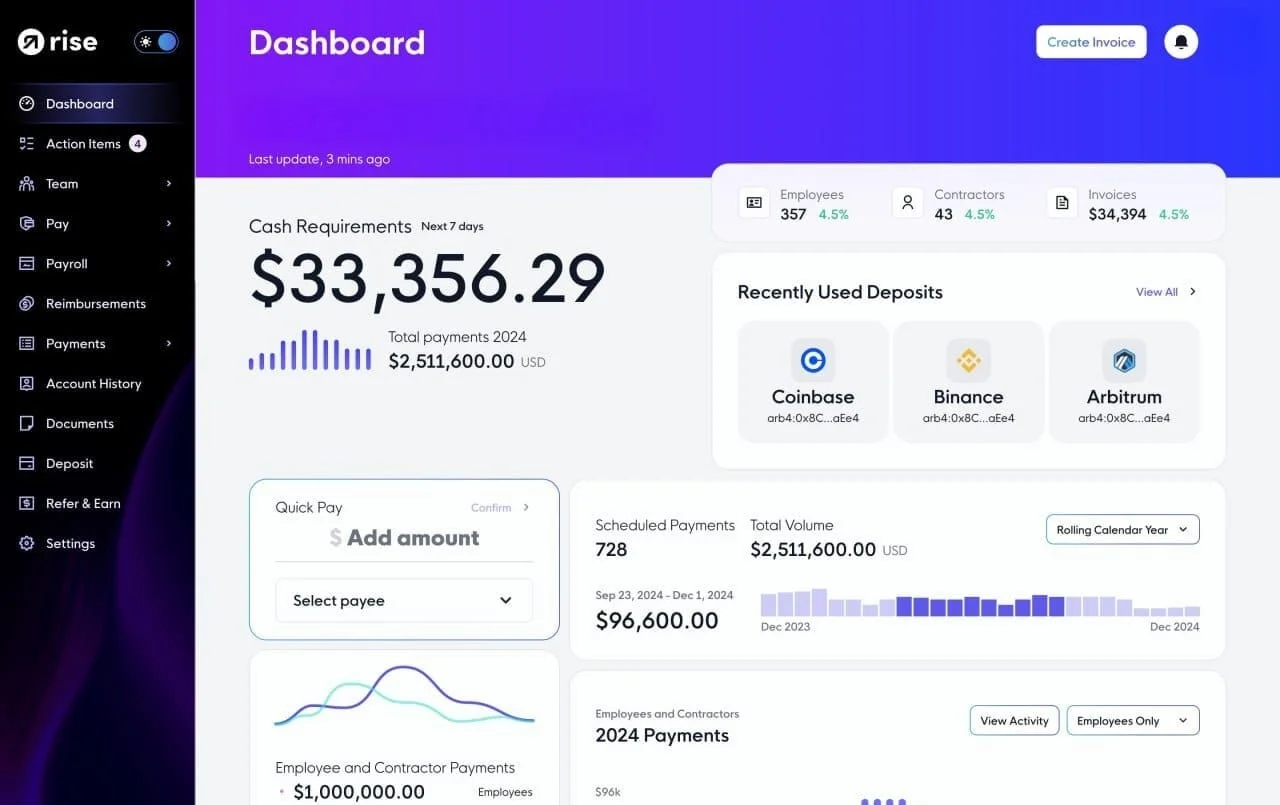
Utilizing Arbitrum for Scaling Payments
To enhance its payment infrastructure, Rise has integrated Arbitrum One, benefiting from its high throughput, low transaction costs, and substantial liquidity in stablecoins. As of December 2025, Arbitrum One boasts a market cap of approximately $8.82 billion in stablecoins, of which around $6.6 billion is USDC and nearly $984 million in USDT.
Rise's platform metrics reveal a significant level of user engagement, with lifetime transaction volumes surpassing $1 billion and $700 million within the last year alone. The funding methods reflect a diverse mix: 30% in crypto and 70% in fiat for deposits, while withdrawals reveal a shift towards liquidity with 40% crypto and 60% fiat.
Arbitrum’s Key Role
Analyzing Rise's on-chain activities, it’s evident that a considerable portion runs through Arbitrum One. Specifically, **80%** of all withdrawal transactions occur via this network, while only **6%** of deposit transactions originate from Arbitrum. This trend underscores Arbitrum's appeal as an efficient payout mechanism with low costs, particularly favored for its compatibility with off-ramps for fiat conversions.
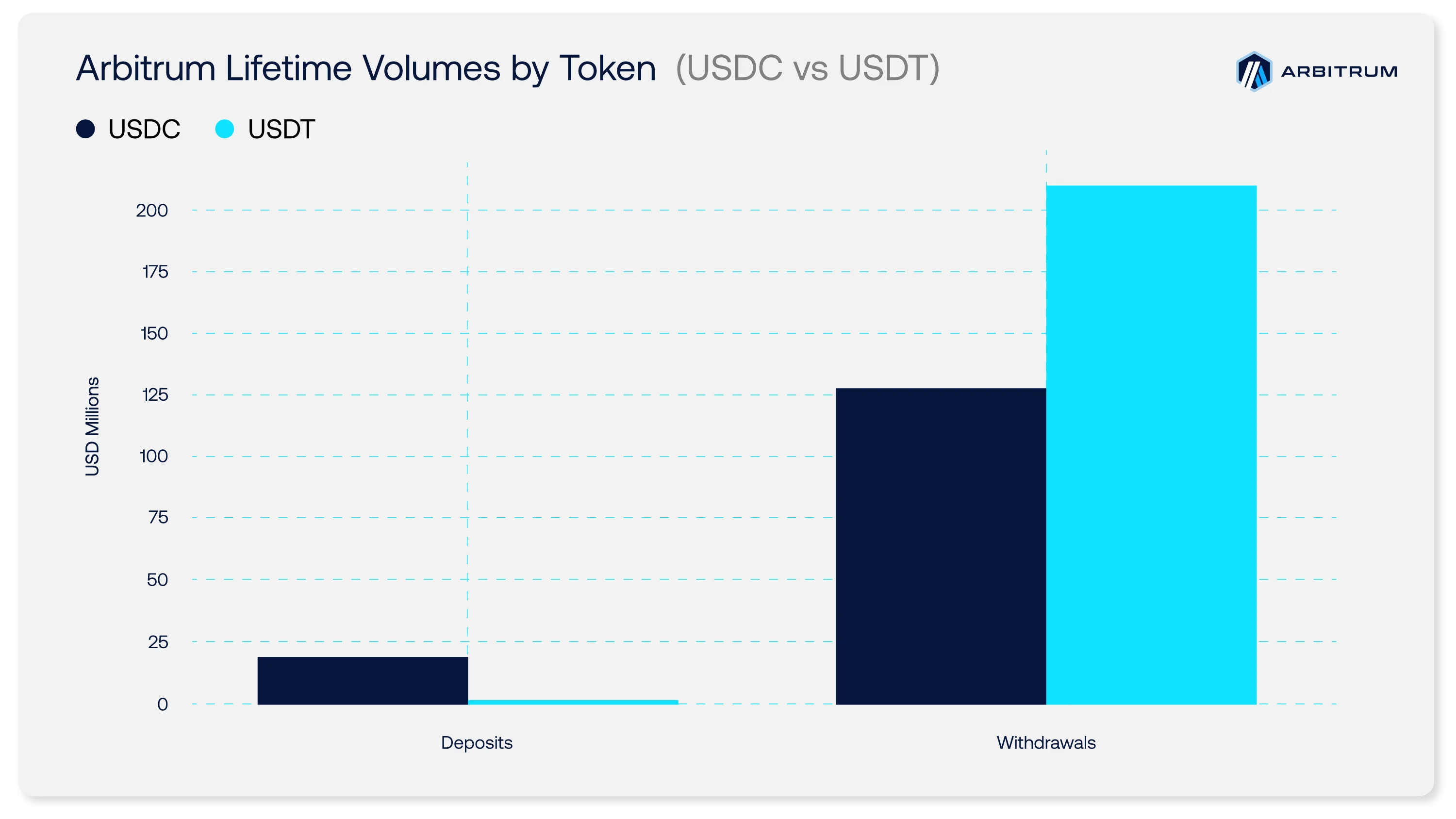
The data underscores Arbitrum's significance for Rise's operational strategy, with impressive stablecoin flows as follows:
- USDC deposits: $17M
- USDC withdrawals: $131M
- USDT deposits: $1M
- USDT withdrawals: $210M
These figures collectively reveal that Arbitrum processes over $340 million in USDC and USDT withdrawals, serving as the predominant channel for Rise's on-chain payouts. Recent trends show that the last 90 days accounted for approximately 25% of total lifetime transactions, indicating a rapid uptick in usage as new payment corridors evolve.
Transforming Payment Modalities
Organizations are increasingly seeking cross-border payment solutions that are efficient, predictable, and low-friction. Arbitrum meets these demands through its liquidity and rapid confirmation times, allowing platforms like Rise to facilitate automatic, rules-based payments without manual intervention, thus eliminating time-sensitive challenges.
Steps in Rise’s Payment Process:
1. Fund with Flexibility
Customers can add funds in multiple currencies (both fiat and crypto), which allows for a flexible treasury management approach. There's no need to overhaul treasury practices immediately, as additional payment rails can be incorporated gradually.
2. Automated Payment Rules
Smart contracts detail all necessary payment parameters—like amounts, currencies, and timing—streamlining the transfer process and reducing risks associated with manual errors.
As Rise describes, this leads to “automated, rules-based reliability at scale,” eliminating delays and complexities associated with traditional payment systems.
3. Quick Execution
Once preset conditions are met, payouts are executed on Arbitrum within seconds, with the added benefit of zero customer fees, making smaller payments more financially viable than with traditional methods.
4. Tailored Recipient Withdrawals
Recipients can withdraw in USDC or USDT or convert to local currencies through integrated channels, providing a transparent audit trail for all transactions.
Implications for Businesses
The shift to zero-fee Arbitrum payouts represents a pivotal evolution for smaller transfers, while automated smart contracts minimize manual steps that typically slow down payment processing. The depth of liquidity available accelerates the conversion to local currency, proving advantageous for contractor and marketplace dynamics today, with potential for massive scalability in the future.
Contact us to explore how Arbitrum can transform your financial operations.
Sources & Disclosures
Sources
- Arbitrum One metrics derived from Entropy's Dashboard
- Data on Rise's platform derived from a Q&A session (December 2025)
Disclosure
The information herein is for informational purposes only and does not constitute financial or investment advice. Please perform comprehensive independent research and consulate a qualified professional before making decisions. This content does not endorse any product, service, project, or entity mentioned.

Discussion
Sign in to join the discussion.