Wells Fargo lifted its Alphabet target to $417, citing external TPU sales and cloud growth, while flagging AI spending and search competition risks.

Wells Fargo’s higher Alphabet price target rests on a specific bet: selling Google’s tensor processing units (TPUs) to outside customers could give Google Cloud a meaningful new source of growth. The firm raised its target to $417 from $411 and kept its Overweight rating in an October 6 investor note. The change is modest in dollar terms, but the reasoning behind it points to an important test for Alphabet: whether an internal AI chip can become a business that earns revenue from other companies.
At Alphabet’s cited share price of $346.47, the revised target implies about 20% upside. Analyst Ken Gawrelski expects external TPU sales to lift Google Cloud Platform revenue beyond current market forecasts. Wells Fargo estimates those sales will reach roughly $9.2 billion in the third quarter of 2026 and $11.5 billion in the fourth. Those figures make the TPU assumption a substantial part of the firm’s growth case, rather than a minor addition to its cloud outlook.
TPU sales shape Wells Fargo’s forecasts
The firm projects Alphabet’s 2027 revenue will exceed Wall Street estimates by 14%, largely on the strength of TPU-related sales. For 2028, its revenue and earnings-per-share forecasts are 20% and 5% above consensus, respectively. The gap between the revenue and earnings estimates suggests that higher sales alone don’t settle the question of how much profit Alphabet will retain after serving customers and supporting the infrastructure behind those sales.
Wells Fargo also raised its earnings-per-share estimates to $20.66 for 2026 and $15.17 for 2027, and lifted its 2027 revenue forecast by 4%. Its $417 valuation applies a 27.5-times multiple to projected 2027 earnings. That multiple makes the target sensitive to both parts of the thesis: Alphabet needs to deliver the earnings forecast, and investors need to remain willing to value those earnings at the level Wells Fargo assumes.
The thesis builds on Alphabet management’s comments about growing external demand for TPUs, which Google also uses throughout its own cloud infrastructure. Google Cloud has already reported 82% year-over-year revenue growth and started recording revenue from outside TPU customers. That provides a sign of commercial activity, though it doesn’t by itself establish how quickly sales can scale or what margins they’ll produce.
Wells Fargo sees further cloud acceleration as AI workloads expand. It also points to global Google Search sessions rising about 36% year over year and says the Gemini 4 Argon model could strengthen Alphabet’s position in AI. The combination gives the firm a case for growth across both cloud and search, though the TPU sales forecasts carry much of the upside in its estimates. This is more significant than it looks: the forecast depends on Alphabet turning its technical infrastructure into a service that customers will buy, while its existing search business continues to contribute growth.
Competition and infrastructure costs remain in view
The firm’s positive outlook comes with several execution risks. More competition in search could weigh on Alphabet, while the economics of selling TPUs externally remain a question. A chip product can attract demand and still fall short of expectations if the cost of serving customers, maintaining capacity, or supporting the wider cloud service absorbs too much of the revenue.
The company is also committing substantial capital to data centers and AI infrastructure, leaving investors to watch whether cloud growth can continue at a rapid pace alongside that expansion. The spending reflects the physical requirements of AI services: customers need computing capacity, and providers need to build and operate the systems that supply it. And yet, rising capacity is only part of the calculation. Alphabet also has to bring that capacity into use at a pace that supports the revenue assumptions in Wells Fargo’s forecasts.
For investors assessing the thesis, the central distinction is between demand and returns. External customers may want access to TPUs, but the available figures don’t show what those sales will mean for profit after infrastructure costs. (And this is the part most people overlook.) Cloud growth can look strong while the economics of expanding the business remain unsettled. The numbers here are encouraging, but the earnings estimates make clear that the revenue opportunity still needs to translate into results.
What the forecasts will need to prove
Analyst sentiment across Wall Street remains favorable. TradingView consensus data shows a Strong Buy rating and an average one-year target of $426.26, nearly 24% above the cited share price. The highest analyst target is $515. Those figures describe analyst expectations, not evidence that the forecasts will be met; the range also shows that views on Alphabet’s potential value aren’t identical.
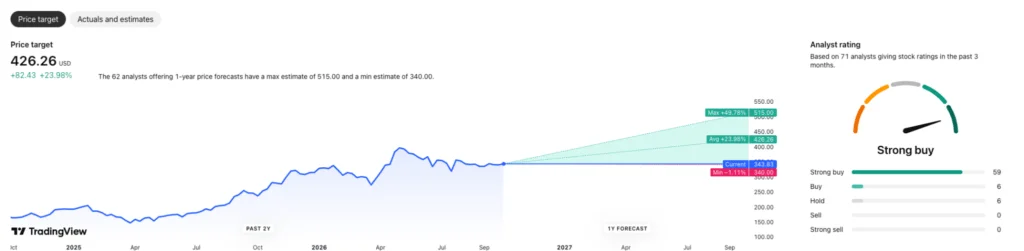
If you’re working in this space, the practical question is whether outside TPU customers keep adding enough demand to support the cloud forecasts, and whether Alphabet can serve that demand while funding the required infrastructure. Wells Fargo’s estimates put a concrete scale on the bet. Delivery remains uncertain.
The test ahead for Google Cloud
The key measure in Wells Fargo’s outlook will be whether external TPU demand converts into the cloud revenue its forecasts assume, while Alphabet continues funding the infrastructure needed to serve AI workloads. Search growth and the Gemini model add support to the broader case, but they don’t remove the need for TPU sales to perform. If those sales fall short, the gap between Wells Fargo’s projections and market expectations could narrow.
That said, the thesis has a clear logic: Google already uses TPUs in its cloud infrastructure, management has pointed to outside demand, and Google Cloud has begun recording revenue from external TPU customers. The next question is how durable that demand proves to be, and what it costs to meet it. For now, Wells Fargo’s higher target rests on a plausible growth path with meaningful execution questions still open.
Featured image via Shutterstock
The post Wall Street analyst updates Google stock price target appeared first on Finbold.

Discussion
Sign in to join the discussion.