Amid declining bond prices, retail investors are increasingly turning to the iShares 20+ Year Treasury Bond ETF, signaling a strategic buying opportunity.

Retail investors are notably flocking to the iShares 20+ Year Treasury Bond ETF (NASDAQ: TLT), making this fund one of the most sought-after exchange-traded funds in the current market environment. This uptick in interest comes despite a sharp decline in bond prices. As economic indicators remain mixed, retail sentiment appears to be shifting toward long-duration government bonds as a sanctuary from volatility.
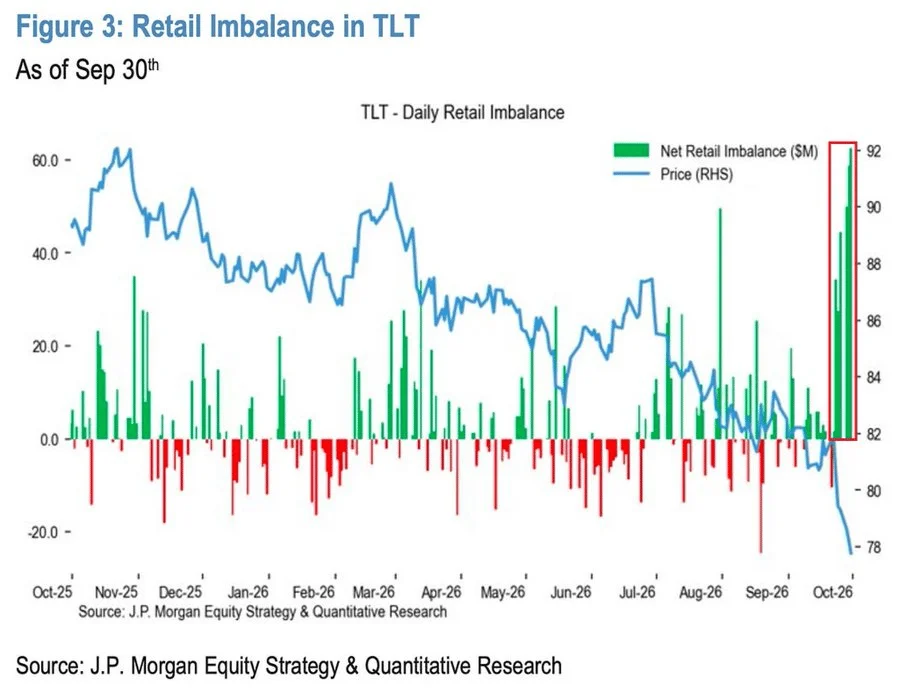
Recent figures from JPMorgan, shared in The Kobeissi Letter, indicate a significant retail influx into TLT, with $61 million acquired on Wednesday alone. This marks the most substantial single-day retail investment in the fund in at least a year. To put this in perspective, consider the prior two days of trading: $59 million on Tuesday and $50 million on Monday. This momentum accumulated into a remarkable three-day total of $170 million—the strongest influx since September 2025. Such a surge raises questions about underlying motivations and investor strategies.
Unexpected Retail Interest
Retail interest in TLT has remained consistently high, with daily purchases exceeding $20 million over six consecutive trading sessions leading up to Wednesday. Before this week, retail inflows into the fund hadn't eclipsed the $50 million mark on any individual trading day this year, highlighting the recent shift in investor sentiment. What’s perhaps most telling about this rally is that it coincides with a period where bond prices are falling, hinting that many investors may perceive this as an ideal entry point.
In the backdrop of this rush to TLT, the ETF has seen considerable challenges. It experienced a 1.9% decrease during the week, extending its year-to-date losses to 8%. Current levels show the ETF standing approximately 55% lower than its 2020 peak. This contrast between increased inflows and falling prices suggests that investors might be trying to capitalize on what they see as a temporary dip in long-duration Treasury bonds. Such behavior points to a more nuanced view amongst retail investors, one that’s often at odds with the prevailing market trends.
Bond Market Pressures
The broader bond market has faced heightened pressure recently, largely due to a surge in long-term Treasury yields. Currently, the 30-year Treasury yield hovers around 5.7%, while the benchmark 10-year yield has surpassed 5.3%. Various factors contribute to these shifts, including robust economic growth and ongoing inflation concerns, alongside adjustments in Federal Reserve policy expectations. The resulting environment has made traditional bonds a less appealing investment for some, yet others see this as a prime opportunity.
While rising yields negatively affect bond prices, they simultaneously enhance income opportunities for investors. The yield on TLT has climbed to roughly 5.5%, increasing its appeal to those seeking stable income streams from government-backed securities. You could argue this presents a classic case of 'selling the fear', as investors capitalize on yields rather than retreat from the market.
This recent buying trend signifies a larger movement towards fixed-income ETFs, with billions flowing into Treasury-focused products. TLT has emerged as a key beneficiary of this shift, drawing in both seasoned and novice investors. What's more, options activities related to TLT have reached unprecedented levels, underscoring heightened investor interest in interest-rate speculation. This uptick in trading activity indicates a calculated approach to riding out volatility in the bond market, but it also reflects a certain level of risk-taking behavior.
These inflows suggest a divided market, with some investors anticipating further yield increases while others see current bond prices as a compelling long-term investment opportunity. The dichotomy between these two investor perspectives illustrates a critical tension in the market, one that could influence future price movements of TLT and similar ETFs.
Significance and Future Implications
What does this mean for the bond market and retail investors in general? First, this trend could pave the way for a broader acceptance of fixed-income ETFs in investment portfolios. If retail investors continue to view TLT as a viable option during uncertain times, we might witness similar trends across other bond-focused funds. This could shake up traditional asset allocation strategies, especially among those predisposed to equities.
That said, the short-term volatility of TLT and its fundamental price declines raise questions. It’s a tricky proposition when the best-performing ETFs are those with significant losses on the year. Investors must grapple with the old adage of buying low; the challenge lies in discerning whether these are truly dips or merely a prelude to further price declines. (and this is the part most people overlook) Timing is everything, and many will be hoping this exuberance in retail interest leads to favorable outcomes rather than regrets.
As market conditions evolve, the landscape for TLT and similar funds will undoubtedly shift. If you’re working in this space, it could be worth tracking next quarter’s performance metrics, as they will be pivotal in affirming whether this recent surge is sustainable or simply a fleeting moment born out of market turbulence. Keep an eye on economic indicators, as they will influence investor sentiment and demand for long-term bonds.



Discussion
Sign in to join the discussion.