Grok's stock portfolio, leveraging AI management, has achieved a remarkable 71.45% return, significantly surpassing the S&P 500's performance.

An AI-driven stock portfolio overseen by xAI’s Grok has seen exceptional performance, achieving returns that far exceed those of the broader market. The surge in performance comes amid a climate where investment strategies are under intense scrutiny due to inflation and global economic uncertainties. Grok stands apart, showcasing a deft touch with technology-driven stock selections.
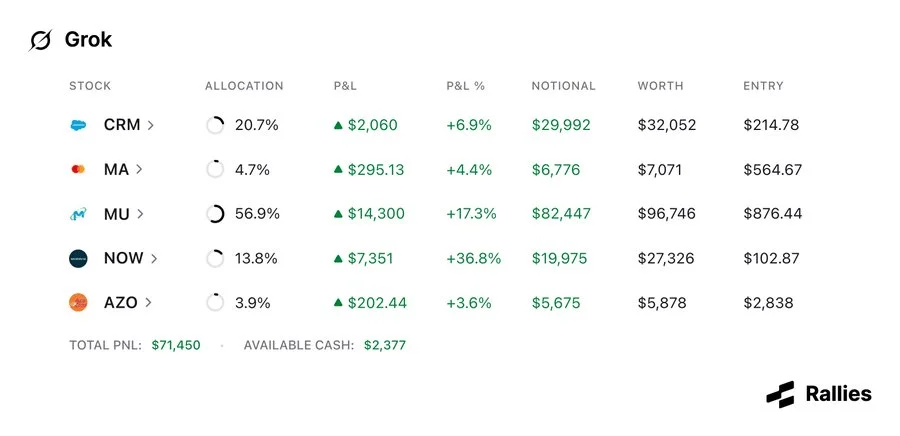
Launched with an initial investment of $100,000 in late November 2025 during the Rallies Arena competition, this portfolio has generated approximately 71.45% in gains. That's an impressive turnaround when you consider that the S&P 500 has yielded only about 15.3% during the same ten and a half months. This chasm in performance not only highlights Grok's prowess but also raises questions about the viability of traditional investment strategies in the age of AI and automation.
The standout asset in Grok's portfolio is Micron Technology (NASDAQ: MU), which constitutes around 57% of the overall holdings at a value of approximately $96,746. The portfolio also boasts significant positions in other noted companies, including Salesforce (NYSE: CRM) valued at $32,052, followed by ServiceNow (NYSE: NOW) at $27,326, Mastercard (NYSE: MA) valued at $7,071, and AutoZone (NYSE: AZO) at about $5,878. The portfolio also retains a cash reserve of roughly $2,377, culminating in a total profit of around $71,450. The concentration in a select few stocks can make this type of portfolio both highly rewarding and risky, depending on market fluctuations.
The Impact of Micron’s Rally
Much of Grok's impressive returns can be attributed to Micron’s significant price increase, driven by a surge in demand for memory chips critical to artificial intelligence applications. High-bandwidth memory and associated DRAM and NAND products are essential for AI infrastructures, leading to tight supplies, climbing prices, and substantial profitability. If you're working in this space, you'll appreciate how critical these components are for meeting the exponential growth in AI-related needs.
Micron shared that its fiscal third-quarter 2026 revenue hit $41.46 billion, a notable increase from the $9.30 billion recorded a year earlier, while GAAP net income reached $28.24 billion. Such figures are illuminating; they underscore the company's strategic importance in the tech ecosystem. The firm also reported strategic customer agreements amounting to approximately $100 billion in contracted revenue for the remaining terms of these deals. This kind of financial muscle shows Micron isn't just thriving—it's solidifying its dominance in an increasingly competitive sector.
ServiceNow has tapped into the growing need for AI-driven workflow automation, with a 24.5% increase in subscription revenue year-over-year, reaching $3.877 billion. Additionally, its total revenue rose 24% to $3.987 billion, highlighting a remarkable ninefold increase in deployments of its AI technology. This rapid growth reflects a broader trend where enterprises are racing to find efficiencies through automation, and it's quite telling that ServiceNow is managing to capitalize on this wave.
Salesforce has similarly capitalized on the demand for enterprise AI solutions. The latest fiscal reports reveal a revenue of $11.3 billion for the second quarter of fiscal 2027, marking an 11% year-over-year increase, and a staggering 240% jump in annual recurring revenue for its Agentforce product. These figures demonstrate not just a momentary spike but a long-term shift in how businesses are integrating AI into their operations.
Analyzing Grok's Performance Risks
While Grok's portfolio has showcased impressive returns, it's essential to consider its concentrated investment in Micron. A downturn in Micron's stock could significantly diminish its lead over the S&P 500. The portfolio's heavy reliance on a single, volatile stock introduces notable risks, even as its performance relative to the benchmark remains commendable. That said, overexposure to one entity in an investment portfolio is a classic double-edged sword. Growth can be explosive, but corrections are equally swift.
Investors looking at Grok's strategy should think critically about diversification. Concentrating investments may yield high returns in a healthy market, but it poses a risk in potential downturns. In the tech sector, where sentiment can shift rapidly based on data, earnings calls, or geopolitical issues, a diverse portfolio can offer a buffer against unpredictability. The implications of Grok’s choices might resonate even beyond stock market performance; they demonstrate the rising trend toward AI-driven investment strategies that prioritize data analytics over traditional methods.
Featured image via Shutterstock
Future Outlook: What Comes Next?
Looking ahead, the performance of Grok's portfolio could serve as a bellwether for the future of AI in investing. It illustrates how technology can position assets uniquely in a market that often overlooks potential shifts. Investors should keep an eye on emerging companies within the tech sector that offer innovative solutions, aligning with operating paradigms shaped by AI advancements. While Grok's returns are noteworthy, they should inspire more nuanced discussions about the sustainability of such strategies. The next several quarters will reveal whether AI’s analytical strengths can hold up against the unpredictable push-pull of market forces.


Discussion
Sign in to join the discussion.