Two wallets dormant for more than 12 years transferred 417 BTC, while fewer coins from recent holders are reaching exchanges.


Bitcoin’s latest on-chain signals point in different directions, which makes any simple reading of the data risky. Two wallets that had been idle for more than 12 years moved a combined 417 BTC, worth about $33.85 million, while a smaller share of coins held by more recent investors flowed to exchanges. One set of transactions draws attention because the coins are old; the other offers a more direct, though still incomplete, view of potential selling activity.
Blockchain analytics platform Lookonchain reported in a Sunday post that the two wallets had been inactive for more than 12 years. Their holdings were accumulated when Bitcoin traded near $127 and $355, producing gains of 638 times and 229 times their original value, respectively. Those returns help explain why the transfers attract scrutiny, but they don’t explain what the owners intend to do. The coins could be moved to new addresses for custody or other reasons, and the transfers alone don’t establish that a sale is underway.
Older coins move, but destinations matter
The activity follows another transfer involving a long-dormant wallet. A day earlier, that wallet sent 411.45 BTC, worth roughly $34 million at the time. Data attributed to Arkham Intelligence indicates that most of those coins were accumulated in September 2013, when Bitcoin traded around $131. Taken together, the transactions put a large amount of old Bitcoin back in motion, but the available details don’t show whether the transfers are connected or reflect a broader decision by long-term holders.
These movements draw attention because of their size and the age of the coins. Age can make a transaction look meaningful, especially when a wallet has stayed inactive for years, but a blockchain records movement between addresses rather than the owner’s motive. A transfer to another address doesn’t establish that the holder is preparing to sell. Exchange flows offer a more direct clue about potential selling activity, though even those flows don’t prove that coins were sold.
CryptoQuant analyst IT Tech reported that just 4.4% of Bitcoin aged six to 12 months that moved in the 30 days ending October 15 went to exchanges. That amounted to about 9,100 BTC out of 205,400 BTC moved. The distinction matters: the total shows that coins changed addresses, while the exchange-bound share identifies a smaller portion sent to venues where they could be sold. It’s a useful signal, but it remains a measure of potential supply rather than a record of completed trades.
Bitcoin exchange-bound flows from this age group had been much higher earlier in the period: 40.4%, or 63,800 BTC, in the 30 days ending June 17. The share then fell to 30.9% in July, 9.8% in August and 3.7% in September, before edging up in October. That sequence points to a marked decline in the proportion reaching exchanges, even as the latest reading sits slightly above September’s. The pattern is more informative than any one month’s figure, but it doesn’t tell us whether holders will keep their coins off exchanges.
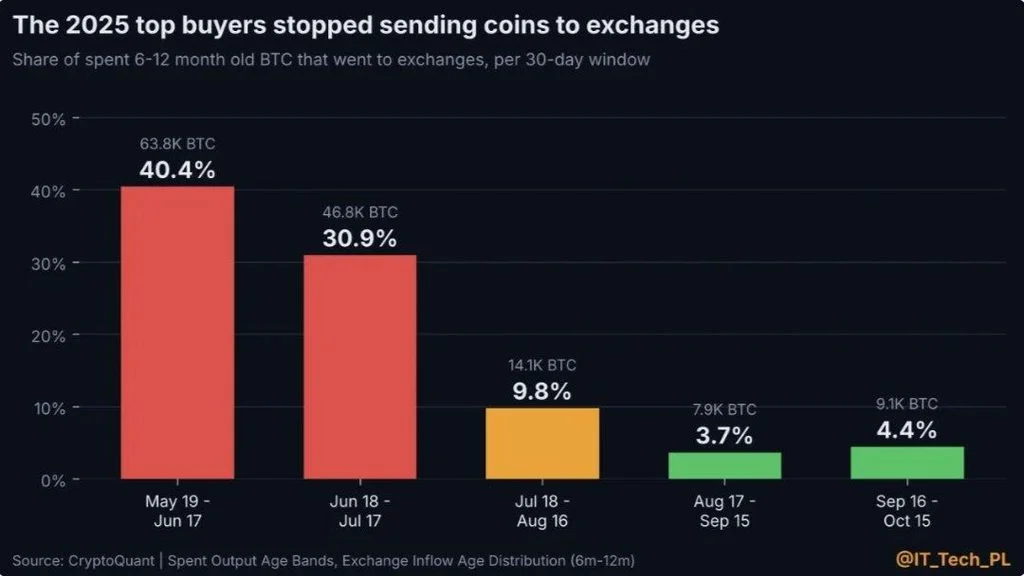
The latest 30-day window saw more total movement than the June period—205,400 BTC versus 157,700 BTC—but far fewer coins reached exchanges. That gap suggests reduced selling pressure from this cohort, though it doesn’t reveal what every holder intends to do. Here’s the thing: movement and selling pressure aren’t interchangeable measures. A holder can move coins without selling, and coins sent to exchanges can remain there rather than being sold immediately.
Valuation returns to a less common range
CryptoQuant analyst Darkfost said Bitcoin fell below the 30th percentile of its Market Value to Realized Value (MVRV) metric after failing to hold near $87,000. The percentile measure places the valuation in historical context rather than relying on the MVRV ratio alone. That gives readers a way to understand how unusual the current level has been relative to the metric’s past range, but it doesn’t by itself establish where the price will go next.
“By falling back below the 30th percentile, Bitcoin is returning to a zone where it has spent only about 25% of its time at this valuation level,” Darkfost said. The statistic describes how often Bitcoin has occupied this range according to the measure; it isn’t a timetable for a rebound or a floor under the market. That distinction can get lost when an uncommon valuation is presented as a signal. Uncommon doesn’t automatically mean undervalued.
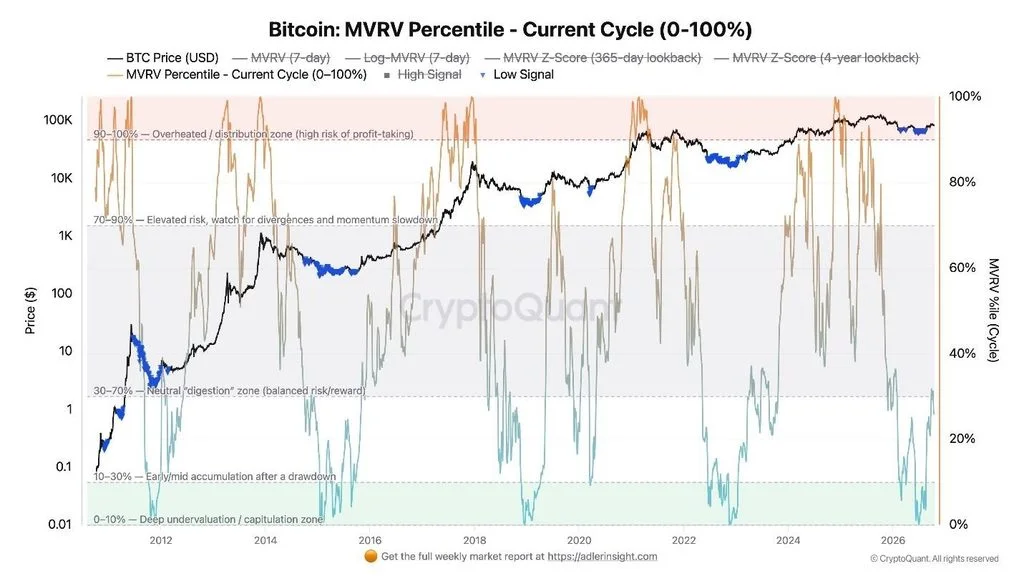
Darkfost described the range as consistent with accumulation, while saying Bitcoin had moved beyond the extreme undervaluation levels historically associated with market lows. That reading is measured: the valuation may interest buyers without matching the conditions associated with the deepest historical lows. This is more significant than it looks, but only as context for the current market, not as a prediction. At press time, BTC traded at $82,146, up 1.02% over 24 hours.
What the signals can—and can’t—tell us
Read together, the wallet transfers, exchange-flow data and MVRV measure describe different parts of Bitcoin’s activity. The old-wallet movements show that long-held coins changed addresses; the exchange figures show that a relatively small share of a younger cohort’s transfers reached exchanges; and the valuation metric places Bitcoin in a historically less common range. None of those observations answers the same question, and none establishes what holders will do next.
If you’re working in this space, the practical question is whether these signals persist and begin to move together. A continued decline in exchange-bound flows could support the view that this cohort is exerting less immediate selling pressure, while more old coins moving would keep attention on long-term holders. And yet, the data can’t identify every owner’s intentions. The key signal to watch is whether the recent decline in exchange-bound flows persists as older wallets continue to move coins. For now, a cautious reading fits the evidence. A mixed one.

Discussion
Sign in to join the discussion.