New Bitcoin whales’ share of whale realized cap has climbed to 33%. One analyst sees $81,000 as support and $89,000 as a possible target.


Newer whale wallets gain ground
Newer large Bitcoin holders are taking a bigger share of whale holdings, while older whales have barely shifted their positions. CryptoQuant analysts report that wallets with recent market activity now account for 33.06% of whale realized capitalization, up from 18% earlier in 2026. The change points to a reshuffling among large holders, though it doesn't by itself show that the market's established whales are selling.
Realized capitalization tracks the value of coins at the price they last moved on-chain, offering a view of the capital associated with different groups of wallets. It can help describe changes in ownership and cost basis, but it isn't a direct measure of cash entering or leaving the market. That's a useful distinction here: a rising share for newer whales can reflect changing activity and valuation without proving that every new dollar came from a particular source.
New holders expand their share
CryptoQuant puts the realized cap of new Bitcoin whales at $78.61 billion, versus $159.15 billion for older whale wallets. The newer cohort’s realized cap has risen steadily since September, and analysts say its growth has helped stabilize BTC’s price. That interpretation fits a familiar market dynamic: buyers with substantial holdings can absorb some available supply, although on-chain estimates alone can't establish how much influence they had on each price move.
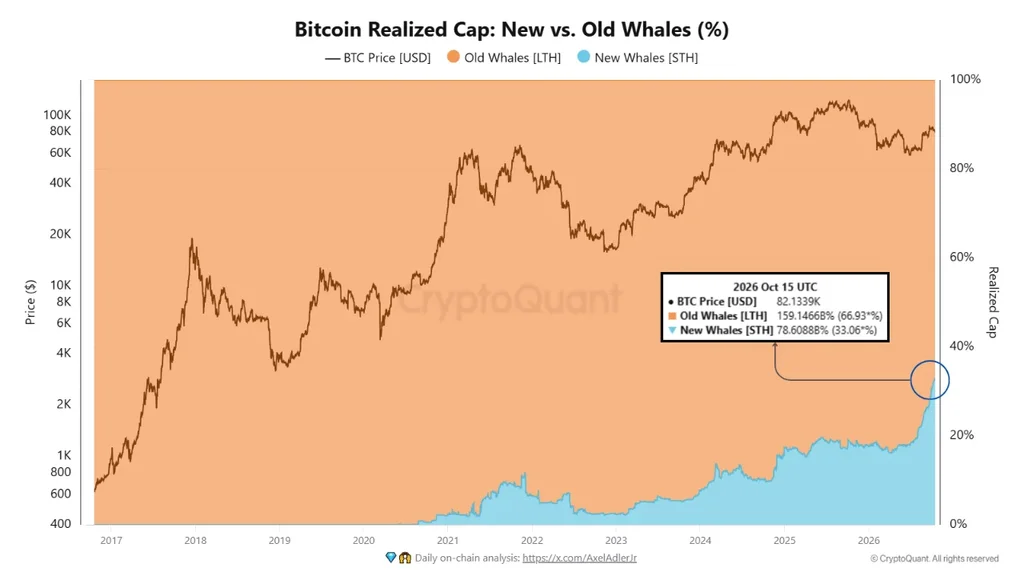
The report defines new whales as wallets holding more than 1,000 BTC that have been active recently. Their rising share points to fresh capital entering the market, including institutional and ETF inflows, and a gradual shift in ownership among large holders. That reading deserves some care: wallet activity can identify a change in the composition of a cohort, but the figures provided don't break out institutional purchases or ETF flows separately.
The cohort’s reported cost basis is around $77,000 and has recovered alongside Bitcoin’s price. A cost basis near that level gives analysts a reference point for where this group’s holdings were last acquired or moved, but it doesn't guarantee that holders will defend that price or sell if it falls. Older whale holdings, by comparison, have remained broadly flat. This is more significant than it looks: a growing newer cohort alongside steady older balances suggests the shift may be happening at the margins of ownership rather than through a broad exit by long-established holders.
$81,000 support keeps $89,000 in view
Bitcoin was trading at $81,615 in the report, down 1.5% over seven days. CryptoQuant analyst GugaOnChain described recent price action as consolidation after a strong run, with support forming near $81,000. That places the reported price close to the level the analyst is watching, making the next moves more informative than the headline target on its own.
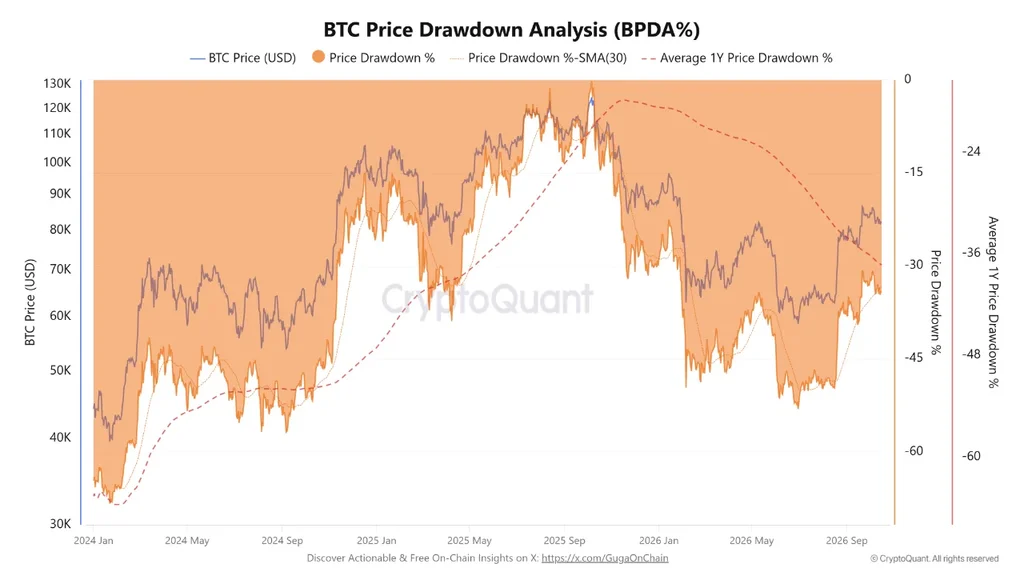
GugaOnChain sees buyers accumulating around that level while resistance holds. The analyst points to continued buying pressure as evidence of renewed bullish momentum and a possible move toward $89,000. That target depends on buying interest persisting as BTC tests its nearby support. Here's the thing: a chart level is a framework for reading market behavior, not a promise that price will follow a particular path.
If you're working in this space, the distinction between observed wallet data and price interpretation matters. The reported figures describe whale cohorts and their realized capitalization; the support and target levels reflect one analyst's reading of market activity. Put together, they offer a plausible account of why Bitcoin may be holding near $81,000, but they don't establish that newer whales alone are responsible.
What the shift could mean
The main implication is a change in who holds a larger share of whale-associated capital, while older wallets remain comparatively steady. That may help explain why whale movements haven't fully translated into an obvious change in price action: the aggregate balance can look quiet even as activity within the broader group shifts. A change in cohort composition can matter over time, but the available figures don't show how quickly those holders will trade or how their behavior will change under pressure.
And yet, the near-term market question remains straightforward: will buying around the reported support continue, and will resistance give way? The newer cohort's growth and its reported cost basis provide context, while the $81,000 area and the $89,000 target frame the analyst's price outlook. The numbers here are suggestive, not decisive. For now, the strongest takeaway is that ownership appears to be changing more clearly than the price trend itself.


Discussion
Sign in to join the discussion.