Bitcoin recorded 14,942 BTC in net exchange outflows ahead of key US economic reports, while its price hovered near $80,000.
Bitcoin’s latest exchange flows point to less BTC being immediately available for sale: Santiment Intelligence recorded net outflows of 14,942 BTC, the largest single-day total in five weeks. The move came just before the Federal Reserve’s Wednesday rate decision and Thursday’s US GDP and PCE inflation reports.
That timing puts the flow data alongside a cluster of macroeconomic signals that can shift how traders price risk. Interest rates affect the appeal of assets across markets, while GDP and inflation reports can influence expectations about the economy and the Fed’s next steps. The reports don’t explain why Bitcoin moved off exchanges, and the available figures don’t identify who initiated the transfers. They do, however, give traders a reason to watch whether a change in available supply holds through a busy news cycle.
Exchange outflows are often read as a sign that holders are moving coins into custody or otherwise away from immediate trading. That interpretation has limits: coins can move for many reasons, and a transfer doesn’t establish that an owner intends to hold for the long term. The number is a snapshot of flows, not a direct measure of conviction.
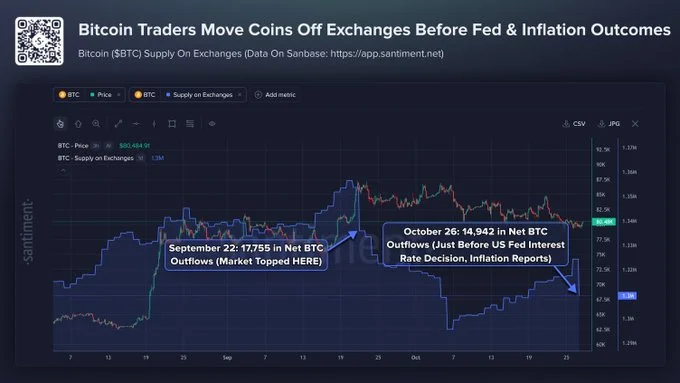
The Fed held rates at 3.75%–4% in a 10–2 vote. Two policymakers supported a quarter-point increase, underscoring concern about persistent inflation. Exchange outflows don’t guarantee a price rise, but they can reduce the supply readily available for trading and ease near-term selling pressure.
The dissent matters as a reminder that the policy outlook isn’t settled. A rate hold gives markets one decision to process; the disagreement signals that policymakers still see inflation as a live concern. Bitcoin traders therefore have to weigh asset-specific indicators against broader uncertainty about borrowing costs and economic conditions.
Here’s the thing: a lower quantity of coins on exchanges can make the market more sensitive to shifts in demand, but it can’t create demand on its own. If buyers don’t step in, reduced exchange supply may have little immediate effect on price. And if holders send coins back to exchanges, the picture can change quickly.
Bitcoin’s $80,000 level in focus
Bitcoin was trading at $78,047, according to CoinGecko data. A sustained move above $80,000 could improve the near-term outlook, with $82,500 and $84,000 cited as potential next levels.
Those levels are reference points, not promises. The gap between the reported price and $80,000 leaves the market short of the threshold described in the source as important to the near-term outlook. A brief move above it would tell traders less than a sustained hold, which would offer stronger evidence that buyers can absorb selling pressure around that area.
This is more significant than it looks only if price confirms the flow signal. A large outflow can attract attention, but the price response is what shows whether market participants are treating that shift in supply as meaningful. If you’re working in this space, the practical question is whether price, exchange flows and holder behavior continue pointing in the same direction.
Not a forecast.
Price levels can help organize market commentary, but they don’t explain what will cause a move or how long it might last. The cited figures give a framework for watching the next stretch of trading. They don’t establish that Bitcoin has cleared resistance or entered a recovery.
Wallet data adds another signal. Santiment says Bitcoin has lost about 30,000 non-empty wallets since October 16, leaving roughly 59.95 million. That decline may reflect smaller holders exiting after weak price action rather than a drop in underlying network activity. Retail selling can reduce speculative pressure, though it doesn’t establish that a recovery is underway.
The distinction between wallet counts and network activity matters. A non-empty wallet count records addresses holding Bitcoin, not the number of people using the network or the size of their positions. One holder may control multiple wallets, while a wallet can contain a very small balance. The decline is a useful observation about addresses, but it can’t by itself show how many people have left or how much selling those exits involved.
That said, smaller holders leaving after weak performance can change the mix of market participants. It may reduce some short-term speculative activity, while also showing that confidence among retail participants has softened. Both readings can be true at once. The data doesn’t say which effect will matter more in the next price move.
Corporate holdings offer a separate measure of accumulation: publicly listed companies hold about 1.3 million BTC, up 31% over 14 months, according to CryptoQuant data reported by ZyCrypto. The market is balancing reduced exchange supply and corporate holdings against a price that still needs to reclaim $80,000.
Corporate ownership and exchange flows describe different parts of the market. The first tracks Bitcoin held by a particular category of owner; the second tracks movement into and out of exchanges. Neither figure shows how those holders will act next. A company’s existing holdings don’t automatically translate into fresh buying, just as coins leaving an exchange don’t prove that their owners won’t sell later.
What the signals can—and can’t—say
Taken together, the figures show reasons for cautious interest, not a settled bullish case. Exchange outflows suggest a thinner pool of coins immediately available for trading, wallet counts show fewer non-empty addresses, and corporate holdings have grown over the reported period. Each metric captures a different behavior, and none provides a complete account of demand.
(And this is the part most people overlook.) Several supportive indicators can coexist with a price that hasn’t crossed the level traders are watching. Markets respond to actual buying and selling, not to the appeal of a narrative built from separate data points. The clearest near-term test remains whether Bitcoin can move above $80,000 and stay there while the macroeconomic news is being absorbed.
For now, the data supports monitoring rather than certainty. A sustained break above the cited level would strengthen the case that buyers are gaining ground; failure to hold it would leave the price signal unresolved. The next reports and trading sessions may add context, but these figures alone don’t show which outcome is coming.



Discussion
Sign in to join the discussion.