Compare leading crypto tax tools by integrations, transaction limits, reporting features, and pricing to find one that fits your activity.

Crypto taxes become a data problem fast
Crypto tax software tackles a tedious job: collecting activity across exchanges and wallets, calculating gains and losses, then preparing reports for tax filing. If you traded during the last financial year, you may owe tax on your gains—or be able to report losses. Either way, you’ll need records of what you bought and sold, and when and at what price.
That bookkeeping gets unwieldy when you’re handling hundreds or thousands of transactions. These tools connect to crypto exchanges and web3 wallets to organize activity and produce tax reports. The automation helps, but it doesn’t make every categorization or tax treatment right by default. The choice matters most when your activity spans many platforms or includes more than straightforward trades.
This guide looks at Summ (formerly CryptoTax Calculator), Awaken Tax, TurboTax, Koinly, CoinTracking, CoinLedger, ZenLedger, Blockpit, TokenTax, and CoinTracker. The obvious read is that they all do the same thing. In practice, their integrations, reporting options, transaction limits, and pricing differ—and those differences can shape how much cleanup you still have to do.

This section is brought to you by Summ.
Summ (formerly CryptoTax Calculator)
Summ connects with exchanges and wallets to import transactions and prepare tax reports. It covers activity beyond buying and selling, including airdrops, staking rewards, mining, and participation in an initial coin offering (ICO). DeFi and decentralized exchange activity, NFTs, margin trades, and futures are also supported. Its software calculates reported gains and losses, though the resulting records still depend on the accuracy of imported and categorized transactions.
Best features
- Connects to more than 3,500 exchanges and wallets, including Coinbase, Binance, Kraken, MetaMask, and Trust Wallet.
- Formats reports for US users to reflect IRS and state rules.
- Offers automatic transaction categorization and spam detection.
- The Trader plan supports up to 100,000 transactions in a tax year.
Pricing
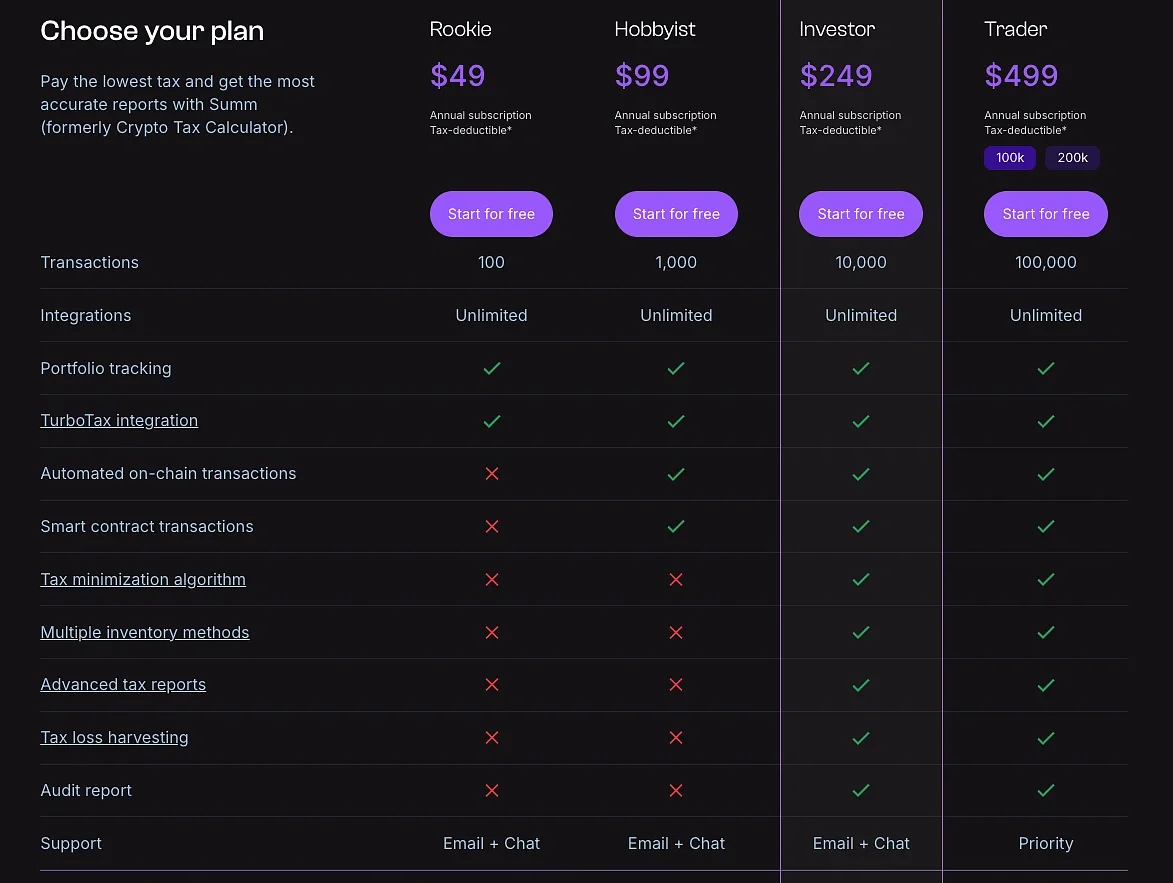
Summ has four plans, priced by annual transaction volume:
- Rookie: $49 for up to 100 transactions. Aimed at infrequent traders, it includes up to three imports and basic portfolio tracking.
- Hobbyist: $99 for up to 1,000 transactions, with on-chain transaction support and tax reports.
- Investor: $249 for up to 10,000 transactions. Adds advanced reports, inventory methods, and tax loss harvesting.
- Trader: $499 for up to 100,000 transactions, with Investor features and priority support.
Awaken Tax
Awaken Tax is built around on-chain activity spread across wallets, chains, and dApps. It uses AI to categorize transactions such as liquidity providing, staking, bridging, and swaps, making it a candidate for DeFi users, memecoin traders, and NFT collectors. You can connect wallets and preview capital gains for free; payment is required to download tax reports.
Awaken Bridge transfers tax history—including wallets, transactions, edits, and notes—from another tax tool. Awaken also serves businesses and funds, and offers a full-service option in which its team handles tax work for you.
Best features
- AI categorization covers more than 10,000 dApps; the platform has more than 500 integrations, including Coinbase, Binance, Kraken, MetaMask, Phantom, and Hyperliquid.
- Supports more than 55 countries. US reports include Form 8949 and Schedule D, with exports to TurboTax and TaxAct.
- Offers FIFO, LIFO, average cost, and wallet-based specific identification for cost tracking.
- Charges based on the current tax year’s transaction count, includes reports for past years, and does not auto-renew.
- Accepts USDC payments.
Pricing
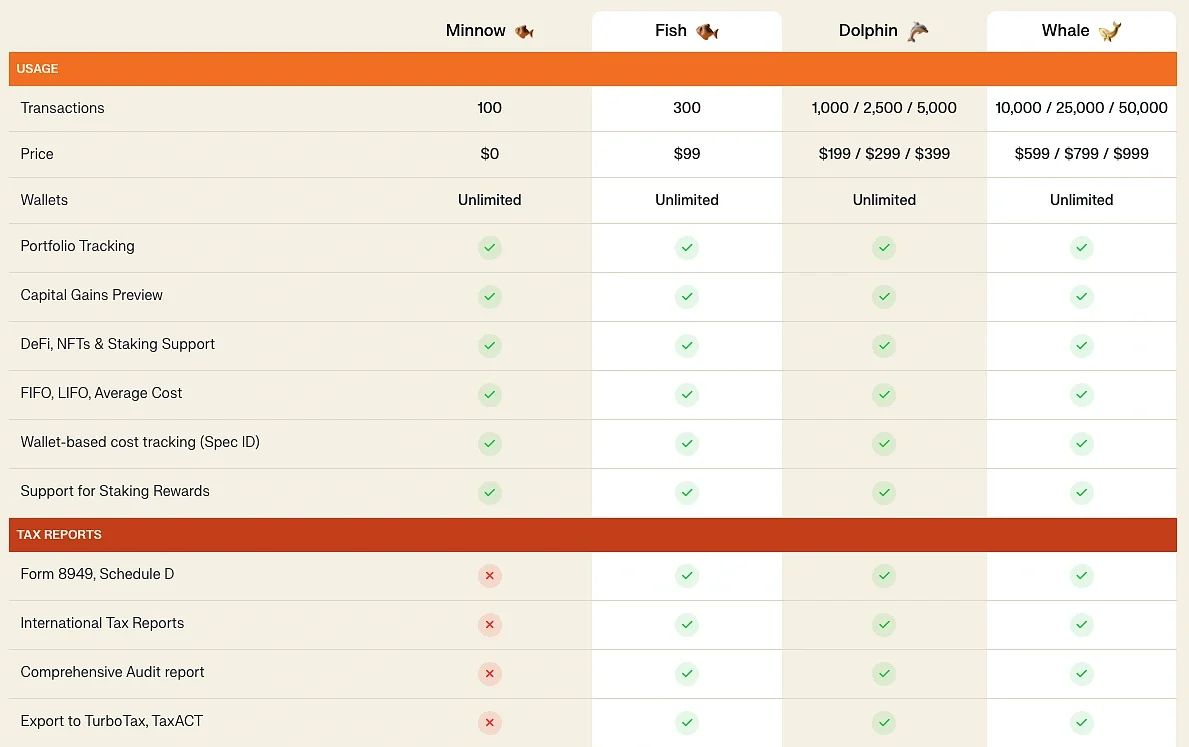 has four self-serve plans plus a full-service option:
- Minnow: Free portfolio tracking and capital gains previews for up to 100 transactions; tax report exports aren’t included.
- Fish: $99 per year for up to 300 transactions, with tax reports and TurboTax export.
- Dolphin: $199, $299, or $399 per year for 1,000, 2,500, or 5,000 transactions. Adds advanced tax settings and performance tracking.
- Whale: $599, $799, or $999 per year for 10,000, 25,000, or 50,000 transactions. Adds tax lots, tax planning, and priority support.
- Full Service Bookkeeping: Starts at $3,000 per year and includes a dedicated crypto tax specialist and direct Telegram access to your assigned team.
TurboTax
TurboTax has supported individual and business tax filing since the 1980s. Its question-and-answer format guides users through filing, and people who want more help can connect with tax experts through TurboTax Live. That familiarity may appeal if you already use TurboTax, though the platform’s crypto reporting now depends on integrations with specialist services.
Note: TurboTax discontinued Investor Center on July 22, 2025, but still supports crypto tax reporting through integrations with dedicated crypto tax software.
Best features
- TurboTax Live plans offer access to a tax expert, with higher levels of filing assistance available.
- Token depreciation tools track the performance of major holdings during the year.
- Users can upload transaction data through straightforward import options.
- Integrates with crypto tax services including CoinLedger, Koinly, and TokenTax.
Pricing

TurboTax offers two broad service types:
- Do it yourself: Start for free and pay when you file.
- Live (Assisted or Full Service): For filers who want expert guidance or help with more complex returns. Pricing depends on complexity.
Koinly
Koinly says it can track transactions and generate reports in about 20 minutes. It supports tax filing in more than 20 countries and offers suggestions for reducing future tax bills. Once transactions are synced, its portfolio view shows realized and unrealized gains.
You can import a CSV or connect through Koinly’s API. The service integrates with more than 800 exchanges, blockchains, and wallets. There’s a free tracking tier for up to 10,000 transactions, but downloading a tax report requires a paid plan.
Highlights
- Currency coverage: Tracks more than 6,000 digital assets, including Bitcoin (BTC), Ethereum (ETH), and Binance Coin (BNB).
- Portfolio dashboard: Displays tax-year gains and losses, total growth and return on investment (ROI), and current investments.
- Double-entry accounting: Records both sides of transactions, which can help surface errors during later reviews.
- Integrations: Connects to more than 800 exchanges, wallets, and blockchains.
Pricing
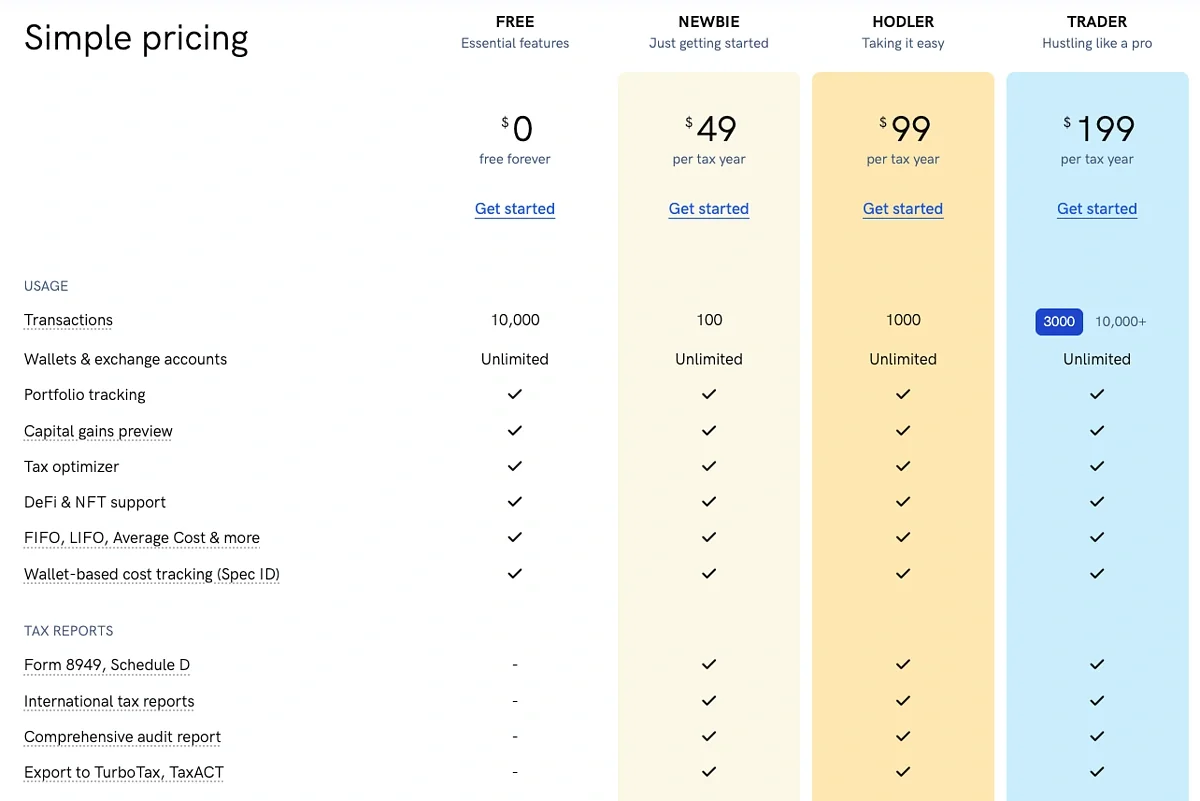
Koinly’s free tier is limited to portfolio tracking; it doesn’t generate reports. Paid plans are:
- Newbie: $49 per year for 100 transactions.
- Hodler: $99 per year for 1,000 transactions.
- Pro: $199 per year for 3,000 transactions, or $299 and up for 10,000 or more.
CoinTracking
CoinTracking combines tax reporting with portfolio tracking, including realized and unrealized gains and current crypto value. It supports 14 tax calculation methods and is available in more than 100 countries. The company says it protects accounts with two-factor authentication and encrypts data and API connections.
Note: Under current IRS guidance, Specific Identification and First In First Out (FIFO) are the two cost basis methods allowed for reporting on a tax return.
Highlights
- Generates more than 25 customizable reports, including gains and losses and realized and unrealized gains.
- Supports more than 400 exchanges and 100 blockchains.
Pricing
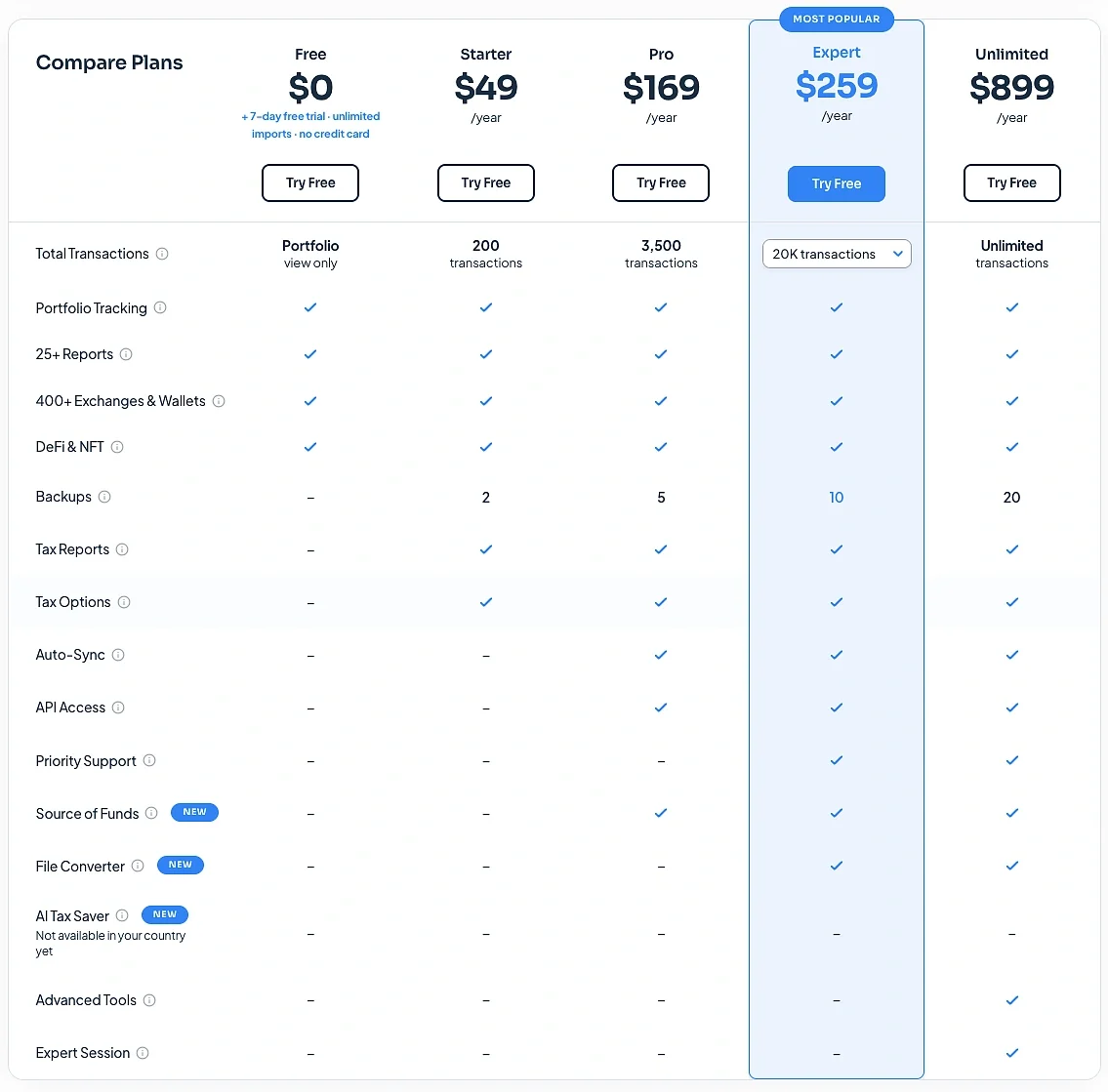
Plans are available on yearly, two-year, and lifetime subscription terms:
- Free: A seven-day unlimited trial with all features. After it ends, free accounts can view their existing portfolio, but need a paid plan to make new imports.
- Starter: $49 per year for up to 200 transactions. Includes tax reports and options, two backups, portfolio tracking, more than 25 reports, support for more than 300 exchanges and wallets, and DeFi and NFT features.
- Pro: $169 per year for up to 3,500 transactions. Adds five backups, automatic imports, auto-sync, and API access.
- Expert: $259 per year for up to 20,000 transactions. Includes 10 backups, priority support, advanced tools, and access to expert sessions.
- Unlimited: $899 per year with no transaction cap. Includes 20 backups, premium support, advanced tools, and expert sessions.
CoinLedger
CoinLedger, previously CryptoTrader.Tax, has helped users file crypto returns since 2018. It’s designed to import and review trades quickly, then generate reports covering gains, losses, and income from NFTs, staking, and mining. Its interface is meant to work for both newcomers and experienced traders.
Best features
- Produces short- and long-term gains reports, crypto income reports, and tax loss harvesting reports.
- Lets users track their portfolio for free; payment is required to generate tax reports.
- Connects to more than 700 exchanges, wallets, and blockchains.
- Works with TurboTax, TaxAct, H&R Block, and TaxSlayer.
Pricing
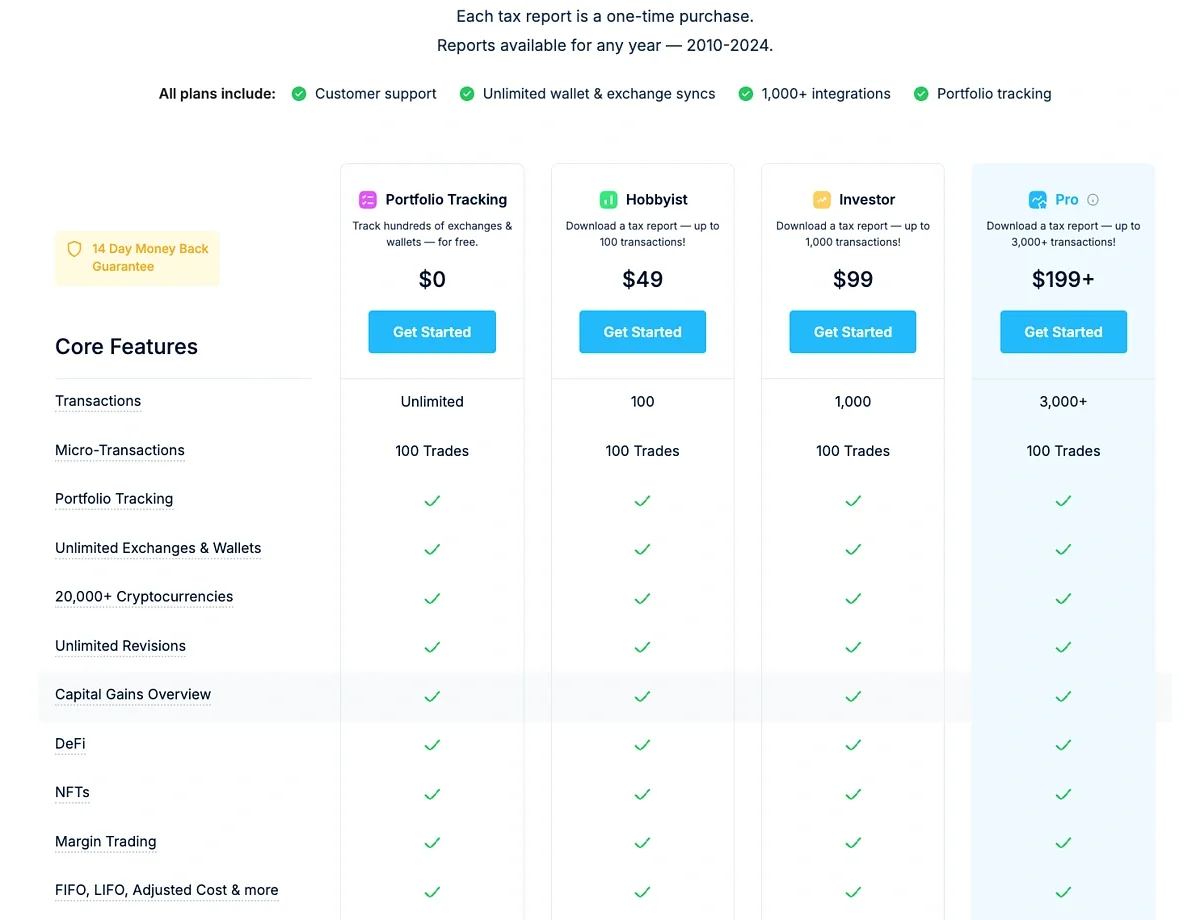
CoinLedger’s four plans are priced by annual transaction volume:
- Free: Import transactions and track a portfolio, without tax reports.
- Hobbyist: $49 for up to 100 transactions per tax year, including tax reporting.
- Investor: $99 for up to 1,000 transactions per year, including tax reporting.
- Pro: $199 for 3,000 or more transactions per year, including tax reporting.
Users with more than 3,000 transactions can buy additional capacity in the app.
ZenLedger
ZenLedger generates crypto tax reports that include customized Form 8949, Schedule 1, and Schedule D. Its workflow is simple: import exchange or wallet history, review the entries, then download a report. ZenLedger says its tracking tools help users report accurately and avoid overpaying.
The platform supports more than 400 exchanges and wallets, plus more than 100 decentralized finance (DeFi) and NFT protocols. Customer support is available by email, live chat, and phone during the week. ZenLedger also offers a one-year refund policy, and some plans include support for non-fungible tokens (NFTs).
Highlights
- Tax tracking and reports are designed to help users assess their investments and tax liability.
- Grand Unified Accounting gathers transaction details and estimated tax liability in one place, making activity across multiple platforms easier to review.
ZenLedger: Two factor security and tiered pricing
ZenLedger uses two factor authentication to protect account access and keep user information private. That’s a useful safeguard for a service handling sensitive financial records. [CoinGecko’s crypto security tips](https://www.coingecko.com/learn/16-crypto-security-tips-by-coingecko-s-co-founder-so-you-can-invest-hodl-in-peace) offer broader advice on protecting those accounts.
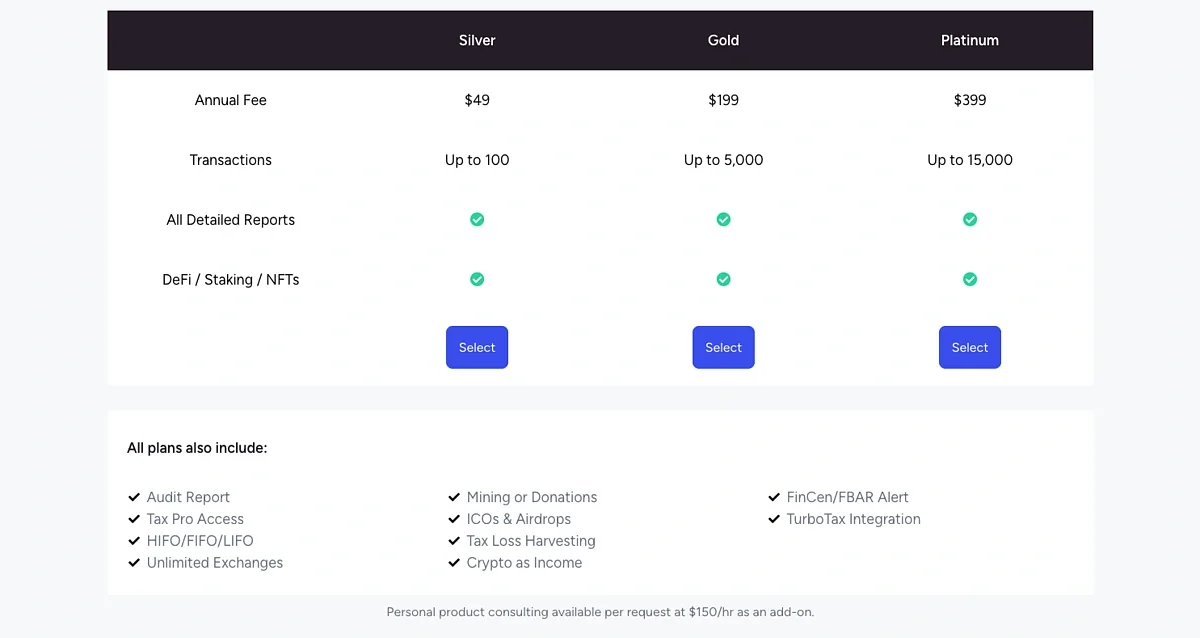
ZenLedger prices its three plans by transaction volume: Silver costs $49 a year for up to 100 transactions, Gold is $199 for up to 5,000, and Platinum is $399 for up to 15,000. The jump in price between tiers is substantial, so your expected transaction count matters more than the plan names.
Blockpit: Compliance coverage with a separate add-on
Blockpit, based in Austria and Germany, focuses on cryptocurrency compliance. It tracks transactions and prepares tax reports, while also supporting work around anti-money laundering (AML) rules and other tax requirements. The company says its real-time reporting and integrations with exchanges and wallets help streamline those processes.
Its reports cover Austria, France, Germany, Spain, Switzerland, the UK, the US, and other countries. Transactions can be added manually or imported through auto-sync, and reports are available in multiple formats. Blockpit also provides a view of past and current portfolio performance and supports more than 250,000 assets across major exchanges and blockchains.
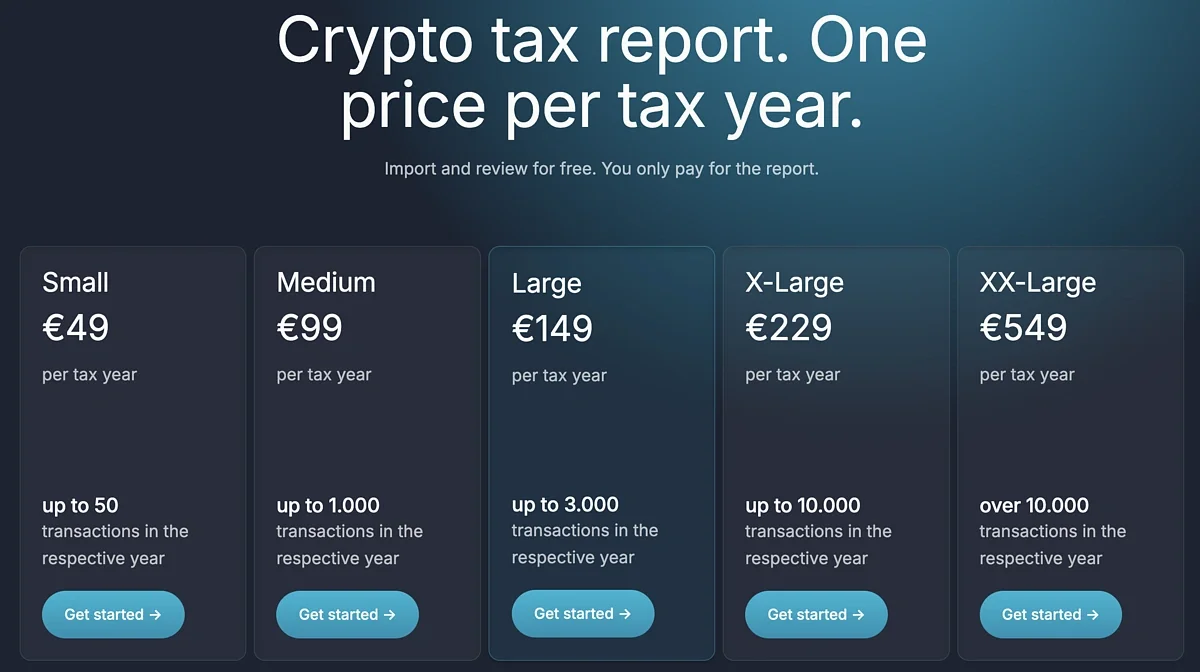
Blockpit’s five transaction-based plans range from €49 for up to 50 transactions a year to €549 for more than 10,000. Between those ends, Medium costs €99 for up to 1,000 transactions, Large costs €149 for up to 3,000, and X-Large costs €229 for up to 10,000 per tax year. Blockpit Plus is a separate €59 annual subscription for premium features, including tax optimization tools.
Here’s the thing: the listed tiers make the transaction ceiling easy to compare, but the Plus add-on means the headline plan price may not tell the whole story if you need its premium tools.
TokenTax: Software backed by tax professionals
TokenTax combines crypto tax software with a digital currency accounting business. Its support team works with cryptocurrency, DeFi, metaverse, and NFTs, and can offer tax saving strategies while preparing reports. TokenTax connects directly to more than 120 exchanges and wallets; for services without a direct connection, users can upload a CSV.
The platform can track tax liability in real time, create a range of reports including international filings, and provide full service filing through in-house CPAs and enrolled agents. That human support comes at a price, especially at the higher tiers.
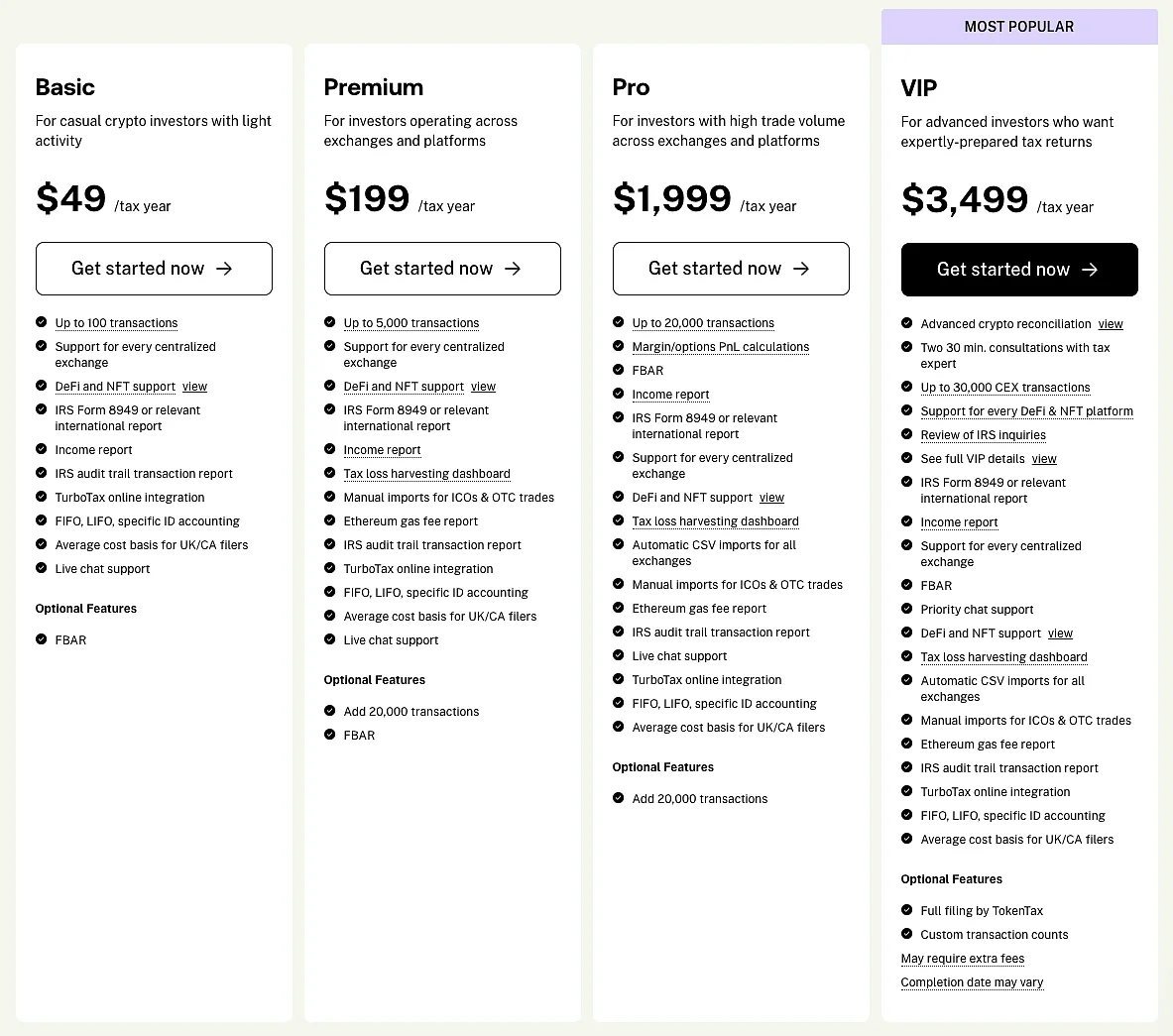
Basic costs $49 for up to 100 transactions a year. Premium is $199 for up to 5,000 and adds a tax loss harvesting dashboard and an Ethereum gas fee report. Pro costs $1,999 a year for up to 20,000 transactions, automatic CSV imports for all exchanges, and margin and options profit and loss calculations. VIP is $3,499 for up to 30,000 centralized exchange transactions, support for every DeFi and NFT platform, IRS inquiry review, and the option of full filing by TokenTax. Premium and Pro customers can add another 20,000 transactions.
CoinTracker: A strong fit for Coinbase users
CoinTracker launched in 2017 and now serves more than 2.5 million users worldwide. It is Coinbase’s and TurboTax’s official crypto tax partner, supports over 500 exchanges and wallets and more than 10,000 cryptocurrencies, and integrates directly with both platforms.
CoinTracker is geared toward people whose activity is concentrated on centralized exchanges and who want automated tracking across wallets. It follows transactions, portfolio performance, and capital gains. The platform says it is IRS compliant and supports Rev. Proc. 2024-28, which introduced mandatory per-wallet cost basis tracking in 2025. That requirement makes wallet level records especially relevant for US users, though the software alone can’t determine whether an imported transaction history is complete.
Other features include unlimited wallets, live portfolio and tax liability views, tax loss harvesting on paid plans, iOS and Android apps, and direct filing connections to TurboTax and H&R Block.
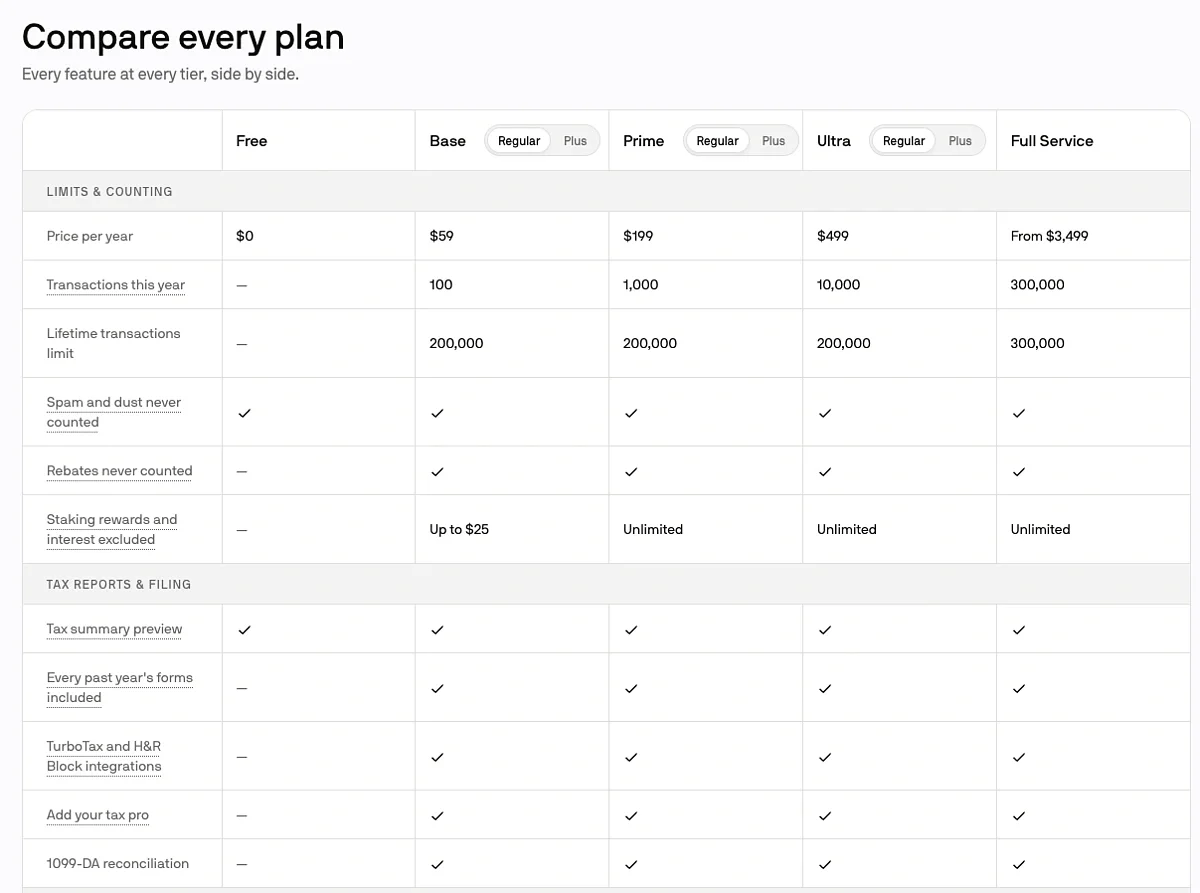
CoinTracker has a free tier for portfolio tracking and a tax summary preview. Paid plans scale with activity: Base starts at $59 a year for 100 transactions, Base+ at $99 for 250, Prime at $199 for 1,000, Prime+ at $299 for 2,500, Ultra at $499 for 10,000, and Ultra+ at $999 for 25,000. Prime and Prime+ include tax lot breakdowns, tax loss harvesting, and performance tracking; Ultra and Ultra+ add priority support and multiple cost basis methods. Full Service starts at $3,499 a year and includes a dedicated account manager, personal assistance, and capacity for up to 300,000 transactions.
Choosing a tool is only the first step
Crypto tax software can save time by pulling records from exchanges and wallets, organizing transactions, and generating tax reports. But an automated report is only as dependable as the data behind it. If you trade across chains, use DeFi, or hold NFTs, check how each service handles those records before choosing a plan.
The differences between these products are practical: Summ emphasizes smart categorization, Koinly offers international support, CoinLedger focuses on affordability, ZenLedger includes broad DeFi features, and CoinTracker integrates with Coinbase. Match those strengths to your transaction volume, trading activity, budget, and need for professional help. Many services let you try portfolio tracking for free, which is a sensible way to see whether the workflow suits you before paying.
Disclaimer: This article is for informational purposes only and is not financial advice. Research any financial product or tax advisor before making a decision.
An earlier version of this article included TaxBit, which has since shifted to a B2B enterprise model.
An earlier version of this article was written by Josiah Makori.


Discussion
Sign in to join the discussion.