Pompliano points to Bitcoin, gold and productive land as scarce assets, though custody, volatility and management make each harder to hold.
Anthony Pompliano’s proposed hedge against inflation pairs Bitcoin with two older stores of value: gold and productive land. The case for holding all three rests on scarcity and utility. When the money supply expands and savings lose purchasing power, assets that can’t be created at will may help preserve wealth, though none guarantees that outcome.
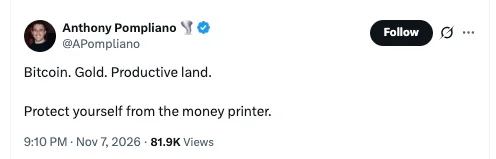
Pompliano has repeatedly warned that a dollar-based economy faces mounting pressure. In a recent post on X, he invoked the “money printer,” a familiar jab at central banks’ expansion of the money supply. The phrase captures a concern about currency debasement, but it leaves a practical question: how reliably do scarce assets protect an owner when prices, markets and access to cash can all change?
Three assets, three different cases
Bitcoin has become a favored scarce asset among investors drawn to alternatives to the financial system after the 2008 crisis. Its appeal centers on a supply that can’t be expanded in the way a national currency can, alongside the possibility of transferring and holding value digitally. That design has attracted supporters, but scarcity alone doesn’t tell an investor what an asset will be worth when they need to sell.
Gold brings a much longer record as a store of value and has appreciated strongly over roughly the past decade. It’s a physical asset with a familiar role in portfolios, yet ownership brings questions of storage, security and ease of sale. Productive land offers a different proposition: it can generate food and other output as concerns about food security grow. Its value therefore depends partly on use and management, not just on the idea that land is finite.
These are three distinct claims on value. Bitcoin is a digital asset, gold is a physical commodity, and land is property that can produce goods. A portfolio containing all three would spread exposure across different forms of ownership, but it would also bring different risks and practical demands.
That mix appeals to investors seeking ways to protect or grow wealth amid stimulus, rising debt and inflation. Pompliano’s view reflects a broader preference among crypto investors and advocates for assets whose supply cannot be expanded as easily as fiat currency. The argument is intuitive, but it shouldn’t be mistaken for proof that every scarce asset will preserve purchasing power over every period.
Scarcity comes with practical costs
Each option has drawbacks that complicate ownership. Physical gold needs secure custody and produces no yield. Bitcoin can be volatile and demands comfort with digital tools. Land requires ongoing management, can be difficult to sell quickly, and is exposed to local economic and environmental conditions. Those differences shape what it means to hold each asset in practice.
Liquidity is a central part of the comparison. An owner may value an asset as a long-term store of wealth, but still need access to money on a shorter timetable. Land can take time and effort to sell; gold has to be stored and transferred; Bitcoin’s digital format doesn’t remove the possibility of sharp price swings. A hedge that can’t be sold when needed may not serve an investor’s immediate purpose.
Responses to Pompliano’s post reflected that divide: some followers endorsed the trio and pointed to its past growth, while others questioned how practical the assets are to hold. That split is familiar in debates about inflation protection. Supporters tend to focus on scarcity and potential appreciation; skeptics ask about volatility, costs and the work required to own the assets.
Here’s the thing: a hedge is only useful in relation to the risk it’s meant to address. If you’re working out how to protect savings, the relevant question isn’t just whether an asset is scarce, but whether you can hold it through price swings, manage it and access its value when circumstances change.
What the mix implies for investors
Pompliano’s shortlist is more significant than it looks because it puts three very different ideas of value side by side: limited supply, established recognition and productive use. But the combination doesn’t make their risks disappear. It asks an owner to accept different forms of uncertainty, from market volatility to custody and property management (and this is the part most people overlook).
That said, the proposal is a framework for comparison, not a simple formula. An investor who prioritizes ease of access may judge the options differently from someone prepared to manage land or store physical gold. The balance between liquidity, effort and potential price movement matters as much as the shared appeal of scarcity.
For investors weighing inflation protection, Pompliano’s shortlist is a prompt to compare those tradeoffs with the risks of holding cash. Cash is accessible, while these assets bring their own costs and constraints. No easy answer.
The choice among Bitcoin, gold and land comes down to the kind of volatility, effort and liquidity limits an owner can accept. The argument for scarcity is clear; whether the mix fits a particular investor depends on the practical details of ownership and the reason for holding it.



Discussion
Sign in to join the discussion.