Nvidia's recent approval for a $150 billion share buyback underscores its financial strength but raises questions about execution and AI market dynamics.

The recent announcement from Nvidia (NASDAQ: NVDA) regarding a staggering $150 billion share buyback is indicative of its strong financial health and confidence in the future of artificial intelligence (AI). This decision, disclosed on September 28, entails an extension of the buyback program, now totaling $235 billion.
Nvidia's CEO, Jensen Huang, articulated the rationale behind this program, emphasizing how the ongoing AI boom is a pivotal factor for their cash flow. He stated, “NVIDIA’s growth is being driven by a once-in-a-generation platform shift to AI and accelerated computing.” This financial maneuver not only supports shareholder returns but also reinforces the company’s investment capabilities within this booming sector.
Insights on the $150 Billion Buyback's Impact on NVDA Stock
Stock market reactions highlight the immediate effect of the buyback announcement—on the day of the news, NVDA shares surged by 1.78%, reaching $229.08 in pre-market trading. This uptick builds on a modest increase of 0.22% on September 25, bringing a renewed sense of optimism among investors. However, those reactions might be more surface-level than foundational. If you're working in this space, you know that stock prices can react violently to buyback news, but that doesn't always correlate with long-term health.
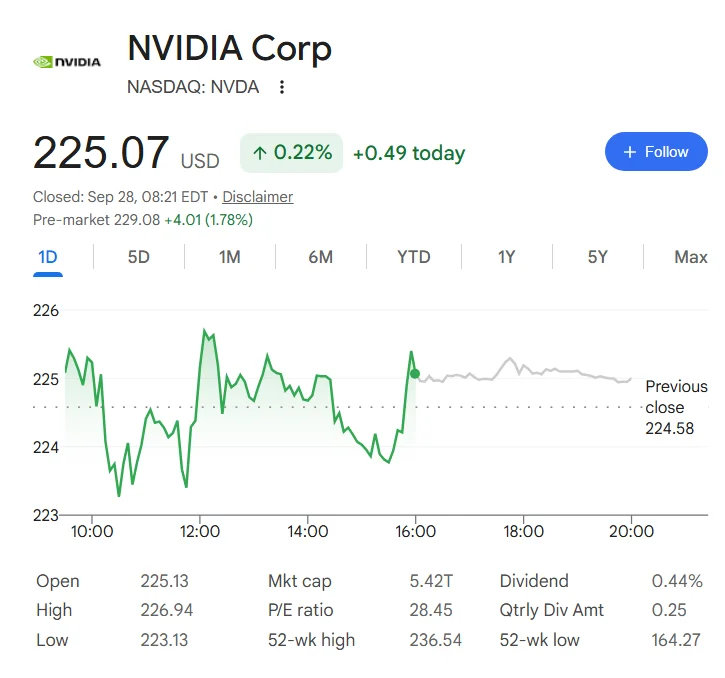
This increase in share price demonstrates a common market dynamic: buybacks can lead to a more favorable supply-demand balance. As Nvidia repurchases its own shares, it reduces the available float, creating upward pressure on the stock price. Still, investors should remain cautious. Buybacks can sometimes mask underlying business struggles rather than genuinely improve a company's financial health.
Challenges Ahead: Concerns About Execution
However, there are skeptics who question the feasibility of Nvidia's $150 billion buyback commitment. In the past, the company has faced criticism for not fully executing on other substantial promises. A notable example includes the planned $100 billion investment in OpenAI, which was later scaled down significantly. This history raises red flags about whether Nvidia can keep its commitments or if it’s merely throwing financial resources at a problem to appease shareholders.
Moreover, a separate initiative aimed at financing a $500 billion AI infrastructure program has seen little progress, raising concerns about Nvidia's actual capacity to fund the new buyback scheme. Critics have emerged, voicing their concerns about Nvidia’s tendency to announce grand plans without subsequent fulfillment. This pattern could alienate investors looking for solid commitments rather than flashy headlines.
Potential Risks and Broader Market Implications
The market for AI technologies has recently experienced turbulence, with reports of significant setbacks in productivity expectations. Prominent companies in the sector, such as Oracle, have issued warnings that further destabilize investor confidence. This uncertainty may cast doubt on Nvidia's ability to maintain its current revenue trajectory, especially if it continues to expend resources on large-scale buybacks. After all, spenders need to show results, not just intentions.
The skepticism is further fueled by commentary from market analysts, including a notable Twitter analyst, who raised concerns. He suggested that given previous financial commitments to AI ventures, the actual financial surplus available for the buyback could be constrained. That said, the sentiment here could reflect broader anxieties in the tech community regarding market volatility and the survival of AI companies lacking solid financial foundations.
Adding to the skepticism, recent analyses by critics indicate that a significant percentage of sold GPUs may still remain uninstalled, raising questions about Nvidia’s operational stability and future sales growth. This isn't just a passing concern; it speaks to how well Nvidia is managing its supply chain and customer relations in a crowded marketplace.
Despite ongoing bearish sentiments among certain analysts, many leaders in the AI sector maintain an optimistic outlook. The balance between caution and confidence will be crucial as Nvidia navigates its ambitious financial endeavors alongside market realities.
Implications: What Does This Mean for Nvidia and Its Stakeholders?
What this means for Nvidia is a two-sided coin. On one hand, the buyback signals to investors that the company is financially secure and believes in its growth trajectory. It reassures stakeholders that the company is willing to reward them directly. On the other hand, if Nvidia can't follow through on these grand financial commitments, we could see investor trust erode quickly. Companies can't just reassure investors; they must deliver consistent performance. If Nvidia experiences hurdles in executing its ambitious plans, it might face backlash from its shareholder base, particularly those who place great value on transparency and accountability.
This scrutiny reflects a growing trend in the tech industry: investors are increasingly demanding substance over style. With AI technology continuously evolving, strategic decisions made today will resonate far into the future. For Nvidia, seizing the moment in AI while maintaining responsible financial practices will be key, allowing it to thrive amidst both opportunities and challenges.
Featured image via Shutterstock
The post Nvidia's Massive $150 Billion Share Buyback: Implications for Stock Investors appeared first on Finbold.
Discussion
Sign in to join the discussion.