Tesla's Cybertruck sales are drastically underperforming, with only 7,263 sold in H1 2026, despite the company's continued EV market leadership.

Tesla, despite maintaining a stronghold with a 52.3% share of the electric vehicle (EV) market in the first half of 2026, faces significant struggles with its Cybertruck sales. Out of 242,100 vehicles sold so far this year, just 7,263 are Cybertrucks, indicating a staggering shortfall compared to Elon Musk’s optimistic prediction of at least 250,000 units annually.
Musk previously vocalized a belief that a quarter million Cybertrucks per year was a reasonable expectation, even suggesting it might reach 500,000.
Even under optimistic projections, should Cybertruck deliveries manage a moderate increase to 15,000 units by year-end, the total would still fall 94% short of Musk's estimates, showcasing how drastically expectations have not matched reality.
Context of Tesla's Market Position
Interestingly, the Cybertruck's lackluster performance does not reflect Tesla’s overall market strength. The company has been responsible for more than half of all EV sales this year, greatly aided by the Tesla Model Y, which alone accounted for an impressive 35.3% market share in H1 2026. These numbers illustrate how Tesla has maintained its dominance, with the Model Y being a staple in the driving experience of many consumers.
Moreover, the Tesla Model 3, another key player in its lineup, contributed to 14.4% of EV sales, demonstrating that while the Cybertruck struggles, other models continue to excel. The next closest competitor to the Tesla range, Hyundai’s Ioniq 5, only captured 4.5% of the market, emphasizing Tesla's strong foothold. Yet, a deep dive into these figures reveals layers of nuance; the dichotomy between high-performing models and the Cybertruck's dismal output raises alarms about the impact of consumer expectations versus product delivery.
However, there’s a noticeable decline in Tesla's total sales, which dropped by 10.9% from 271,635 in H1 2025, highlighting ongoing challenges that the company must navigate. This decline suggests that the perception of Tesla, once synonymous with electric vehicle excitement, may be starting to shift. Established competitors are stepping up, potentially eroding the brand's formerly undeniable cachet.
Challenges for Tesla Ahead
Looking ahead, the outlook remains uncertain. The excitement surrounding the Cybertruck mirrors the anticipation for Tesla's upcoming robotaxi offerings and Full Self-Driving (FSD) features, yet actual deployment has seen hurdles. Competing firms like Lucid and Waymo are expanding, intensifying pressures on Tesla's market dominance. You can't overlook how these players are targeting segments where Tesla has flourished, thus leveraging their technology to create a competitive atmosphere.
While there are whispers of Tesla's forthcoming Roadster making waves, with potential marketing stunts suggesting cutting-edge features, the reality remains that rivals like XPeng already showcase advanced concepts such as flying vehicles, which might challenge Tesla's innovative narrative. Consumers today are drawn to the glitz and glamour of what's next; if Tesla doesn't adapt quickly, it risks being left in the dust.
Stock Performance Insights
The impact of these difficulties is also visible in Tesla's stock performance. Throughout 2026, TSLA shares began the year with a notable decline, and despite a brief rally of about 30% in April and May, the stock experienced a sharp drop in July. Investing in Tesla's stock feels like riding a roller coaster where the dips are as dramatic as the climbs.
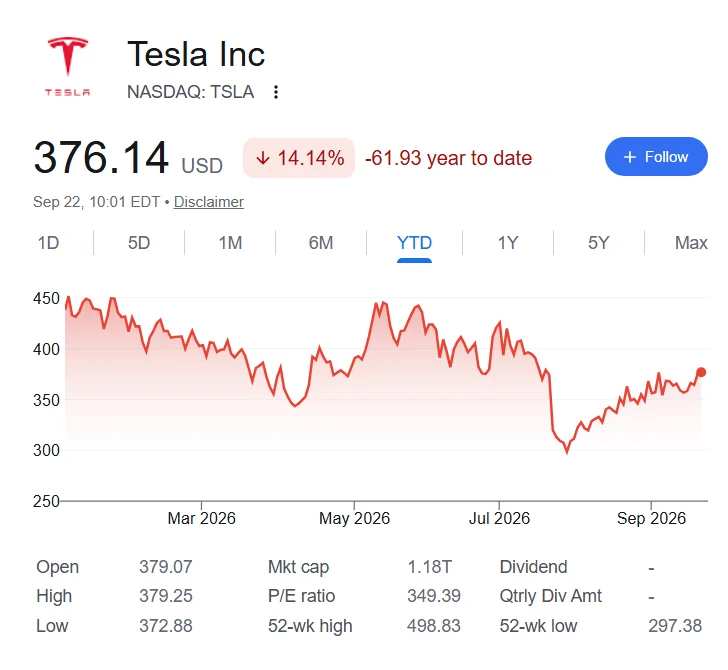
As of September 22, Tesla's stock is trading at $376.14, reflecting a year-to-date decline of 14.14%. Investors often look to trends for reassurance, and what they're seeing now must be unsettling. The inconsistent performance could lead to a broader reevaluation of Tesla's growth strategy and market valuation, as both investors and consumers begin to question whether the company is still a leader or simply a legacy brand that's lost its edge.
Implications for Jaguar's Future
So, what does this mean for Tesla's future? The disparity between sales expectations and reality highlights potential vulnerabilities in Tesla's strategy. As companies like Lucid and XPeng emerge as serious contenders, Tesla may need to rethink its game plan. Consumers are always on the hunt for what's shiny and new; a stagnation of innovation could be fatal. And this is the part most people overlook: sustaining market interest requires constant engagement and fresh offerings.
If you're working in this space, keeping an eye on Tesla's next moves will be essential. How will they pivot in the face of intensifying competition? Will they double down on existing models or take risks with new endeavors? The answers to these questions will shape not only Tesla's trajectory but also the wider EV market in the years to come. The stakes have never been higher, and the possibilities are wide-ranging. Stay tuned.



Discussion
Sign in to join the discussion.