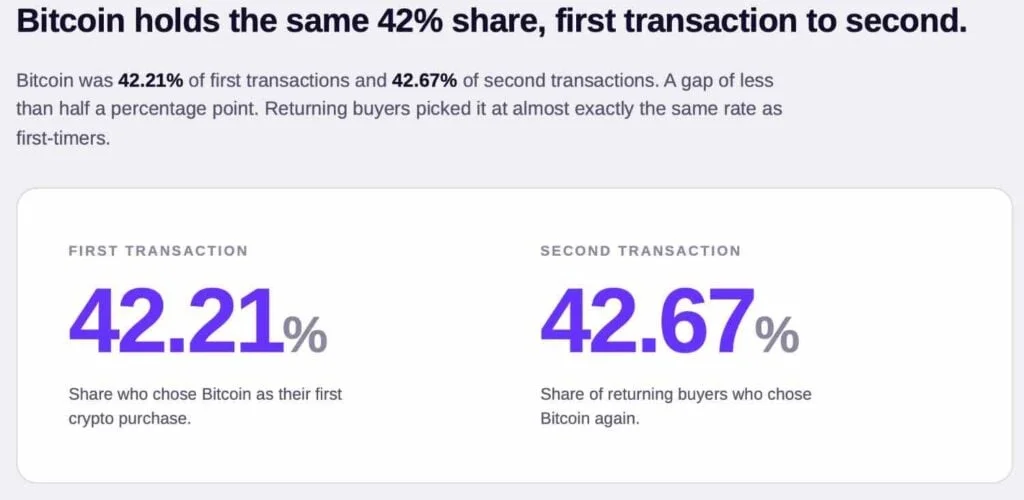
Data from Paybis highlights Bitcoin’s continued appeal, accounting for 42% of both first and second purchases among retail investors.

Bitcoin (BTC) remains the leading choice for retail investors making repeat purchases, according to recent data from crypto exchange Paybis. An analysis spanning August 2023 to August 2026 reveals that Bitcoin captured a remarkable 42.21% of initial transactions and slightly increased its share to 42.67% for subsequent purchases. This consistency is striking, showcasing Bitcoin’s level of trust and reliance among retail buyers, who begin their cryptocurrency journeys with BTC and often return for more.
Ethereum and Stablecoins Struggle to Keep Up
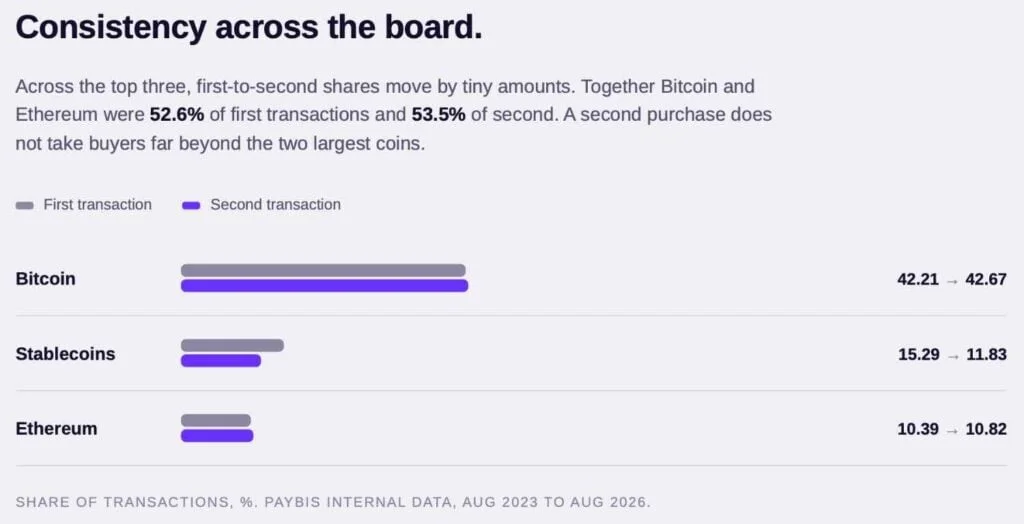
In contrast, Ethereum took a smaller slice, with only 10.39% of first transactions and a marginal increase to 10.82% for second transactions. The data indicates that, while Ethereum maintains a foothold in the market, it's not resonating with buyers in the same way that Bitcoin does. Stablecoins, on the other hand, experienced a more dramatic drop from 15.29% to 11.83%. It's particularly telling that Bitcoin alone accounts for almost double the combined share of Ethereum and stablecoins during repeat transactions, which together hold only 22.65%. This suggests that retail investors see Bitcoin as a more stable, promising long-term investment compared to either Ethereum or stablecoins.
Bitcoin is the Preferred Asset Among Returning Buyers
The data further shows that Bitcoin and Ethereum account for a substantial 52.6% of first transactions and 53.5% of second transactions among users. However, Bitcoin overwhelmingly dominates this segment. What this reveals is that most returning buyers are sticking with the two largest cryptocurrencies rather than venturing into alternatives, a trend that poses questions on the potential for newer entrants in the market. Retail investors seem to value familiarity and perceived safety, rather than the promise of newer projects.
The analysis covered over 795,000 returning users, with around 70%, or roughly 558,000, conducting between two and five transactions in total. Roughly 22% completed six to 20 transactions, indicating a notable segment of users are significantly engaged. However, over 8% engaged in more than 20 transactions, highlighting a core group of highly active buyers who show loyalty to this leading digital asset.
Insights on Crypto Adoption
Konstantins Vasilenko, co-founder and CBDO of Paybis, highlighted how the findings challenge conventional metrics for measuring crypto adoption. He stated, “Bitcoin is the asset people keep buying. Stablecoins usually serve a transactional purpose, and users have less incentive to return.” This statement encapsulates a key issue in the cryptocurrency market: not all assets are created equal when it comes to user engagement and loyalty. Stablecoins, once considered a safe harbor for transactions, are now falling short of the repeat engagement metric because they serve more as transactional vehicles than as long-term investments. And that’s where Bitcoin shines.
“Bitcoin is the asset people keep buying. Stablecoins usually do a payment or transfer job in a single transaction. The user has no reason to return. Repeat purchase is a poor measure for them.”
Stablecoin Trends Suggest a Different Narrative
The decline in stablecoin share does not necessarily reflect decreased usage. Paybis pointed out that repeat purchases aren’t the best indicator of stablecoin activity since users often buy them for specific transactions. For example, if you're working in this space, you know that once a user converts fiat to a stablecoin to complete a purchase, the focus shifts elsewhere. Once that purpose is fulfilled, there's little motivation for repeat purchasing. These coins typically see spikes in transactions during specific market conditions but don’t enjoy the consistent retention that Bitcoin does.
The volume of stablecoin transactions remains significant, with Paybis processing $1.2 billion in Tether (USDT) and $583 million in USD Coin (USDC) over the last 12 months. The stability of stablecoins is key, yet the transactional nature of their use leads to dissatisfaction among those looking for repeat engagement.
Ethereum showed minimal variation in its purchase patterns, with a marginal rise from 10.39% to 10.82%. This slight increase suggests stable retention among its users as well, albeit far less than Bitcoin. Their users appear to be satisfied with what Ethereum offers, but it’s clear that it lacks the same loyalty factors driving Bitcoin’s popularity.
Implications for the Future
Ultimately, these trends illustrate that while Bitcoin attracts a highly engaged user base, the typical retail investor metrics might not apply uniformly across different types of cryptocurrencies. Bitcoin isn’t just a digital asset; it represents a mindset where investors look for trustworthiness and reliability. This pattern of behavior signals a significant shift in how retail investors prioritize their assets. If you're navigating this space, it’s time to rethink how you assess the performance of different cryptocurrencies.
This data suggests a strong retail preference for Bitcoin beyond initial purchases, highlighting that it captures 42% of both first and second purchases per the Paybis dataset, leaving its closest competitors far behind. The crypto market remains a complex environment, where engagement isn't merely a function of technology but also user trust and long-term investment strategy.
Featured image via Shutterstock
The post Bitcoin Dominates Repeat Transactions Among Retail Crypto Buyers appeared first on Finbold.
Discussion
Sign in to join the discussion.