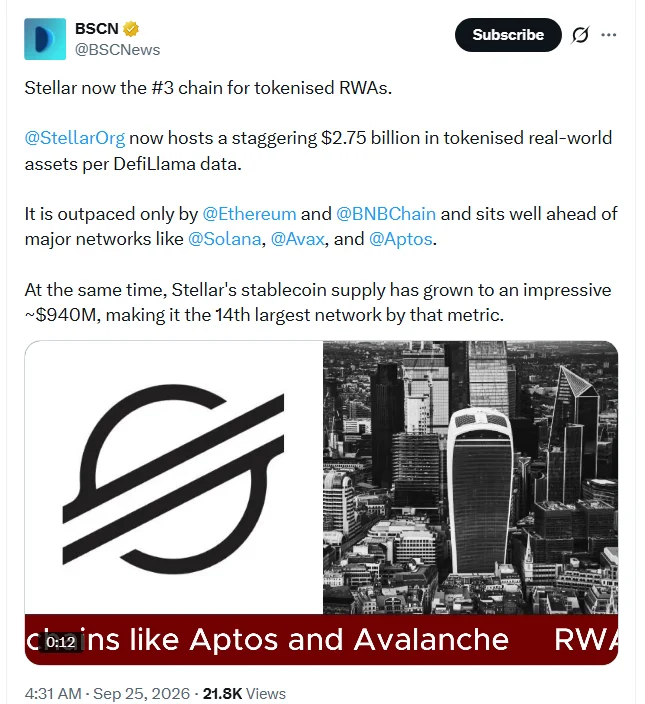
Stellar has achieved a significant milestone, now ranking third in tokenized real-world assets with $2.75 billion, surpassing Solana, Avalanche, and Aptos.
Recent on-chain metrics reveal that Stellar (XLM) has secured its position as the third-largest blockchain for tokenized real-world assets (RWAs), amassing an impressive $2.75 billion in assets under management. Data from market analyst BSCN confirmed this upward trend today.
Across public blockchains, the total value of tokenized RWAs now stands at $28.67 billion, reflecting a remarkable 79.8% increase since the year's start, as highlighted by DeFiLlama. This explosion emphasizes the rapid pace of tokenization in the crypto sector, converting a variety of traditional assets—including real estate, treasury bonds, and commodities—into digital tokens.
Stellar is Emerging as a Tokenization Hub
Analyzing the data underlines a significant narrative surrounding the Stellar network as it transitions beyond the typical crypto phenomena. With $2.75 billion in RWAs, Stellar has eclipsed competitors like Solana and Avalanche to claim its spot behind BNB Chain and Ethereum, which rank first and second, respectively. This ascent is noteworthy not just for numbers, but for the implications it holds for the broader market dynamics.
This immense growth illustrates a shifting tide toward on-chain RWAs, encompassing stablecoins, tokenized U.S. treasuries, and private equity—demonstrating Stellar's emerging identity as a critical player in this market. It raises questions about how this integration of assets will reshape financial ecosystems. As traditional finance intersects with blockchain technology, experts ponder what this means for regulatory oversight and consumer protection.
What Sets Stellar Apart in a Competitive Market
Stellar’s market for RWAs has flourished more than fourfold since the beginning of the year. Such growth signifies increased engagement with tokenized private credit, U.S. treasuries, and money-market products, indicating a steady migration toward on-chain financial products. If you're working in this space, this transition could represent a seismic shift in how services are offered and who can access them.
Financial institutions are increasingly recognizing the advantages of on-chain settlements and tokenized assets, positioning Stellar as a favorable platform due to its cost-effective transactions and quick processing times. This isn't just about efficiency; it's also about accessibility. Institutions that have historically been limited by legacy systems now see opportunities to streamline operations and cut costs.
The network's focus on financial services, cross-border payments, and asset issuance distinguishes it significantly from its adversaries, drawing issuers and clients alike into its ecosystem. Stellar is tackling the challenge of adoption head-on. Its architecture is designed to cater to institutions looking to enter digital finance with a lower barrier to entry.
The Bigger Picture of Tokenization
Tokenization is reshaping the way assets are perceived in financial terms. Traditionally, assets have set limits on accessibility and liquidity. However, by converting these assets into tokens, they can be fractionalized, allowing investors of different sizes to participate. This trend could democratize investment opportunities; for instance, smaller investors could gain access to real estate markets that were previously out of reach. But that’s not all. The implications for valuation, ownership, and asset liquidity are profound.
For many investors and businesses, this ability to tokenize represents not just a novel way to manage assets, but also potential new revenue streams. The interaction between traditional financial mechanisms and blockchain-based solutions might alter the competitive landscape for investment firms, banks, and other financial intermediaries. And yet, for these innovations to achieve widespread acceptance, they will likely need to grapple with existing regulatory frameworks that aren’t fully equipped to handle such transformations.
(And this is the part most people overlook) — the actual pacing and adoption of tokenization. While stellar metrics are promising, the reality of user education, platform trustworthiness, and legal frameworks could inhibit rapid growth. As the industry grapples with these challenges, the race toward broader acceptance continues.
Implications and Future Outlook
The rapid growth of Stellar’s market share in tokenized RWAs could signal a turning point for the blockchain and financial services industries. The more institutions adopt tokenization, the more they'll drive regulatory discussions and transparency efforts in this space. This momentum is something to watch closely; the future direction could carve pathways for new regulations aimed explicitly at these digital assets.
What this means for you is a potential shift in how you may manage investments in the near future—especially if tokenized assets become ubiquitous. Unlike standard investment vehicles, tokenized assets could offer higher liquidity and lower transaction costs. But these advantages will come with uncertainties surrounding security, market volatility, and value consistency.
The success of Stellar could pave the way for other blockchains to follow suit—but there's no guarantee they'll replicate its formula. Competitors will undoubtedly attempt to innovate relentlessly, vying for similar accolades. It's essential to keep an eye on Stellar's roadmap, including upcoming updates like Protocol 20, which could further enhance its capabilities in this burgeoning field.
Discussion
Sign in to join the discussion.