Pendle is strategically positioned to capitalize on the growing demand for yield in DeFi through innovations in stablecoins, RWAs, and perpetual futures.

Yield has always been at the heart of finance, enticing investors and lenders alike. Pendle's aspiration is straightforward: it aims to be the marketplace for pricing, trading, and securing yield wherever it exists, almost like a gravitational force in the ecosystem.
With the introduction of Pendle V2, the platform allows users to divide any yield-bearing asset into a Principal Token (PT), which guarantees a fixed yield, and a Yield Token (YT), enabling speculative activities on the variable yield. This function parallels how one might separate a bond's definite returns from its potential upside, allowing separate trading of each portion.
Additionally, Pendle’s Boros functionality extends this yield management to perpetual futures funding rates—an area that typically involves significant financial flows, estimated in the tens of billions yearly across the crypto landscape.
The team behind Pendle has identified three significant growth waves poised to shape the DeFi space: stablecoins, tokenized real-world assets (RWAs), and perpetual futures.
Wave 1: Stablecoins
Stablecoins represent one of the most mature products in the cryptocurrency sector and continue to see remarkable growth. As of mid-September 2026, the total supply stands at approximately $300 billion, reflecting a 14% increase year-over-year. Traditional finance forecasts are particularly bullish, with Citi estimating stablecoins could reach $1.9 trillion by 2030, while Standard Chartered posits $2 trillion by 2028, marking a potential sixfold increase from current levels.
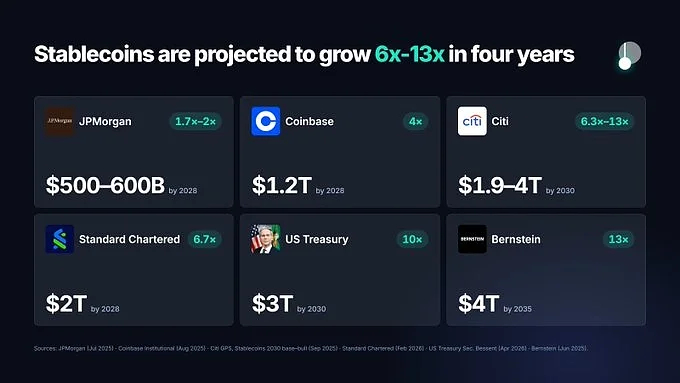
This cycle's distinguishing factor is the involvement of established players as regulatory frameworks advance. Notably, the Global Dollar Network, which includes firms like Kraken, Robinhood, Galaxy, and Mastercard, has launched a USDG market on Pendle.
In less than two months since establishing this market, Pendle has surged to hold roughly 27.9% of USDG's supply on Ethereum, translating to $121 million. On the X Layer, the Pendle USDG market constitutes 40% of the chain's total value locked (TVL).
Analytics firm Dune has termed the phenomenon following Pendle launches as The Pendle Effect, where tokens experience a noticeable increase in demand post-market introduction.
- At its peak, approximately half of Ethena's TVL, amounting to around $7 billion, was routed through Pendle.
- On Monad, AUSD markets reached around $230 million in TVL, with Pendle holding over 78% of the stablecoin's overall supply.
- Stable pools on Pendle have amassed a staggering $6 billion in notional volume this year alone.
The logic for issuers is evident: stablecoins need avenues for holders to earn yield, and Pendle has positioned itself as the go-to platform for this purpose. Even under conservative estimates from JPMorgan, where stablecoin supply doubles, Pendle's potential market growth remains significant.
Wave 2: Tokenized Real-World Assets
Tokenized RWAs, such as U.S. Treasuries and other traditional assets represented on-chain, have caught the attention of institutional investors, marking them as the second growth wave in this evolving landscape.
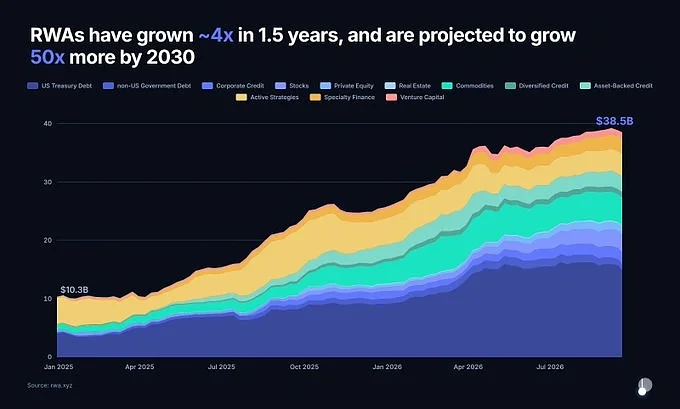
Excluding stablecoins, the tokenized RWA market has skyrocketed from around $10 billion in 2025 to nearly $39 billion currently—a fourfold increase within two years. Projections suggest this market could reach anywhere from $2 trillion to over $16 trillion by 2030, even the more conservative estimates indicating a rapid 50x growth.
This year, Pendle has highlighted RWAs as its central theme for growth, launching 66 RWA-linked markets, which encompass products like Treasury bills and private credit.
- $210 million worth of RWA-backed PTs is currently collateralized on Morpho.
- The STRC markets on Pendle exceeded $500 million in TVL in May, alongside more than $977 million in total cumulative volume.
- USDai, a project that tokenizes compute infrastructure, reached a peak TVL of $568 million, with a total volume of approximately $2.5 billion.
- Partners Group recently launched a fund on Pendle, signaling an influx of assets.
Despite the impressive traction, the Pendle team acknowledges that RWA tokenization is still in its infancy. Recent actions by platforms like Robinhood are indicative of an emerging product-market fit, signifying a rapid convergence of on-chain and off-chain finance.
Wave 3: Perpetual Futures
The final wave revolves around perpetual futures (or perps), specifically the funding rates that accompany them. These markets are transforming how assets are traded in a 24/7 format mirroring traditional markets.
Current data shows equity-linked perp open interest has surpassed $6 billion, increasing more than ten times in the last six months. Trading volumes have ballooned, with Hyperliquid jumping from $4 billion to $212 billion. The IPO of SpaceX notably saw shares price-discovered on perp markets before actual shares became available.
Despite the activity, the volatility surrounding perp funding rates poses challenges, particularly for assets further from crypto’s core. For instance, average yearly funding rates can differ significantly between Bitcoin and commodities like oil; in May, funding rates on oil averaged 14 times more volatile.
The difference in funding rates across asset classes highlights a severe risk for traders, with RWA funding volatility representing a unique challenge that traditional strategies may struggle to address.
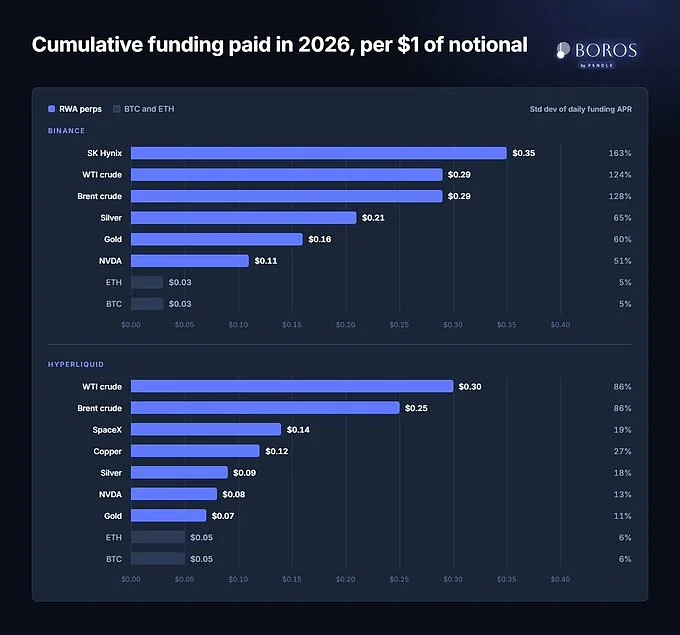
To address this issue, Boros offers features that allow traders to lock in funding costs and enables fixed-return carry trades, enhancing trading strategies. A recent tool called Arbitrage has simplified cross-exchange funding arbitrage into a straightforward process, allowing traders to synchronize positions across platforms with ease. Reports indicate that these opportunities can yield a fixed annual percentage rate of around 20–40%.
Distribution and Liquidity: Pendle's Competitive Advantage
Pendle's Principal Tokens (PTs) boast wide acceptance across both DeFi and centralized finance (CeFi) platforms. Its cross-chain functionality ensures that collateral is fluid, exemplified by a $170 million PT-USDe transfer from Ethereum to the BNB Chain for broader use.
Recent advancements in liquidity have been noteworthy. For instance, a $50 million swap into PT-sUSDS currently provides approximately 4.6% fixed APY with only 0.05% slippage, a level of efficiency comparable to leading centralized exchange markets. This level of capital effectiveness, with a TVL of just $130 million supporting a $20 million trade moving yield by just 0.22%, further highlights Pendle's liquidity depth and efficiency.
Pendle's unique combination of automated market maker (AMM) liquidity with a limit order system offers an optimal pricing strategy for trades. The implementation of an algorithmic incentive module (AIM) has also contributed to a reported 71% growth in tradeable liquidity this year.
The Broader Implications
Each of the three identified growth waves—stablecoins, tokenized RWAs, and perpetual futures—follows its own trajectory, yet they converge on a shared necessity: a mechanism for yield to be effectively priced, fixed, or hedged.
- A stablecoin's scalability is directly linked to the capacity for holders to earn yield.
- Tokenized funds arriving on-chain require a solution to stabilize floating rates effectively.
- Perps, regardless of asset type, inherently include funding rates that necessitate effective trading venues.
As these markets evolve, they increasingly rely on the same fundamental infrastructure, positioning Pendle as a key player ready to meet this demand.
For those interested in fixed yield options on stablecoin and RWA markets, explore app.pendle.finance. To trade or hedge funding rates, visit boros.pendle.finance.
This analysis draws upon Pendle's original "Inevitable" piece, with TVL, volume, and market-share figures sourced from the platform's reporting.
Discussion
Sign in to join the discussion.