The IMF has granted El Salvador a waiver regarding Bitcoin accumulation, while stressing the need for stricter oversight and no further investments in BTC.
IMF’s Decision: A Waiver and Its Implications
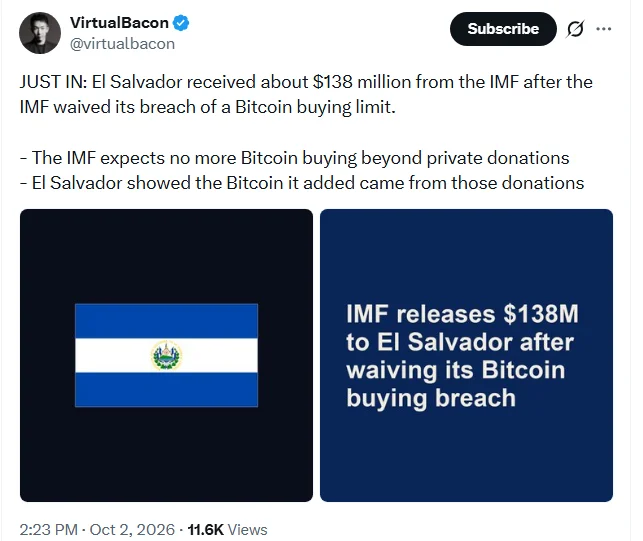
The International Monetary Fund (IMF) has made a notable decision regarding El Salvador's Bitcoin strategy, granting the country a waiver after it failed to meet certain conditions related to its Bitcoin assets. This waiver is accompanied by a $139 million financial award, reflecting an improvement in El Salvador's economic performance, which has been bolstered by enhanced investor confidence and better security parameters. But what does this mean in terms of policy and future economic decisions?
The credit facility, which totals $1.4 billion, indicates that the IMF is taking a pragmatic approach to its relationship with El Salvador. They aren't just handing out cash indiscriminately; they're looking at the bigger picture of regional stability and financial integrity. El Salvador’s economic reform potential is a narrative that has been pushed by various stakeholders, but the IMF's current waiver implies a cautious optimism—favoring the immediate over the long-term consequences of Bitcoin volatility.
IMF Reviews and Economic Indicators
This financial aid follows the IMF's thorough evaluations encompassing the second and third reviews of the $1.4 billion credit facility allocated to El Salvador earlier this year. While on one side you have financial assistance, on the other, there's a strict framework of accountability. The reviews encompass fiscal measures that El Salvador has implemented but may also implicitly challenge the government’s embrace of Bitcoin. There's a palpable tension between pursuing innovative economic avenues and adhering to traditional fiscal discipline.
Investor confidence appears to have strengthened, albeit cautiously. The IMF signals that improved security parameters are encouraging, but skepticism about Bitcoin's role in the national treasury remains. The confluence of these factors marks a delicate balancing act. If El Salvador's economy thrives, it could ward off discontent from institutions like the IMF; however, a misstep in Bitcoin investments could lead to dire consequences that the IMF is keen to avoid.
Future of Bitcoin Accumulation in El Salvador
The IMF's recent statements underscore its expectations for El Salvador to refrain from further Bitcoin purchases. This stance follows the waiver allowing the country to address its non-compliance regarding BTC holdings under the $1.4 billion credit agreement. Observers are left to wonder: is this an indication of decreasing faith in Bitcoin as a national asset? It's not just about stopping purchases; it demands that El Salvador rethink its entire cryptocurrency narrative.
Moving forward, the IMF anticipates a cessation of government engagement in Bitcoin investment beyond previously documented donations. Who would be surprised if the IMF enforces higher scrutiny in light of ongoing global discussions regarding cryptocurrency regulation? Given the volatility historically associated with Bitcoin, the IMF's insistence on heightened transparency regarding public Bitcoin assets seems more an act of caution than an outright rejection of cryptocurrency.
El Salvador's Bitcoin Journey
Back in 2021, El Salvador took a historic step by becoming the first nation to integrate Bitcoin into its national financial reserves. This bold move, however, has drawn scrutiny, particularly when the IMF warned against the risks associated with cryptocurrency volatility affecting public funds. These criticisms aren't new; they echo the concerns many economists have about mixing digital currencies with sovereign finance. If you're working in this space, you understand that Bitcoin's hype doesn’t always translate to stable economic policy.
As it stands, El Salvador currently holds 7,787.37 Bitcoin, valued at approximately $658 million. Recent purchases of eight BTC and an additional 31 in the last month signal the country’s continued investment strategy in Bitcoin. Yet, these purchases might be misaligned with the IMF's guidance, raising questions about the government's willingness to comply with international norms. Are these actions tantamount to a rebellion against institutional pressure? Or are they a sign that El Salvador believes deeply in Bitcoin's transformative potential?
Implications for El Salvador and Broader Economic Impact
The implications of the IMF's waiver and conditional stance could reverberate beyond El Salvador’s borders. Other nations watching closely might reconsider their own cryptocurrency plans based on this cautionary tale.
While some in El Salvador view Bitcoin as a pathway to modernization and financial inclusion, the reality is that the risks are substantial and cannot be ignored. For a nation still grappling with issues like poverty and economic instability, betting on an inherently volatile asset seems like a gamble—one that could alienate financial institutions that otherwise might offer critical support.
All this points towards a complicated future: if the government overcommits to Bitcoin, it risks financial instability. If it shifts back towards traditional currencies without a clear roadmap, it could lose precious gains made under its current strategy. What this means for you is understanding that El Salvador's journey is emblematic of the dilemmas many countries will face as they navigate the complexities of cryptocurrency adoption.
So what's next for El Salvador? A prudent approach seems necessary. The international community will be watching closely, and the stakes couldn’t be higher. After all, the last thing a fragile economy needs is a misstep that jeopardizes not just investment but its relationship with critical global financial institutions.


Discussion
Sign in to join the discussion.