Peter Schiff links gold’s resilience to a possible tech sell-off, pointing to $4,000 as support and warning that recession risks could help bullion and miners.

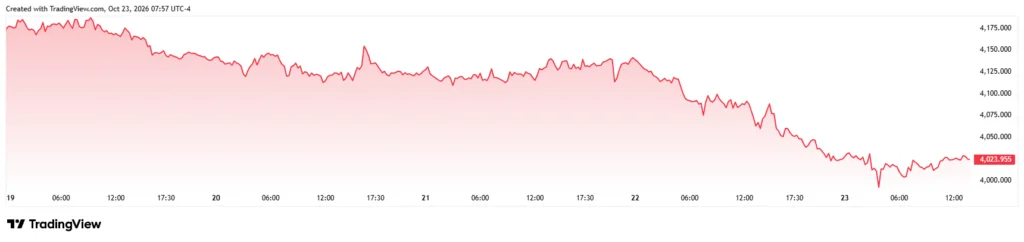
Peter Schiff’s case for gold hinges on a split in investor expectations: a pullback in AI spending could hurt stocks and the broader economy while strengthening demand for the metal. After gold shed $116 on October 22, the economist argued that traders may be right to brace for a technology sell-off but wrong to expect gold to keep falling. His claim rests on a familiar defensive-asset argument: if a market shock weakens confidence in growth, investors may reassess what they want to own. That possibility doesn’t make gold immune to losses during a broad sell-off, though. Schiff’s view is a forecast about what could follow the initial reaction.
Schiff attributed the day’s pressure across equities, cryptocurrencies and commodities to investors preparing for “a tech wreck and an unwind of the leveraged AI trade.” In a post on X, he said gold had already corrected and predicted that a stock market crash would ultimately be bullish for the metal. The distinction matters: he isn’t arguing that gold must rise every time stocks fall, but that a downturn could change demand once investors begin weighing recession risk. Here’s the thing: that thesis depends on the market moving from selling assets broadly to seeking protection, and the timing between those phases can be hard to read.
Gold fell $116 today, closing just above $4,000 support. Traders seem to be bracing for a tech wreck and an unwind of the leveraged AI trade. They may be right to expect that, but they’re wrong that gold will fall too. Gold already corrected. A stock market crash will be bullish.
Gold tests the $4,000 level
Price action gave that support level an immediate test. Gold briefly approached $3,990 later on October 22, then recovered to $4,023.96 at the time of reporting. Schiff sees $4,000 as a key threshold, though a single rebound doesn’t establish how the metal will trade over the coming months. For readers tracking the argument, the level offers a concrete reference point; it doesn’t settle the larger question of whether demand will strengthen if the economy weakens. A brief recovery can reflect shifting expectations, but it can also prove temporary.
His argument extends beyond gold prices. Schiff said AI-related capital spending is the only factor keeping U.S. GDP growth positive, and that more expensive, harder-to-find borrowing could slow the AI buildout. That’s a strong claim about the role of one area of spending in the economy, and the source material offers no independent evidence to test it. The underlying mechanism is plausible in general: when financing becomes more costly or less available, companies may reconsider large projects. But whether that pressure would be enough to push the wider economy into recession is a separate question. (And this is the part most people overlook.) He expects a recession to benefit gold and silver miners, even as their shares have also fallen.
Schiff points to recession risks
Schiff gave no date for the downturn he anticipates. He cited record stock valuations, rising bond yields, a “soft” job market and accelerating inflation as conditions that could bring a collapse before the midterm elections. Each item points to a different source of concern: stock prices can look vulnerable when expectations are high, while rising yields can raise borrowing costs across the economy. A soft job market and faster inflation would add pressure from opposite directions, complicating the outlook for households and policymakers. Those are his stated risk factors, not proof that a crash is imminent. The numbers here are underwhelming as a timing guide: without a date or a stated trigger, the forecast is difficult to evaluate in the near term.
That outlook fits his longstanding criticism of the U.S. economy. In an October 21 post, he challenged claims that the economy is booming, arguing that GDP growth during Donald Trump’s first two years was lower than during Joe Biden’s final two, while inflation was higher. The comparison is his framing of the figures, and it’s meant to question whether growth alone supports a celebratory description of the economy. GDP and inflation describe different parts of the picture; neither, on its own, tells readers how households experience costs or how durable current growth may be. If you’re working in this space, the distinction between a political claim about economic strength and the data Schiff cites is worth keeping in view.
Larry Kudlow just said there is no question that the U.S. economy is booming. Given that GDP growth during Trump’s first two years is lower than during Biden’s last two years, but with higher inflation, based on what evidence does Kudlow conclude the economy is booming?
Schiff also warned cryptocurrency holders against complacency. He acknowledged that Bitcoin (BTC) had performed comparatively well, but said recent gains might be “just the calm before the storm.” That warning extends his broader argument about risk across markets: strength in one asset over a short period doesn’t, in his view, rule out a sharp reversal if the economic backdrop deteriorates. Yet the post doesn’t establish that Bitcoin’s recent performance predicts what comes next. A cautionary phrase is not a forecast with a timeframe.
What the argument depends on
Schiff’s thesis has two linked parts: AI investment slows enough to weigh on growth, and investors then turn toward gold as a hedge against the consequences. If either link fails, the expected benefit to gold could be delayed or absent. Gold miners add another layer, since their shares can respond to both the metal’s price and broader market conditions. That makes Schiff’s expectation for miners more complicated than a simple bet on rising gold.
And yet, the scenario is worth watching because it puts a clear tension in front of investors: the same pullback that could pressure gold in an initial rush to sell might, in Schiff’s view, later support it as recession fears grow. The available price evidence remains limited to the October 22 move and the recovery above $4,000 reported afterward. This is more significant than it looks as a test of the argument, but it isn’t confirmation of it. For now, gold’s ability to hold near $4,000 is the clearest price level to watch. The larger question is whether the economic slowdown Schiff expects will materialize. Not yet answered.
Featured image via Shutterstock
The post U.S. economist says ‘stock market crash will be bullish’ for Gold appeared first on Finbold.



Discussion
Sign in to join the discussion.