Ripple National Trust Bank received final OCC approval to manage RLUSD reserves and provide digital asset custody, expanding Ripple’s regulated services.

Ripple’s final approval to establish a national trust bank gives the company a federally supervised base for managing RLUSD reserves and providing digital asset custody. It also puts Ripple National Trust Bank (RNTB) under the same regulatory authority as JPMorgan Chase, a notable change in how the company’s institutional services are organized. The charter adds a formal banking structure to Ripple’s push into financial services used by larger institutions.
That status deserves attention, though it shouldn’t be mistaken for proof that every Ripple product now has the reach or operating record of a major commercial bank. A national trust bank has a defined role, and the approval described here centers on reserve management and custody. The practical test will be whether those services meet institutional expectations as usage grows.
What the charter authorizes
The Office of the Comptroller of the Currency granted the charter after issuing conditional approval in December 2025. RNTB is authorized to manage segregated reserves for Ripple USD (RLUSD) and provide fiduciary custody for digital assets. Those functions connect the bank directly to the backing and safekeeping arrangements that can matter to institutions considering a stablecoin or custody provider.
Segregated reserves are intended to keep assets supporting a financial product distinct from other funds. That structure can make responsibilities easier to identify, although the charter alone doesn’t tell readers how the reserves will be managed day to day or what operating safeguards will apply. The details of execution will matter as much as the formal permission.
Custody is a separate but related service. Institutions holding digital assets generally need clear processes for safeguarding them and establishing who has authority over them. A federally supervised bank gives Ripple a defined institutional framework for that work, but trust will depend on how the service operates in practice.
A move toward institutional finance
CEO Brad Garlinghouse welcomed the decision ahead of Ripple’s invite-only Swell conference, scheduled for October 27–29, 2026. He said the charter strengthens the foundation for RLUSD and Ripple’s institutional work across payments, custody and capital markets. His remarks frame the approval as part of a broader business strategy, rather than a stand-alone banking milestone.
“We’ve spent over a decade building regulated financial infrastructure that institutions can actually use at scale. A national trust charter gives us an even stronger foundation for RLUSD and the institutional products we’re building across payments, custody and capital markets,” Garlinghouse noted.
That ambition is clear; what remains less clear from the announcement is how quickly the charter will translate into services institutions adopt. A bank’s authorization can remove one structural obstacle, but customers still weigh operational reliability, custody arrangements and the usefulness of a product in their own systems. The approval creates a platform for that competition. It doesn’t settle its outcome.
XRP and RLUSD market figures
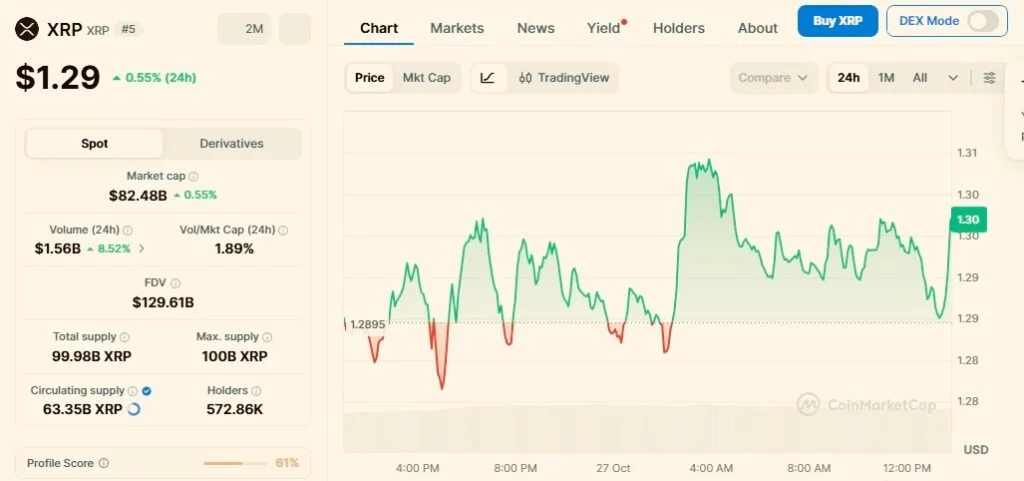
At the time of reporting, XRP was up 0.55% over 24 hours at about $1.29, with a market capitalization of roughly $82.48 billion and average daily trading volume of $1.56 billion, according to CoinMarketCap data. Those figures offer a snapshot of trading activity, not a measure of the trust bank’s performance or evidence that the charter caused a price move.
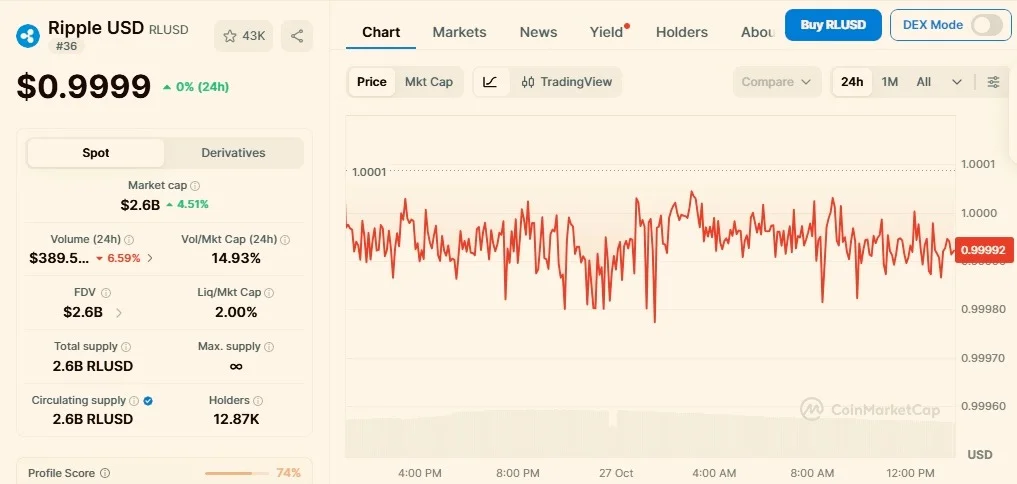
RLUSD’s market capitalization stood at $2.6 billion, while its average trading volume over 24 hours was $389.5 million. These measures show the scale of the stablecoin’s market activity at the time cited, but they don’t explain how much demand comes from institutional customers or how the new bank will affect reserve operations. That distinction matters: market size and the quality of the supporting infrastructure are related, but they aren’t interchangeable.
What to watch as RNTB develops
This is more significant than it looks because it gives Ripple a regulated entity with a stated role in the plumbing behind RLUSD and its custody offering. Yet a charter is a starting point. Readers should look for evidence in how reserve management, fiduciary duties and custody are carried out, rather than treating approval itself as a verdict on service quality.
(And this is the part most people overlook.) Institutional adoption often turns on operational details that are less visible than a headline approval: how assets are accounted for, how responsibilities are assigned and whether a provider can support customers’ day-to-day needs. The announcement establishes the authorized functions, while leaving those practical questions open.
If you're working in this space, the development offers a useful signal about Ripple’s direction: it’s building regulated infrastructure around stablecoin reserves and digital asset custody. The next measure of progress will be whether that structure supports products institutions actually choose to use. For now, the charter formalizes a role; the results will depend on execution.
Featured image via Shutterstock
The post Ripple scores major U.S. banking approval in push into traditional finance appeared first on Finbold.



Discussion
Sign in to join the discussion.