Bitcoin and gold posted losses of 7.3% and 7.5% through October 23, an unusual pairing that could still change before year-end.

An unusual pairing at the bottom of the rankings
Bitcoin and gold rarely share the bottom of the major-asset rankings. Yet by October 23, 2026, they were the year’s two weakest performers, with Bitcoin down 7.3% and gold off 7.5%, according to a table posted by Charlie Bilello, chief market strategist at Creative Planning. The pairing stands out even though both assets have finished previous years in negative territory. What makes this comparison notable is the timing: two assets often discussed for very different reasons were struggling at once, leaving investors with little comfort from either one’s usual role in a portfolio.
Bitcoin is commonly treated as a high-volatility asset, while gold is often held as a store of value or a hedge against market stress. Those broad descriptions don’t guarantee that either will rise in a particular period, and they don’t mean the two respond to the same forces. This is more significant than it looks: their joint appearance at the bottom of the table challenges a simple reading that weakness in one might be offset by strength in the other.
Bitcoin and gold were also down in 2014, 2018 and 2022, but Bitcoin’s losses then were far steeper: 58%, 73% and 65%, respectively. The 2026 figures therefore describe a different kind of poor performance: relatively modest year-to-date losses at that point, but an unusual overlap in the rankings. With more than two months left in 2026 when Bilello shared the figures, the standings had room to shift. By October 26, Bitcoin had fallen further, while gold had recovered slightly. A snapshot of rankings can make a year look settled before it is, especially when the assets are moving quickly.
Bitcoin’s slide follows a record high
Bitcoin’s decline has followed a sharp run-up. After setting an all-time high above $125,000 late in 2025, BTC entered a downtrend and stood at $80,155 by the article’s publication, about 36% below that peak. Its year-to-date loss was smaller, but the path has been volatile. That gap between the peak-to-current decline and the year-to-date figure matters: the first describes the damage since Bitcoin’s high, while the second captures its net performance over the calendar year. Neither alone tells the full story of the swings investors experienced along the way.
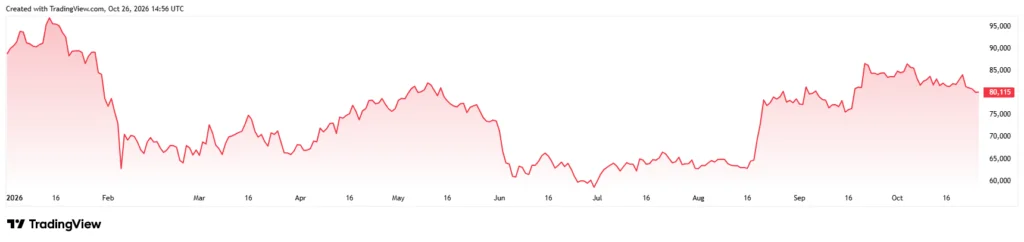
Some investors and analysts had expected a late-year rebound, with forecasts made early in 2026 pointing to a possible bottom in October. Bitcoin began recovering in late August, earlier than those expectations suggested, but that rally didn’t insulate it from market shocks. Renewed concern that the Iran War could intensify coincided with a slide toward $80,000. The sequence is a reminder that a recovery can be real and still prove fragile: a change in sentiment or broader market conditions may quickly overwhelm momentum.
Bitcoin’s history of steep declines also shapes how this episode is read. Previous down years saw much larger losses, but that doesn’t make a smaller decline painless or signal that the market has found a floor. For anyone watching the asset, the key distinction is between a year-to-date ranking and the broader price trend. Here’s the thing: a ranking tells you where Bitcoin stood relative to other assets on a date; it doesn’t explain what caused each move or establish what comes next.
Gold retreats from its early-year peak
Gold’s reversal came after a sustained climb from 2023 into early 2026. The metal reached roughly $5,400 before turning lower; by late October, it was testing support near $4,000. The drop looks like a sharp correction after a long advance, with market conditions adding pressure. A large retreat from a peak can draw attention even when the asset remains close to levels that once seemed difficult to reach; the distance from the high and the current position answer different questions about performance.
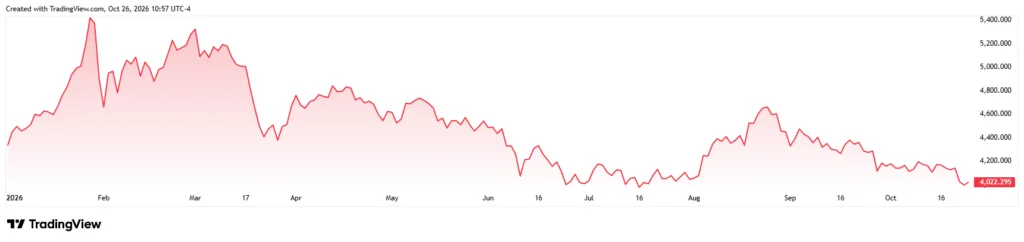
Persistent inflation and turbulence in bond markets raised the opportunity cost of holding gold. A stronger U.S. dollar also weighed on demand from overseas buyers: the dollar index was up 3.84% year to date. When the dollar strengthens, gold priced in dollars can become more expensive for buyers using other currencies, which may weigh on demand. That mechanism doesn’t explain every move, but it helps show why a traditionally defensive asset can still face pressure when currency and bond-market conditions shift.
At the same time, volatility in stocks—linked to oil-market disruption from the Iran War and changing expectations around artificial intelligence—prompted some leveraged traders to sell liquid holdings such as gold to meet margin calls. This kind of forced selling can put pressure on assets even when the reason for the sale has little to do with their long-term appeal. (And this is the part most people overlook.) Gold can be sold to raise cash precisely because it’s liquid, not because traders have reached a new view of its value.
What the shared decline says about diversification
The unusual ranking captures a difficult stretch for both assets, but the drivers differ: Bitcoin has been vulnerable to its post-peak downturn and broader market shocks, while gold has faced pressure from rates, currency strength and trading flows. Their shared weakness doesn’t establish that they have become interchangeable or that their usual roles have vanished. It does show the limits of treating broad labels such as “digital asset” or “safe haven” as reliable guides to short-term performance. In stressed markets, the conditions surrounding each asset can matter more than the label attached to it.
If you're working in this space, the practical lesson is to look past a single ranking and track the forces acting on each market. Bitcoin’s distance from its record high, the changing outlook for a rebound, and sensitivity to market shocks describe one set of pressures. Gold’s exposure to bond-market conditions, the dollar, and liquidity needs describes another. The comparison is useful because it shows that assets with different rationales for ownership can fall at the same time, while leaving the reasons for those falls distinct.
That said, the figures remain a dated snapshot. By October 26, Bitcoin had weakened further and gold had recovered slightly, and the calendar year still had weeks to run. Whether their standings change depends on whether the forces described here ease or persist. For now, the episode offers a pointed reminder: diversification can spread exposure across different drivers, but it can’t ensure that at least one holding will be up whenever markets turn unsettled.



Discussion
Sign in to join the discussion.