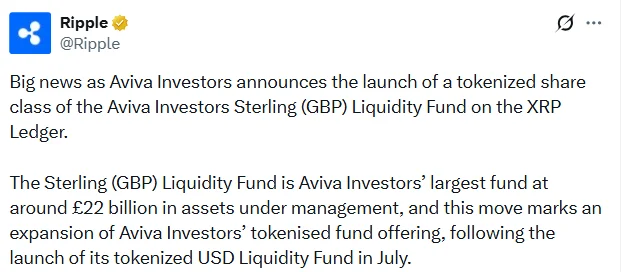
Aviva Investors has launched a tokenized share class of its sterling liquidity fund on XRP Ledger, extending on-chain access to institutional cash management.
Aviva Investors has put a tokenized share class of its £22 billion sterling liquidity fund on Ripple’s XRP Ledger, bringing an established cash-management product onto a public blockchain. The move adds an on-chain channel for institutional fund administration and liquidity, while the underlying fund continues to operate through its existing off-chain structure.
The distinction matters. Tokenization can change how fund interests are represented, issued, and managed without changing the assets a fund owns or the investment strategy it follows. Aviva’s announcement describes a digital representation of investor holdings; it doesn’t say that the fund’s portfolio or its basic operating model has been replaced.
The UK-based manager’s fund, valued at about $29.4 billion, invests in short-term sterling debt. First introduced in 2002, it has used a “digital twin” model: investor holdings are represented on-chain while the fund itself continues to operate off-chain. That arrangement puts a familiar product into a new administrative channel, but it also means the blockchain record and the fund’s conventional operations have to work together.
Tokenized shares extend the fund’s reach
Aviva Investors’ announcement, shared by Ripple, describes the move as an expansion of the firm’s institutional digital-asset strategy. XRP Ledger will support issuance and management of the tokenized GBP fund, with the goal of making its liquidity available around the clock. The stated ambition is clear; the announcement, however, doesn’t establish how quickly investors will be able to transact or what conditions will apply to access.
That gives the fund an on-chain footprint while retaining its existing off-chain operation. For institutional investors, the practical change is another route to hold and manage fund shares; the announcement doesn’t specify changes to the underlying portfolio or operating structure. The tokenized share class should therefore be understood as a new way to represent and administer interests in the fund, rather than evidence that the fund itself has become an entirely on-chain product.
Here’s the thing: a round-the-clock digital record doesn’t automatically make every part of a fund’s liquidity available at every hour. Similar systems typically depend on the connection between the token record, the fund’s existing processes, and the institutions handling transactions. Those details shape whether the new channel feels meaningfully faster or more convenient in practice. The announcement leaves them open.
A measured step into on-chain finance
The launch adds to the use of blockchains for traditional investment products, where tokenized records can support digital issuance and administration. In this category, the central promise is operational: a shared digital record may give participants another way to track and manage ownership. That can be useful, but the value depends on how well the new record fits with the processes that already govern the product.
Aviva Investors is positioning XRP Ledger as infrastructure for expanding its digital-asset offering and liquidity options. That’s a meaningful signal from a manager bringing a long-running cash-management fund onto a public blockchain. Still, the choice of infrastructure is only one part of the story; institutional clients will also care about access, administration, and how the tokenized shares connect to the fund’s existing operation.
What adoption will have to prove
For the wider market, the test will be whether this on-chain share class brings useful access and operating flexibility to institutional clients. Its significance will depend on adoption in practice, beyond the initial addition of a tokenized version of a long-running sterling fund. That’s where this move becomes more significant than it looks: it puts the question of practical utility ahead of the novelty of issuing a familiar product on a blockchain.
If you’re working in this space, the detail to watch is whether clients find the additional channel useful enough to incorporate into their normal fund administration. The announcement doesn’t provide adoption figures or describe changes to the portfolio, so claims about broader effects would be premature. A tokenized share class is a step. Sustained use is the evidence that would show whether the step matters.
And yet. Even without a change to the fund’s investments, offering a digital representation on a public ledger gives institutions a concrete way to assess how blockchain based administration fits into established finance (and this is the part most people overlook). The operational fit will decide how far the model travels. For now, the launch is a measured experiment in reach and administration, with its broader significance still to be demonstrated.


Discussion
Sign in to join the discussion.