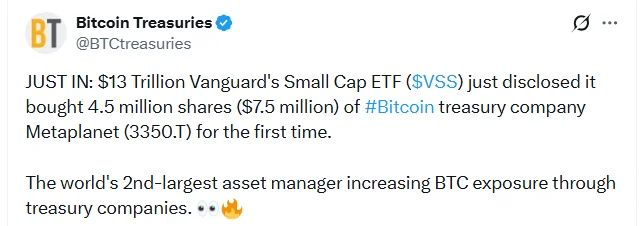
Vanguard’s VSS small-cap ETF reported buying 4.5 million Metaplanet shares, adding indirect Bitcoin exposure through the Japan-listed company.


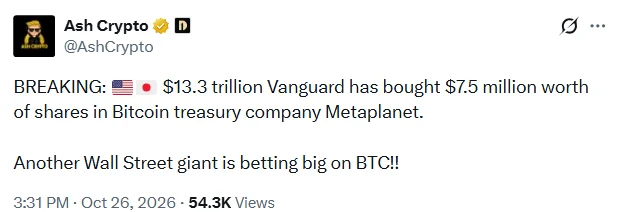
Vanguard’s latest reported holding offers a clear example of how a traditional fund can gain Bitcoin-related exposure through a public company. Its VSS small-cap ETF disclosed a first purchase of 4.5 million Metaplanet shares, valued at $7.5 million, according to a statement announced today. VSS invests in small-cap companies outside the United States, so the position brings the Japan-listed Bitcoin treasury company into the fund’s portfolio. The disclosure describes a stock holding; it doesn’t say that VSS bought Bitcoin itself.
Shares create indirect Bitcoin exposure
Metaplanet Inc. is Japan’s first publicly listed Bitcoin treasury company, according to the source. It holds Bitcoin as its primary treasury reserve asset and trades under the ticker MTPLF. The company has also used debt and equity financing as part of its treasury strategy. That mix means its business is tied to more than the price of Bitcoin: financing decisions and the company’s own performance can also affect its shares.
VSS now holds Metaplanet shares, giving investors in the ETF indirect exposure to a company associated with Bitcoin accumulation. The fund’s reported purchase is a stake in the company, rather than a direct Bitcoin holding. That difference matters because owning shares carries company-specific risks and doesn’t replicate the returns of holding Bitcoin. An investor’s result depends on the value of the shares, which can reflect the company’s treasury choices as well as market sentiment toward Bitcoin.
Vanguard manages about $13 trillion in assets, making the disclosure notable for the scale of the asset manager. Still, the $7.5 million position is a specific holding in one ETF; the source provides no indication that it represents a broader change in Vanguard’s approach to digital assets. The headline figure attached to the manager can make a small position seem larger in meaning than the available evidence supports. This is more significant as a concrete example of indirect exposure than as proof of a strategic shift.
What the holding does—and doesn’t—tell investors
The reported purchase is a holding inside VSS, a fund focused on small-cap companies outside the United States. That context helps explain why Metaplanet appears in the portfolio: the company is listed in Japan and sits within the type of market segment the ETF invests in. The disclosure doesn’t establish why the fund selected the shares, how the position fits its overall portfolio, or whether it intends to add to it.
For fund investors, the practical distinction is straightforward. They own shares in an ETF that owns Metaplanet stock; they don’t thereby own Bitcoin through VSS. The company’s connection to Bitcoin may be central to its identity, but its stock can move for reasons that differ from Bitcoin’s price. Similar corporate treasury strategies can make a company’s financing and asset management choices especially relevant to shareholders. (And this is the part most people overlook.) Exposure through a company adds another layer between the investor and the underlying asset.
If you're working in this space, the useful question isn’t simply whether a major asset manager owns a Bitcoin-related company. It’s what the fund actually holds, how large the holding is, and what the company does with its balance sheet. Here, the reported facts answer the first two questions: VSS bought Metaplanet shares, and the position was valued at $7.5 million. The source doesn’t provide enough detail to draw conclusions about the fund’s motivation or future transactions.
A measured signal from a traditional fund
The purchase highlights one route for conventional investment funds to hold exposure to Bitcoin-related businesses: owning shares in a public company that uses Bitcoin as a treasury reserve. That distinction matters, since Metaplanet’s operating and financing choices shape the exposure alongside Bitcoin’s price. The company’s shares are therefore not a simple stand-in for the cryptocurrency. They represent a claim on a business whose treasury approach is closely associated with Bitcoin.
The disclosure doesn’t establish a wider institutional shift on its own. It does show that Metaplanet’s treasury model has entered the holdings of Vanguard’s international small-cap ETF, making the company’s future performance and Bitcoin strategy relevant to VSS investors. That’s a limited but tangible signal. The position creates a connection between the fund and a Bitcoin-focused corporate strategy, while leaving the scale and significance of that connection bounded by the reported holding.
Why the distinction matters
The broader implication is about the routes investors can encounter Bitcoin exposure in conventional portfolios. A fund may hold companies whose assets or business plans are tied to Bitcoin, even when the fund itself holds no cryptocurrency. That can bring Bitcoin-related risk into a portfolio through an equity allocation, but it also means company-level decisions matter. Investors assessing such a position need to distinguish the asset held by the fund from the asset held by the company.
And yet, one disclosure can’t tell us whether this is a lasting allocation, a routine portfolio holding, or the beginning of a larger position. The source offers no broader statement from Vanguard about digital assets, and it gives no indication of a change to VSS’s mandate. For now, the clearest reading is narrow: VSS has reported owning Metaplanet shares, and the company’s Bitcoin treasury strategy makes that holding relevant to investors tracking institutional links to the sector.
A small position in a large fund. That’s the balance readers should keep in view. The purchase brings Metaplanet into VSS’s portfolio, but the available facts don’t support treating it as a verdict on Bitcoin, a direct bet by Vanguard on the cryptocurrency, or evidence of a broad policy change. What this means for you depends on whether you’re evaluating the ETF, the company, or Bitcoin itself; those are related questions, but they aren’t the same one.


Discussion
Sign in to join the discussion.