ICE and Trade.xyz plan to bring Hyperliquid perpetual futures to U.S. customers, while HYPE climbs more than 20% and an analyst sees room to reach $120.


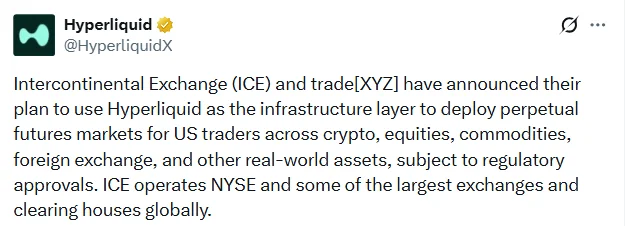
Intercontinental Exchange’s plan to bring Hyperliquid-based perpetual futures to U.S. customers has put HYPE in focus, with the token gaining more than 20% today. The announcement points to a regulated route for on-chain perpetual trading, though the service is still subject to regulatory approval. That qualification matters: the proposal describes a market the companies are preparing, not a service customers can already use. HYPE’s price reaction reflects expectations around the plan, but it doesn’t establish that those expectations will be met.
A proposed U.S. market built on Hyperliquid
ICE, the parent company of the New York Stock Exchange, says it is preparing the offering with Trade.xyz, a platform built on Hyperliquid. The plan is to establish round-the-clock perpetual futures trading for U.S. customers within a regulated market and clearing structure. Perpetual futures let traders take positions tied to an asset’s price without a fixed contract expiry, making continuous trading a central part of the product. Here, the stated aim is to connect that format with a U.S. market structure that includes clearing, though the details of the eventual service aren’t yet established.
The companies have distinct roles. Hyperliquid would supply the underlying infrastructure, while Trade.xyz would build and operate the regulated market and clearing framework. ICE would act as a specialized administrator for those markets and make a strategic investment in Trade.xyz. That division suggests the project depends on more than blockchain technology: the trading venue, its operating rules, and the clearing arrangement must all work together. (And this is the part most people overlook.) A familiar name at the parent-company level doesn’t, by itself, tell customers how the service will function or what protections its eventual structure will provide.
Trade.xyz’s perpetual markets already operate on Hyperliquid. The proposed U.S. service would place them within a regulated framework, with customers expected to access the contracts through Hyperliquid’s HIP-3 framework if approvals are secured. That makes the announcement an effort to extend an existing on-chain market into a new customer and operating context, rather than a claim that the underlying trading concept is new. The practical change would be where and how eligible U.S. customers can access the contracts. For anyone following the project, the key unknown is how the eventual service will connect its on-chain components with its market and clearing arrangements.
HYPE price expectations rise with the announcement
Crypto analyst Michael van de Poppe said HYPE could reach $110 to $120 soon, pointing to preparations for U.S. access to Hyperliquid-based perpetual futures. The token is trading at $96.30 after its gain, below its all-time high of $97.96 set last month. His target is a forecast, not a stated company objective or a confirmed outcome of the proposed service. The move past 20% gives the announcement immediate market visibility, but it also means expectations are already part of the story.
Van de Poppe sees a potential bullish setup, with a successful launch possibly drawing more users to Hyperliquid and supporting a move toward his price target. The near-term catalyst is clear; the next test is whether the planned market wins approval and turns into a live service. Even then, greater access wouldn’t guarantee sustained user growth or a higher token price. Those outcomes would depend on whether customers find the product useful and whether the market can operate as intended. The numbers here are underwhelming as evidence of what comes next: a sharp daily gain and a price forecast describe sentiment, not adoption.
What the proposal could mean for on-chain trading
The broader significance lies in the attempt to pair on-chain perpetual contracts with a regulated U.S. market and clearing structure. Similar efforts in financial markets typically turn on operational details as much as on the underlying trading technology: customers need a functioning venue, clear responsibilities, and a way to settle trades. The announcement names participants and assigns broad roles, but it doesn’t yet answer every question about the customer experience. Those answers will matter more than the headline association with a major exchange operator.
If you’re working in this space, watch for the distinction between a proposed route to market and an available product. Approval remains a condition, and the service’s structure could shape who can participate and how they interact with the contracts. Here’s the thing: the proposal could be meaningful if it creates a usable bridge between Hyperliquid’s existing markets and U.S. customers. That’s still conditional. Until the companies can describe an approved, operating service, the announcement is best read as a potential expansion of access rather than proof that adoption has arrived.
For HYPE, the immediate effect is a burst of attention and a price move that has brought the token close to its recent high. The more durable measure will be whether the planned market progresses from preparation to launch and attracts ongoing use. And yet, even a successful launch would leave open the question of how much of that activity translates into lasting demand for the token. The announcement gives traders a story to price today; the operating results, if the plan proceeds, will provide a harder test.



Discussion
Sign in to join the discussion.