VIA Labs’ messaging system connects Stellar and Ethereum smart contracts, opening new paths for cross-chain apps as tokenized assets gain traction.

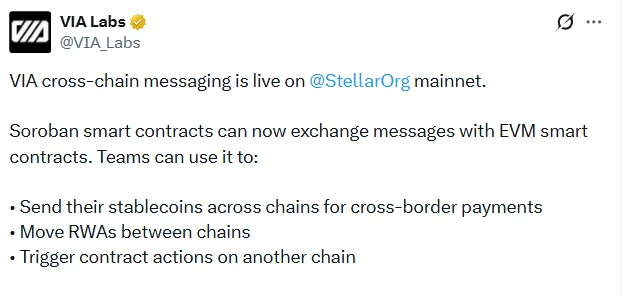
Stellar’s new connection to Ethereum gives Soroban smart contracts a way to exchange messages in both directions. VIA Labs’ cross-chain messaging system is now live on Stellar’s mainnet, linking the network with Ethereum’s mainnet, according to an announcement released today. That establishes a technical route between the two networks, but it doesn’t, by itself, show how much traffic or which applications will use it. The distinction matters: a live connection is a starting point for developers, while its usefulness depends on what they build and whether people choose to use it.
What the Ethereum connection enables
With the bridge in place, smart contracts on Stellar and Ethereum can pass messages and coordinate applications through VIA Labs. Developers can move supported assets and applications between the networks, and build services that coordinate contract activity across chains, including those involving stablecoins and tokenized real-world assets. In practice, message passing can let a contract on one network receive information or trigger an action related to activity on another, subject to the bridge’s supported functions and the rules of each application. That gives developers a way to connect operations that would otherwise be confined to separate blockchain environments.
That two-way access could also make it easier for Stellar users to interact with Ethereum-based services. The practical value will depend on which applications and assets developers support, but the connection gives them another route to work across ecosystems. A bridge doesn’t make the underlying networks interchangeable: each has its own contracts, users and operating conditions. Applications still need to account for how messages are handled, what assets are supported and what happens if an action on one side doesn’t produce the expected result on the other. For users, those details can determine whether a cross-network feature feels useful or simply adds another step.
Here’s the thing: interoperability is often described as a benefit in itself, but a link between networks is only valuable when it solves a real problem for an application. Developers may use cross-chain messaging to coordinate a service, make an asset available in another ecosystem or connect workflows that span multiple networks. Each use case brings its own design choices. The connection creates options; it doesn’t guarantee adoption.
Timing meets rising RWA activity
The launch comes as tokenized real-world assets attract more activity on Stellar. Securitize, described as the largest tokenization platform, has integrated the network to issue and manage tokenized financial assets. Pontoro and ArchaxEX are among the other asset managers that have recently moved tokenized funds to Stellar. These examples give the new connection a relevant potential use: asset managers and application developers may want systems that can coordinate activity across networks as tokenized products take shape. The announcement doesn’t say that any of these firms will use VIA Labs’ system, so that link remains a possible application rather than a confirmed deployment.
For this market, interoperability is more than a convenience: tokenized bonds, property and commodities need dependable links between networks and the systems that represent those assets. Stellar’s Ethereum bridge adds a messaging route that developers can use to coordinate cross-chain contracts. Its significance will become clearer as more tokenized products and applications use the connection. The underlying challenge is operational as much as technical: an application must make clear which network holds an asset, how instructions are communicated and what users can expect when actions cross network boundaries. A message path can help with coordination, but the quality of the overall service depends on the systems and processes built around it.
What developers and users should watch
If you’re working in this space, the useful questions are concrete: which contracts can communicate, which assets are supported, and how applications handle delays or failed actions? Those answers will reveal more about the bridge’s practical reach than the announcement of a mainnet launch alone. The source describes two-way messaging and support for moving assets and applications, but it doesn’t provide a list of integrations, transaction activity or performance details. That leaves the scale of current use unclear.
And this is the part most people overlook: adding a route can increase the number of possible interactions while also adding another dependency for developers to manage. Cross-chain applications need users to understand where actions take place and what the connection is doing on their behalf. Poorly explained flows can make even a technically functional service hard to trust. Better documentation and clear application design will matter alongside the bridge itself.
This is more significant than it looks if Stellar’s tokenized asset activity continues to draw developers who need to coordinate with Ethereum. A messaging link could widen the set of services they can connect to, especially where an application spans both networks. But the current announcement establishes capability, not demonstrated demand. The next evidence to watch is whether developers build on the connection and whether those applications attract sustained use.
For now, the launch gives Stellar developers another tool for cross-network work and gives Ethereum-based services a potential path to coordinate with Soroban contracts. A useful new option. Its longer-term importance will rest on the applications, supported assets and user experience that follow.


Discussion
Sign in to join the discussion.