Coca-Cola has outpaced the S&P 500 and Pepsi in 2026, lifting Berkshire’s stake by more than $10 billion and generating substantial dividends.

Coca-Cola’s 2026 run stands out
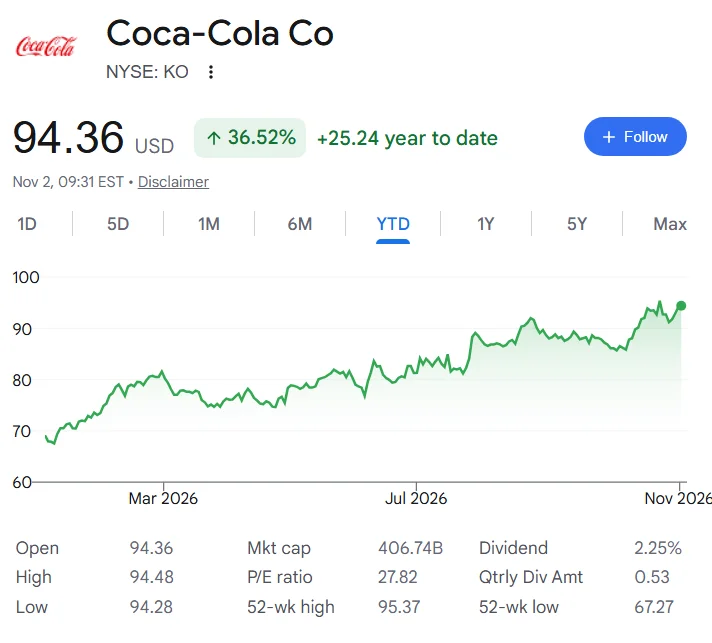
Coca-Cola’s 36.52% rise in 2026 has put the beverage maker well ahead of the broader market and its best-known rival. For Berkshire Hathaway, which held 400 million shares at the start of the year, that performance translates to a gain of more than $10 billion on paper. That’s a striking result for a company often associated with steady demand and familiar products rather than sudden stock moves. The gain remains unrealized unless Berkshire sells shares, so it describes the position’s market value, not cash collected from a sale.
KO climbed from $69.12 at the start of 2026 to $94.36 by Monday, November 2. The S&P 500 advanced 11.06% over the same period, while Pepsi (NASDAQ: PEP) fell 3.03%. A $1,000 investment in Coca-Cola on January 2 would be worth $1,365.20 at the cited price. The comparison is useful because it puts the stock’s rise against both a broad market benchmark and a close competitor. Still, a single stretch of performance doesn’t establish that the difference will persist.
Berkshire’s long-running Coca-Cola position
Warren Buffett began buying Coca-Cola in 1988. Since then, the shares have gained approximately 3,500%, according to the source figures. Berkshire’s fourth-quarter 2025 13-F filing showed 400 million KO shares, valued at about $27.96 billion at the start of 2026. At the November 2 price, an investor who put $1,000 into the stock in mid-1988 would have roughly $36,000.
That long holding period changes how this year’s rally should be read. A one-year return can look dramatic on its own, but Berkshire’s Coca-Cola position rests on a relationship with the company that spans decades. The 2026 rise adds to the value of an established holding; it doesn’t explain why Berkshire bought the shares in the first place, or whether the same rationale applies to someone buying at today’s price. Those are separate questions.
The filing also gives a snapshot, not a live account of Berkshire’s holdings. The 400 million share figure is tied to the reported period, and the year-end dividend estimate depends on the stake remaining unchanged. That distinction matters when translating a reported holding into current portfolio value or expected income. A large gain on paper can attract attention, but it doesn’t show whether the owner has changed its position since the filing.
Dividends add to the return
Coca-Cola has paid $1.59 per share so far in 2026, through three quarterly distributions of $0.53 on April 1, July 1 and October 1. The company is scheduled to pay another $0.53 on December 15. These payouts add a separate stream of return alongside changes in the share price. For shareholders who keep the stock, that distinction is practical: the market value can move from day to day, while declared cash distributions arrive on a schedule.
On Berkshire’s 400 million shares, those payments amount to $636 million so far this year and would total $848 million by year-end if the upcoming filing shows no change in the stake. An investor who bought 100 shares for $6,912 at the start of 2026 would have received $159 by November 2 and could collect $212 over the full year. The calculation makes the income visible at both institutional and individual scale. It also depends on the share count and the stated payment schedule; the estimate for the full year includes a payment that hadn’t yet been made by November 2.
Here’s the thing: the dividend figures can make the return look more complete, but they shouldn’t be confused with the stock’s price gain. The $159 received by the 100-share investor is cash paid out; the rise from the starting price to $94.36 is an increase in market value. If you’re working out your own return, you’d want to account for both, while also checking whether your purchase date and share count match the example.
What the outperformance means
The combination of a sharp price gain and steady quarterly payouts has made Coca-Cola a standout in Berkshire’s portfolio this year. Its relative performance will be the key measure to watch as the year closes. This is more significant than it looks: the comparison with Pepsi and the S&P 500 shows that the result wasn’t merely a reflection of a rising market, at least over the period cited. But the article’s figures describe a particular stretch of trading, not a forecast.
And yet, the return alone doesn’t tell readers what drove the move. The figures provided establish how far KO rose and how it compared with two reference points; they don’t identify the reasons behind that performance. That limits what can be concluded about whether the rally reflects lasting business strength, changing investor expectations, or other market forces. The numbers here are impressive, but the explanation isn’t supplied.
For Berkshire, the position’s scale makes even a modest change in share price consequential to its reported value, while the dividend calculation shows the income generated by holding a large number of shares. For an individual investor, the same arithmetic applies at a smaller scale, though the outcome depends on the price paid and how long the shares are held. A standout year can sharpen interest in a familiar company. It can’t settle the question of what its shares are worth from here.
One more point: the year-end dividend total is conditional, and the closing performance remains unknown in the figures presented. A final assessment will need to account for the rest of the year’s share-price movement and whether Berkshire’s reported stake changes. Until then, the clearest conclusion is narrower: Coca-Cola has outpaced the market and Pepsi over the stated period, while its existing Berkshire position has benefited from both price appreciation and quarterly payments.
For now, a strong year. With limits.
Featured image via Shutterstock


Discussion
Sign in to join the discussion.