The TRON CEO says he shifted most of his ETH into US crypto stocks, while keeping his Bitcoin holdings unchanged.
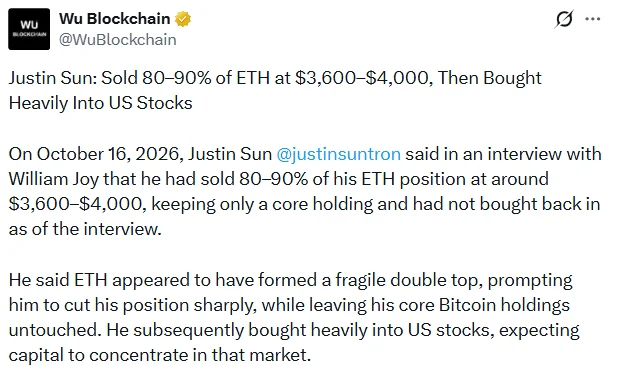
Justin Sun has sharply reduced his Ether exposure, saying Ethereum’s fragile double top and stronger prospects for US crypto stocks drove the move. In an interview with Wu Blockchain, the TRON CEO said he sold 80% to 90% of his personal ETH holdings and redirected the funds toward US-listed crypto-related stocks. He said his Bitcoin position remains unchanged, making this a targeted change to his portfolio rather than a broad retreat from crypto assets. That distinction matters: Sun is describing a shift in where he sees opportunity, not a loss of interest in the sector as a whole.
A chart pattern behind the exit
Sun described Ethereum’s chart as a “fragile double top,” a pattern he associates with sustained downward pressure. In technical analysis, a double top is generally read as a warning that a market has struggled to move above a prior high and could weaken; it’s a way of interpreting price behavior, not proof of what prices will do next. Sun also characterized ETH’s performance as sluggish and said the setup had made it harder to generate returns. His decision reflects his reading of the market, rather than a claim that every investor should reach the same conclusion.
Here’s the thing: a chart pattern can help explain why a trader changes positions, but it doesn’t establish that the next move is inevitable. Sun’s description offers a window into his reasoning, while leaving unanswered how much weight he gave to the pattern compared with other considerations. The word “fragile” signals that his concern is about the setup’s vulnerability, not a certainty that Ethereum will fall. For readers, the useful fact is the scale of the sale and the stated rationale; the chart label is his interpretation.
Sun’s view is that capital may have better prospects elsewhere for now. He considers US crypto stocks undervalued and believes they have strong market potential, though the interview details provided here don’t set out how he measures that value or which stocks he bought. Reallocating some Ether into company shares also changes the kind of exposure he holds: an equity can reflect a business and its market performance, while ETH is a crypto asset with its own price dynamics. A different wrapper, with different risks and drivers.
US-listed crypto stocks in focus
Sun has also discussed an investment in World Liberty Financial (WLFI), a US-based crypto-related stock, in a separate Wu Blockchain interview. He said he would invest in WLFI again if given another opportunity. That comment adds context to his preference for US crypto-related assets, but it’s a statement about one prior investment and his own view of it. It doesn’t tell readers what he has bought as part of the latest Ether sale.

Sun bought $30 million in WLFI tokens in November 2024, becoming the largest investor in the DeFi platform. The source describes WLFI in connection with crypto-related US assets, and identifies the purchase specifically as tokens; those details shouldn’t be collapsed into a claim that the latest funds went to WLFI. His earlier investment does show that this interest predates the Ether reduction described in the interview. And it gives his current preference a personal track record, though one investment alone can’t establish how the broader category will perform.
What the portfolio shift signals
The move is more significant than it looks because it combines a large reduction in one major crypto holding with continued exposure to Bitcoin and a stated preference for US-listed crypto-related stocks. Sun isn’t describing a simple exit from digital assets; he’s making a relative judgment about where he expects better prospects. That approach is common among investors who adjust allocations as their market views change, but the outcome depends on the assets selected and the timing of the shift. The interview gives no basis for judging either of those decisions in full.
If you’re working in this space, the distinction between a prominent investor’s disclosed view and a general market signal is worth keeping clear. Sun’s position may draw attention because of his role as TRON’s CEO, yet the account presented here is still his personal portfolio decision. It doesn’t establish that institutional or retail investors share his assessment, and it offers no detailed case for why US crypto stocks are undervalued. That said, his choice highlights a question facing investors across the category: whether exposure through companies can offer a more attractive balance than holding crypto assets directly.
The figures are striking, but the available details leave important parts of the trade open. Sun hasn’t identified the US-listed stocks receiving the proceeds, explained whether he plans to keep the reduced ETH position at its current level, or described the factors that would change his view. Those gaps limit what can be inferred about the strategy beyond its broad direction. A preference today, not a complete map of what comes next.
His Bitcoin position, by contrast, remains unchanged, which suggests his caution is specific to Ethereum’s current setup rather than a uniform view of the largest crypto assets. Even so, holding Bitcoin steady doesn’t reveal why he treats it differently, and the interview account provides no further explanation. The near-term picture is selective: less personal ETH, continued Bitcoin exposure, and greater stated conviction in US crypto-related equities. Whether that mix proves more effective will depend on how those markets develop, something Sun’s comments can’t settle in advance.


Discussion
Sign in to join the discussion.