Bitcoin’s Coinbase Premium has returned to its November 2022 low as BTC falls below $77,000, though CryptoQuant’s Ki Young Ju sees room for a contrarian turn.
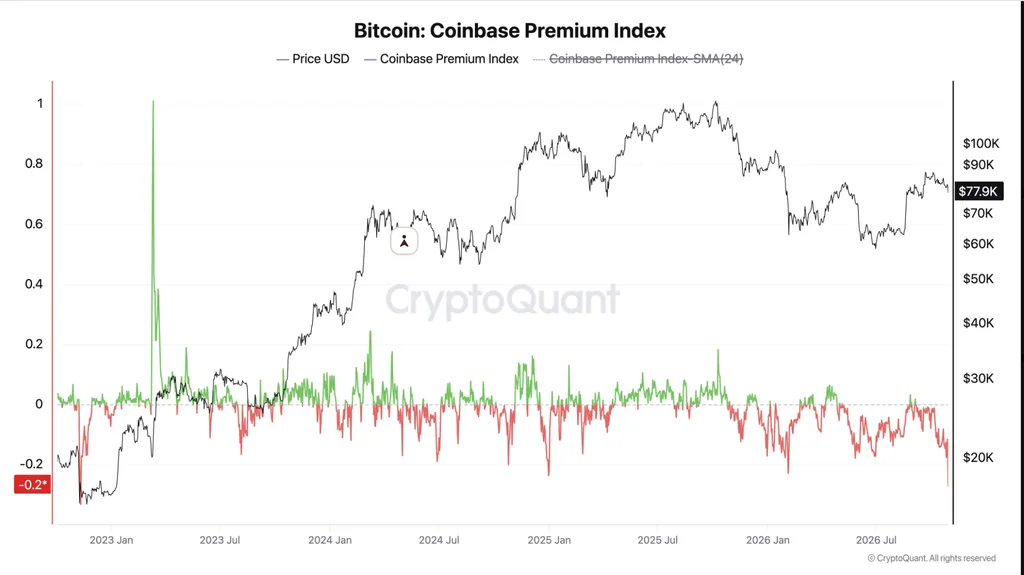
Bitcoin is facing a clear demand warning in the U.S. market: its Coinbase Premium has sunk to a four-year low. The reading matches levels last seen in November 2022, when BTC was nearing its post-FTX market bottom. That comparison is attention-grabbing, but it isn't a timing signal. CryptoQuant CEO Ki Young Ju sees a possible contrarian opportunity in the gloom, even as reports of a Binance security incident add another source of pressure to an already unsettled market.
What the Coinbase Premium says about demand
The Coinbase Premium compares Bitcoin’s dollar price on Coinbase with its USDT price on Binance. CryptoQuant’s index expresses that difference as a share of Bitcoin’s price, making it easier to compare the gap as the asset’s price changes. Its latest chart reading is about -0.2%, or roughly $156 at a displayed BTC price of $77,900. That’s a modest difference in percentage terms, but the direction and persistence of a premium can offer a clue about which market is seeing stronger demand.
A negative premium means Bitcoin is cheaper on Coinbase than on Binance. Since Coinbase is often used as a gauge of U.S. investor activity, including institutional and dollar-based trading, the gap can point to weak buying or heavier selling on that platform. It’s a useful sign of relative demand, though it can’t establish exactly what investors are doing, who they are, or why they’re trading. A price spread is one piece of evidence, not a direct readout of investor intent.
That distinction matters. Similar market indicators can shift because of trading flows, differences between the venues, or changing appetite for the currencies used to quote Bitcoin. A negative reading can support the view that U.S. demand is subdued, but it doesn't tell us whether buyers have stepped away for good or are simply waiting. The chart gives a reason to pay attention, not a verdict on what comes next.
The historical comparison is striking: after FTX collapsed in November 2022, Bitcoin eventually bottomed around $15,500 to $16,000. That parallel doesn’t establish that BTC has reached another bottom. The broader backdrop and the cause of selling can differ from one downturn to another, even when an indicator returns to a familiar level. Ju’s read is that bearish sentiment has become extreme enough to create a potential opportunity. This is more significant than it looks as a measure of mood, but it’s easy to overread it as a forecast.
“Market sentiment is bearish enough to be bullish, imo,” Ju wrote on X, sharing a chart of the premium. The argument is a familiar contrarian one: when pessimism is widespread, the market may have fewer sellers left to push prices down. That can be a useful way to frame risk, but it doesn't show that demand has returned. For now, the premium itself points to weakness on Coinbase.
Bitcoin slips below $77,000 amid Binance concerns
BTC fell more than 5% to below $77,000 as reports of a Binance security incident rattled crypto markets. The linked coverage describes the event as $6.3 billion, while the article also characterizes the reported breach as a historic $6.4 billion theft. Those figures are presented as reports, and the scale makes clarity especially important: market participants need to know what assets were affected, what losses are confirmed, and what remains uncertain. The negative Coinbase Premium adds to the concern by showing little support from U.S. trading activity.
Binance has pledged to cover losses tied to the incident with its own funds. The exchange reportedly set aside more than $6.34 billion, including $5 billion in the affected token assets. A public commitment to cover losses may help contain immediate fears, but investors will still look for evidence that the response is being carried out and for a clearer account of the incident’s scope. In a fast-moving selloff, reassurance and verified information don’t always arrive at the same time.
Bitcoin was trading at $76,739 at press time, according to CoinGecko. The Crypto Fear and Greed Index had fallen to 30, placing sentiment in the “Fear” zone and marking its lowest reading since Aug. 14. The index and the Coinbase Premium tell related but different stories: one captures a broad measure of market sentiment, while the other compares Bitcoin prices on two exchanges. Together, they describe a market under pressure. Neither one, on its own, explains how long that pressure will last.
Here’s the thing: fear can precede a rebound, but it can also persist while prices continue to fall. A low sentiment reading doesn’t make a recovery automatic, and a single exchange premium can’t settle the question. (And this is the part most people overlook.) Market confidence depends not only on whether an exchange says it will cover losses, but also on whether traders can see what happened and judge the response for themselves. The details may matter more than the initial promise.
What could shape the next move
Confidence could improve if positive developments emerge in the coming days. For now, the market’s near-term direction may depend on Binance withdrawals resuming and investors getting clearer information about the incident’s wider effects. Those are practical markers to watch because they relate to whether users can move assets and whether the reported losses have been contained. If you're working in this space, the premium is a useful signal to track alongside those developments, but it shouldn't carry the whole analysis.
And yet, the figures on their own leave key questions open. A return of withdrawals could ease one concern without restoring demand on Coinbase; a negative premium could persist even if the Binance situation stabilizes. Bitcoin’s price, exchange activity, and confidence in the incident response will need to be read together. For now, the data show weak U.S.-linked demand, pronounced fear, and a sharp price decline. What comes next depends on whether those conditions begin to change.



Discussion
Sign in to join the discussion.