Binance XRP reserves fell 8.18% in two days, but whether shrinking exchange balances can support a rally depends on renewed buying demand.
XRP’s shrinking exchange balances are drawing attention as the token trades near $1.25, but the data alone doesn’t establish that a rally is close. The more consequential question is whether buyers return while fewer tokens remain readily available for trading. That distinction matters because exchange reserves describe where tokens are held, not what their owners intend to do next. A lower balance may change the conditions for trading, but it can’t tell us whether demand is about to rise.
Binance balances fall to their lowest since 2022
CryptoQuant analyst Amr Taha reported that Binance held 2.47 billion XRP on October 30, its lowest reserve level since December 2022. The exchange’s balance had been 2.69 billion on October 28, a two-day drop of 220 million tokens, or about 8.18%. The speed of that change is attention-grabbing, but the figure needs careful reading: it measures XRP held at one exchange at two points in time. By itself, it doesn’t identify who moved the tokens, where they went, or whether the move reflects a lasting shift in trading behavior.
The decline wasn’t limited to Binance. Bybit’s XRP holdings fell by 20 million, from 306 million to 286 million, while Bithumb’s reserves slipped by 10 million, from 1.847 billion to 1.837 billion. Taha’s data points to lower balances across several major exchanges amid broader market volatility and selling pressure. That spread makes the movement more notable than a change at a single venue, though it still doesn’t establish a common reason for the withdrawals. Exchange balance data is a useful piece of market context, not a record of investor intent.
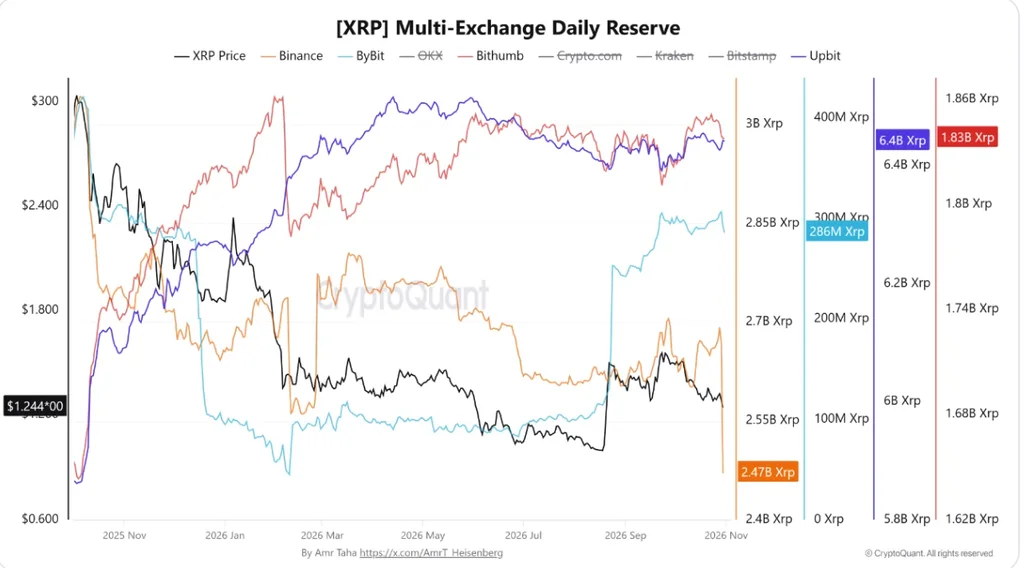
Here’s the thing: a reserve decline can sound more conclusive than it is. Tokens leaving an exchange may become less immediately available for trading there, but they may also move to private wallets or another platform. Those possibilities have different implications for potential selling, and the reported balances don’t distinguish between them. The numbers here are notable, but they don’t tell a complete story.
Outflows need demand to matter for price
Lower exchange reserves can mean fewer tokens are immediately available for sale, which could support prices if buying strengthens. But an outflow doesn’t prove investors are accumulating XRP; tokens may simply be moving to private wallets or other platforms. Nor does a smaller exchange balance show that the remaining sellers have withdrawn their offers. It’s a measure of holdings, not a direct count of tokens for sale at any given price.
That leaves demand as the key variable. If buyers return while exchange balances remain lower, tighter tradable supply could help a recovery. Until that happens, the reserve decline is a signal to watch, not confirmation of a supply squeeze or price rally. For price analysis, the combination matters: reduced readily available supply has a different meaning when buyers are active than when trading demand is weak.
What the reserve data can—and can’t—show
Exchange reserves are often used as a rough indicator of how much of an asset sits on trading platforms. That makes them useful for tracking changes in potential market availability over time. Similar measures can help analysts spot a shift worth investigating, especially when balances move across more than one exchange. But they don’t reveal the identity or plans of the holders behind those balances, and they don’t capture every route through which tokens can reach the market.
There’s also a difference between a lower balance and a supply shortage. A shortage would require more than evidence that tokens have left exchanges; it would depend on whether buyers are competing for the supply that remains available. If you're working in this space, that means treating reserve figures as one input alongside price action and evidence of demand, rather than as a standalone forecast. The data can frame a question. It can’t answer it on its own.
And this is the part most people overlook: the same outflow can be read in more than one way. It may reflect holders choosing to keep assets away from an exchange, or a transfer between venues, without signaling a new view on XRP’s value. The reserve figures make the movement visible; they don’t explain the motive. That uncertainty is especially relevant when the market is already volatile, as the source describes.
Why the next signal matters
The reported low on Binance gives traders a concrete point of comparison with December 2022, while the reductions at Bybit and Bithumb suggest the change extends beyond one exchange. That’s meaningful context. Still, a historical low in exchange reserves isn’t a price target, and the figures provided don’t show whether buyers have stepped in to absorb available supply.
What this means for you is straightforward: watch whether the lower balances coincide with stronger buying, rather than assuming one will produce the other. If demand improves while fewer tokens are held on exchanges, the supply picture could become more supportive. If demand doesn’t return, the outflows may remain an interesting data point without delivering a rally. A signal, not a verdict.

Discussion
Sign in to join the discussion.