Ripple says RLUSD targets other stablecoins, while a tight Bollinger Band squeeze has traders watching XRP for a possible breakout.
Ripple CEO Bradley Garlinghouse sees RLUSD as a way to bring more activity to the XRP Ledger, not as a substitute for XRP. The distinction matters: stablecoin growth could broaden XRPL’s use, but the effect on XRP’s price depends on whether that activity creates direct demand for the token.
At the same time, trader Ali Charts has flagged a technical setup on XRP’s four-hour chart that resembles one preceding a 71% rally. The two developments point to different questions for the market: how Ripple intends to grow the ledger, and whether XRP can turn a chart signal into sustained momentum.
Those questions shouldn’t be collapsed into one bullish narrative. RLUSD concerns the ledger’s potential role in payments and other activity; the chart setup concerns short-term trading behavior. A larger ecosystem might help establish a reason to use XRPL, while price still depends on whether that use involves XRP and whether buyers act on the technical signal.
RLUSD’s role in the XRPL ecosystem
Garlinghouse says RLUSD is competing with other stablecoins, with Ripple aiming to have its use cases run on XRPL. “RLUSD isn’t competing with XRP. It’s competing with other stablecoins. Use case matters, and I want those use cases running on the XRPL,” he wrote on X.
That framing separates the job of a stablecoin from the job XRP might perform in the same network. Stablecoins are designed to represent a relatively steady value, which can make them useful for transfers and settlement where users want to avoid exposure to a fluctuating asset. XRP, by contrast, has its own market price. Whether both assets can find complementary roles depends on how the ledger’s applications are built and used.
His comments answered XRP community researcher WrathofKahneman, who argued that a growing stablecoin could increase liquidity across the ledger. More liquidity, the researcher suggested, could make XRP easier to use over time. But that benefit may not quickly feed through to the token’s price: “The problem is that w/out direct use, price impact is 2nd order,” WrathofKahneman wrote.
That distinction is central to the market debate. Activity on a network can make its services more useful without requiring every participant to hold or transact in its associated token. In similar systems, the connection between broader usage and token demand depends on the mechanics of transactions, liquidity needs, and the choices users make. The existence of a stablecoin on XRPL, by itself, doesn’t settle those questions.
The researcher also raised an open question about XRP’s place in the ecosystem: “Will XRP become a specialized institutional asset with gated liquidity, or be ubiquitous?” Garlinghouse’s remarks support a broader role for XRPL applications, though they don’t resolve how much direct XRP use those applications will require.
That uncertainty gives the stablecoin story two possible readings. If RLUSD draws users and activity to XRPL, it could strengthen the case for the ledger as a place to build and transact. If those users can complete their activity without needing XRP, the benefit to the network may be clearer than the benefit to the token. This is more significant than it looks: investors often treat ecosystem growth and token demand as if they move together, when the link has to be demonstrated.
The price context underscores that gap between ecosystem activity and token performance. XRP is cited at about $1.28, below its previous all-time high of $3.65. Ripple’s institutional expansion may support XRPL adoption, but the market still needs evidence that adoption translates into stronger demand for XRP.
The figures describe a wide distance between the cited price and the previous peak, but they don’t explain what would close it. Network growth, institutional interest, and token buying are related possibilities, not interchangeable measures. For readers tracking the story, the useful evidence will be whether new activity requires XRP in practice, rather than simply taking place on the same ledger.
A compressed chart setup puts traders on alert
Ali Charts says XRP’s four-hour Bollinger Bands recently reached their tightest squeeze since August, then broke above the upper band. The analyst points to a similar compression earlier this year that preceded a rally of nearly 71% in three days.
Bollinger Bands track price movement around a moving average, with the bands widening and narrowing as volatility changes. A squeeze signals that price has been trading in a relatively compressed range; it can draw traders’ attention because a larger move may follow. The direction and durability of that move aren’t guaranteed by the squeeze itself. A break above the upper band is a signal to watch, not a verdict on what comes next.
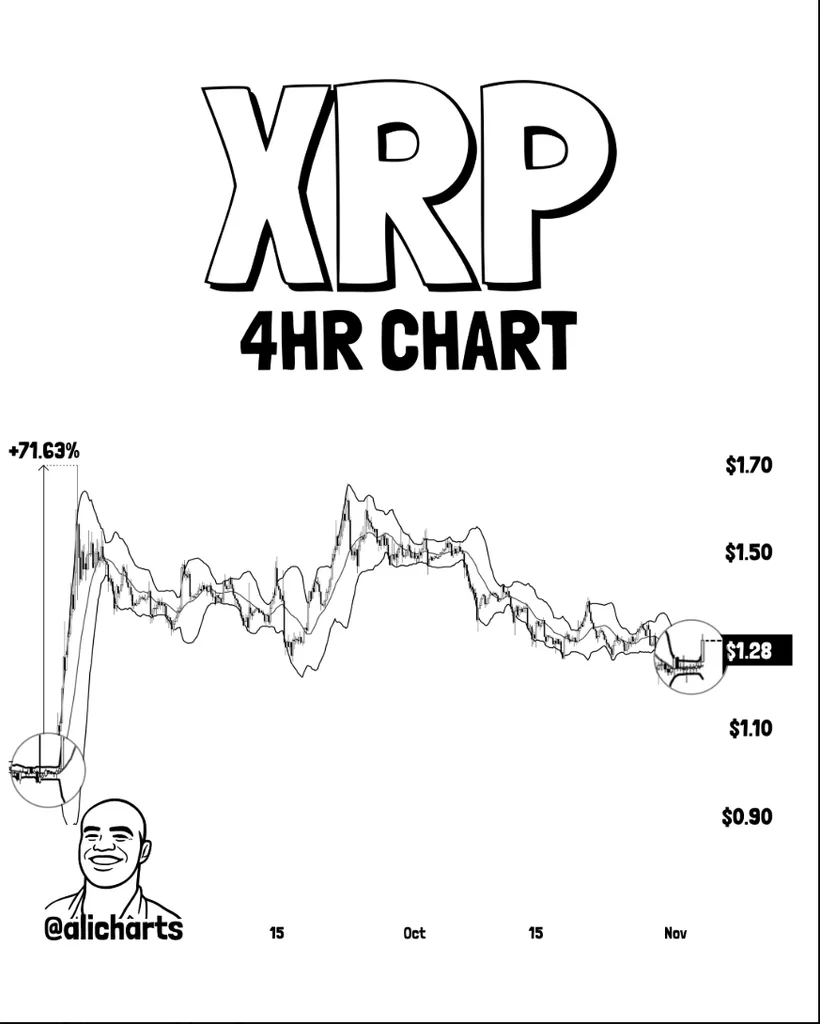
Ali Charts sees the possibility of another sharp move. At the cited price of roughly $1.16, a repeat of that earlier gain would put XRP near $2.19. That would be a substantial rebound, but the prior move doesn’t establish that the same pattern will produce the same result now.
That said, comparisons with a past rally can shape expectations before the market confirms them. The earlier move shows that XRP has made a large advance after a similar period of compression; it doesn’t show that current conditions have the same causes or that buyers will respond in the same way. Technical patterns can help traders frame a scenario, but they’re weaker as evidence when treated as a promise.
For traders, the immediate test is whether XRP can hold above the upper band and attract enough buying to sustain a breakout. A retreat would weaken the signal. The chart may draw attention, but confirmation will depend on what price does next.
Here's the thing: the price cited in this technical discussion is roughly $1.16, while the earlier market context cites about $1.28. Those figures may reflect different points in time or sources, and the article doesn’t establish a single live price. The chart’s relevance rests on its described pattern; readers should be careful about treating either snapshot as a current quote.
What the signals mean for XRP’s next move
The two strands of the story could reinforce each other only if they develop into observable demand. RLUSD could bring more transactions and participants to XRPL, while a sustained price breakout could attract attention from traders. But one doesn’t prove the other: growing ledger activity wouldn’t confirm a chart pattern, and a short-term rally wouldn’t establish that RLUSD is creating lasting utility for XRP.
If you're working in this space, watch for the bridge between those claims. Are applications using XRP directly? Does the breakout hold after the initial move? Those are more useful questions than assuming a stablecoin launch or a familiar chart shape automatically produces a lasting change in the token’s prospects.
For now, the evidence supports a measured reading. Ripple’s stated aim is to expand RLUSD use on XRPL, while the technical analyst has identified a setup that resembles one preceding a sharp rally. The first is an ecosystem ambition; the second is a trading possibility. The market still has to show whether either can translate into sustained demand. And yet.


Discussion
Sign in to join the discussion.