XRP wallets holding at least 1 million tokens hit 2,147, while fund inflows and falling exchange reserves add support to the recovery case.


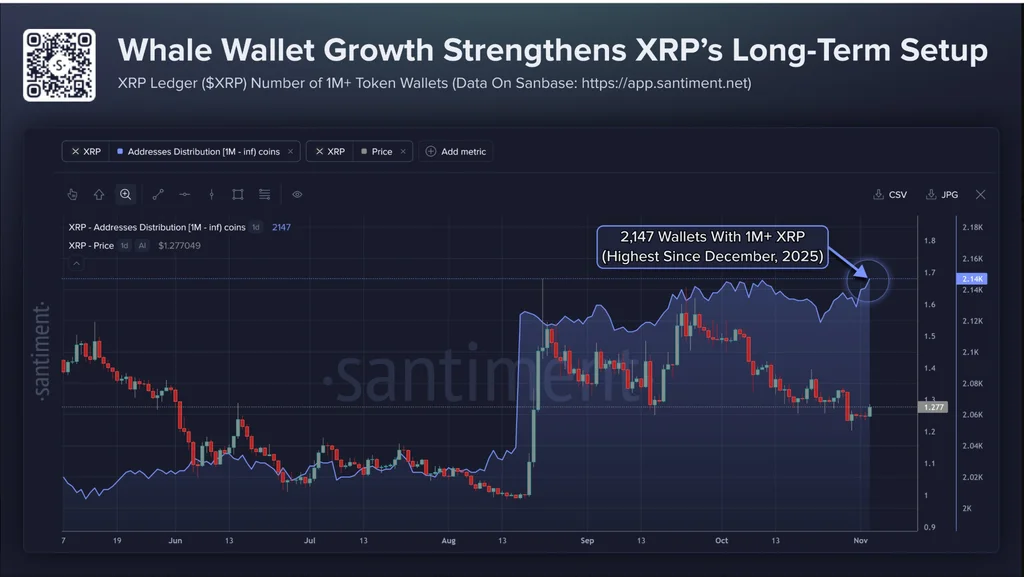
XRP’s large holders are adding wallets even as the token faces price pressure. That divergence is the signal to watch: investors with at least 1 million XRP now control positions across 2,147 wallets, the highest count recorded in 2026, according to Santiment. It suggests some large holders are using the dip to accumulate, though wallet counts alone don’t establish where prices go next.
There’s a useful distinction here between a change in ownership patterns and a forecast. A rising count of qualifying wallets says that more wallets meet Santiment’s threshold; it doesn’t reveal whether their owners bought recently, how much XRP they hold above that threshold, or whether they’ll keep holding. The figure is evidence of concentration at a particular scale, but it can’t by itself show the motives behind those positions.
This is more significant than it looks, but only as a clue. When price weakens while large-wallet counts rise, analysts may read the gap as a sign that some holders are willing to accumulate into uncertainty. That interpretation remains conditional: market participants can change course, and the count may not capture what’s happening across all holders or trading venues.
Wallet growth puts a support test in focus
The millionaire-wallet count has risen by 28 over the past 10 days, with 18 added in just the last three. Santiment identifies $1.20 to $1.25 as a key support range. Its bullish reading depends on XRP holding that zone while the number of wallets with at least 1 million tokens stays above 2,140. If either condition fails, the accumulation signal would look less persuasive.
The speed of the recent increase is part of the story: 18 of the 28 wallets were added in the latest three-day stretch. That may draw attention to a shift in behaviour, but a short window can also make a trend look firmer than it is. Traders watching the metric will want to see whether the count remains elevated over time, rather than treating a brief rise as proof of durable demand.
The price level matters because a support range is a test, not a guarantee. If XRP holds between $1.20 and $1.25 while the wallet count stays above Santiment’s stated threshold, the two observations would continue to reinforce one another. A break below the range, or a retreat in wallet numbers, would weaken that reading. Neither outcome would settle the longer-term direction on its own.
Fund flows and XRPL activity add context
Wallet growth is one part of the picture. Blockworks’ Q3 2026 XRP report put net inflows to global XRP exchange traded products at about $355 million, up 40% from the previous quarter. Assets under management rose 65% to $3.3 billion. Those figures point to increased institutional exposure through investment products, even as XRP’s price remains volatile.
These measures describe activity in investment products, which gives them a different meaning from on-chain wallet counts. Inflows indicate that money entered the products during the period; assets under management reflect the total value held and can change as prices move as well as when investors add or withdraw funds. The reported gains are notable, though they don’t establish that product buyers are driving XRP’s price or that inflows will continue.
Here’s the thing: several indicators can improve at once without removing the risk signalled by a falling or unstable price. Fund flows may show growing access to XRP through products, while the wallet count may suggest accumulation among holders above a particular size. Those are separate signals with different limits. Read together, they offer context; neither gives a reliable timetable for a recovery.
Ripple’s dollar pegged stablecoin, RLUSD, could also broaden activity on the XRP Ledger. Payments, liquidity management and institutional settlement are among the uses that may expand alongside the stablecoin. Its role is a potential network catalyst; the available figures don’t show how much XRP demand it has generated.
A stablecoin can support activity on a network by giving users a digital asset designed to track a currency, which may suit transfers or liquidity needs. But activity involving RLUSD wouldn’t automatically translate into buying XRP. The connection depends on how the ledger is used and whether those uses require XRP; the figures provided don’t quantify that link. And this is the part most people overlook: a busier network and a rising token price aren’t interchangeable outcomes.
Exchange balances are declining
Fewer XRP tokens on centralized exchanges can mean less supply immediately available for trading, which may ease selling pressure if demand strengthens. Binance reserves fell from roughly 2.69 billion to 2.47 billion XRP between October 28 and October 30. Bybit’s holdings dropped from 306 million to 286 million over the same period, a reduction of 20 million tokens.
Those declines are worth tracking, but exchange balances need careful interpretation. Tokens leaving an exchange may be moving into private custody or another venue; the balance change alone doesn’t show the reason, the destination, or whether the owner plans to sell later. Lower exchange reserves can limit the amount visibly available on that venue, but they don’t prove that overall selling pressure has disappeared.
The reported movements are also concentrated in a short period. That makes the figures a snapshot of exchange holdings between October 28 and October 30, rather than evidence of a lasting trend. If you're working in this space, the practical question is whether balances keep declining while demand holds up, not simply whether one interval shows withdrawals.
What the signals can—and can’t—say
The combined signals give XRP bulls several indicators to track: whether the $1.20 to $1.25 range holds, whether millionaire wallets stay above 2,140, and whether institutional flows and XRPL activity continue to build. For now, accumulation is visible; a sustained recovery still depends on those measures holding up alongside price.
That said, the indicators don’t all measure the same thing. Wallet counts describe how many wallets meet a threshold, fund flows describe activity in investment products, and exchange reserves track tokens held on particular trading platforms. Their agreement can strengthen a case for closer attention, but it can’t remove the need to watch price behaviour or establish what holders will do next.
For readers, the clearest near-term test is whether the support range and wallet threshold hold together. If they do, the accumulation narrative has more support from the data cited here. If they don’t, the bullish interpretation becomes harder to defend, even with the reported product inflows and falling exchange balances. A signal, not a verdict.


Discussion
Sign in to join the discussion.