Russia's central bank has prohibited Bitcoin transfers to self-custody wallets, tightening control over cryptocurrency transactions in the country.

In a significant move to tighten cryptocurrency regulations, the Bank of Russia has declared that transactions involving digital currencies such as Bitcoin, Ethereum, and XRP can only occur through state-sanctioned intermediaries. This is part of the implementation of Federal Law No. 282-FZ, which sets the framework for cryptocurrencies and digital rights in Russia, effective from October 12, 2026.
The central bank's directive strictly bans the transfer of these digital assets to non-custodial wallets—platforms that manage private keys locally for direct transactions on a blockchain. Moreover, even moving cryptocurrency from a digital account to a self-custodial wallet held by the same individual is prohibited under this legislation.
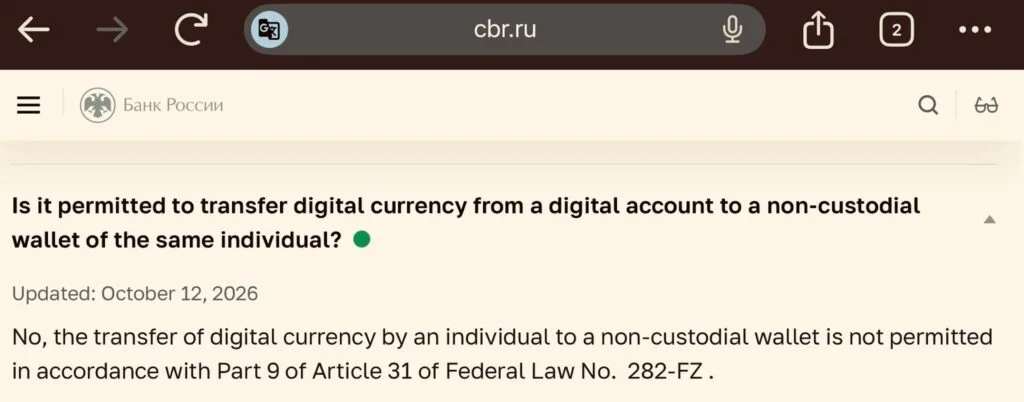
Interestingly, the law acknowledges that parties in Russia will begin using self-custodial wallets by July 1, 2027. This indicates a phased approach to digital asset management, albeit tightly controlled under the state’s jurisdiction.
Russia's Drive Towards Economic Control
The Federal Law No. 282-FZ, which took effect on September 1, 2026, aims to facilitate smoother international payments for local businesses amid overwhelming sanctions from Western nations due to the ongoing conflict in Ukraine.
This legislation positions state-run intermediaries as gatekeepers of domestic crypto transactions, effectively banning the use of cryptocurrencies for payments within the country. By preventing Bitcoin transfers to self-custodial wallets, Russia seeks to bolster its control over digital assets, protect its financial infrastructure from capital outflows, and counteract tax evasion.
The underpinnings of this law are tied to Russia’s recent financial struggles, exacerbated by sanctions that stifle its economic activity. Authorities perceive digital currencies not as a tool for innovation but as potential threats to the state’s monetary policy. The emphasis on state control highlights a tension between cryptocurrency's decentralized ethos and the centralized regulatory frameworks that governments are increasingly imposing in response to global economic pressures.
Regulatory Implications for Users and Businesses
For individuals and businesses operating in Russia, this new regulation reshapes how they can interact with digital assets. Transactions will now require navigating through state-controlled entities, which could result in slower processes, limited options, and less privacy. You may find that the control over these assets is less about protection and more about surveillance. The government intends to prevent capital flight and illicit activities but at the expense of user autonomy.
Moreover, the prohibition of transferring cryptocurrency to self-custodial wallets discourages innovation within the local tech community. Developers may be less likely to create new products or services focusing on user privacy and financial independence. If you're working in this space, these limits could stifle entrepreneurial ventures that hinge on the fluidity of digital currencies and the broader blockchain ecosystem.
This shift also raises questions about compliance. With stringent regulations in place, users may need to be aware of how transactions are monitored. The Transparency of transactions might give the government greater insights into individuals' or businesses' financial activities, further solidifying state authority. The fear is palpable—how can users maneuver in this tightly controlled environment without breaching new laws?
Long-term Effects on Russia's Crypto Ecosystem
The fact that lawmakers anticipate a transition to self-custodial wallets by mid-2027 indicates an acknowledgment of the technology's staying power, even as it's tightly regulated. This suggests that the state's balancing act will involve managing innovation while maintaining oversight. But here's the thing: regulation often lags behind technology. By the time the state is ready to embrace a more open approach, the crypto ecosystem might have evolved significantly, leading to a possible disconnect with user needs and global trends.
The restrictions imposed might initially reshape how cryptocurrencies are used in Russia but could provoke backlash among users discontent with the lack of accessibility and privacy. Much of the crypto community thrives on principles of decentralization and autonomy, values that these laws starkly oppose. An underground market might develop, as users seek ways to avoid falling under the watchful eye of regulations.
And yet, there is a counterpoint. A state-sanctioned system could integrate cryptocurrencies more broadly into the formal economy, potentially leading to a moderated increase in adoption over time. This normalization could attract more cautious investors who are currently skeptical of digital assets due to their association with illicit activities. It’s a double-edged sword—the state’s intervention could stabilize the market in the long run, but at the cost of its core principles.
Featured image via Shutterstock
The post Russia blocks Bitcoin transfers to self-custody wallets appeared first on Finbold.



Discussion
Sign in to join the discussion.