Large XRP wallets now control their biggest supply share since 2022, while falling futures exposure may ease pressure on the price.


XRP’s signals are pulling in opposite directions: its largest holders have built their biggest share of supply in more than four years, while the token remains under pressure near $1.31. That gap matters because accumulation can point to confidence, but it doesn’t establish that buyers are strong enough to push the market higher. Price levels, exchange balances and continued selling will shape whether that confidence turns into a recovery. For now, the data describes a market with competing signals, not a confirmed shift in trend.
Whale holdings reach a four-year high
Santiment reported Tuesday on X that wallets holding at least 10 million XRP now contain 46.87 billion tokens, or roughly 68.5% of the total supply. That’s the largest share held by these wallets since November 2022. The figure tracks the share held by a defined group of large wallets; it doesn’t, by itself, explain why those wallets hold more XRP or whether they’re likely to keep buying. Even so, the concentration is a notable signal at a time when the token’s price has struggled.
“The key signal is that these massive holders have kept increasing exposure even while XRP struggles near $1.29,” Santiment wrote. The figures contrast with an earlier warning from analyst Ali Martinez, who said the number of wallets holding between 10 million and 100 million XRP had fallen from 351 to 339 since November 2022. Those measures aren’t directly interchangeable: one describes the supply held by wallets with at least 10 million tokens, while the other counts wallets in a specific holdings range. Martinez also cited rising exchange balances, from 11.003 billion to about 11.05 billion XRP, as a possible factor in the token’s price stagnation. Exchange balances can add to concern about potential selling, though they don’t prove that a sale is imminent. Martinez warned that continued sales by large holders could push XRP to $0.98.
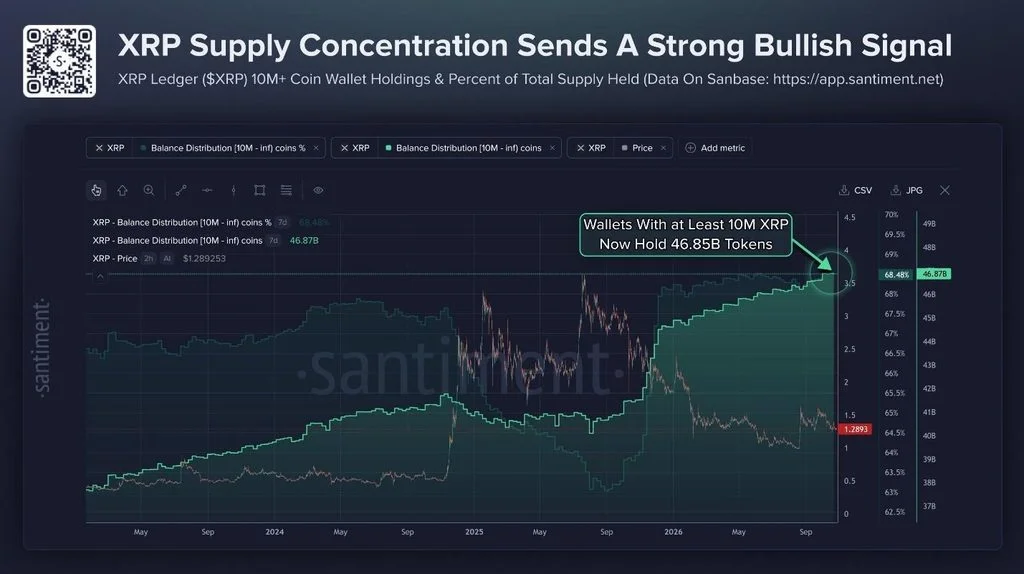
Santiment’s latest data points to stronger accumulation among the biggest wallets, even as XRP struggles to gain ground. The firm described that buying through weakness as evidence of continued conviction. That’s a plausible reading, but a holdings snapshot doesn’t show the timing or intent behind every wallet’s activity. Nor does it settle the question raised by Martinez’s figures: whether XRP moving onto exchanges signals supply that could weigh on the market.
Santiment marked $1.30 as the near-term pivot and $1.90 as a more substantial level for confirming a possible recovery. The distinction gives traders two different things to watch: whether XRP can hold its current area, and whether it can later reclaim a higher threshold that would make the recovery case stronger. Those levels are reference points, not guarantees. A brief move above a price marker wouldn’t answer whether demand can persist.
Futures exposure falls as traders unwind positions
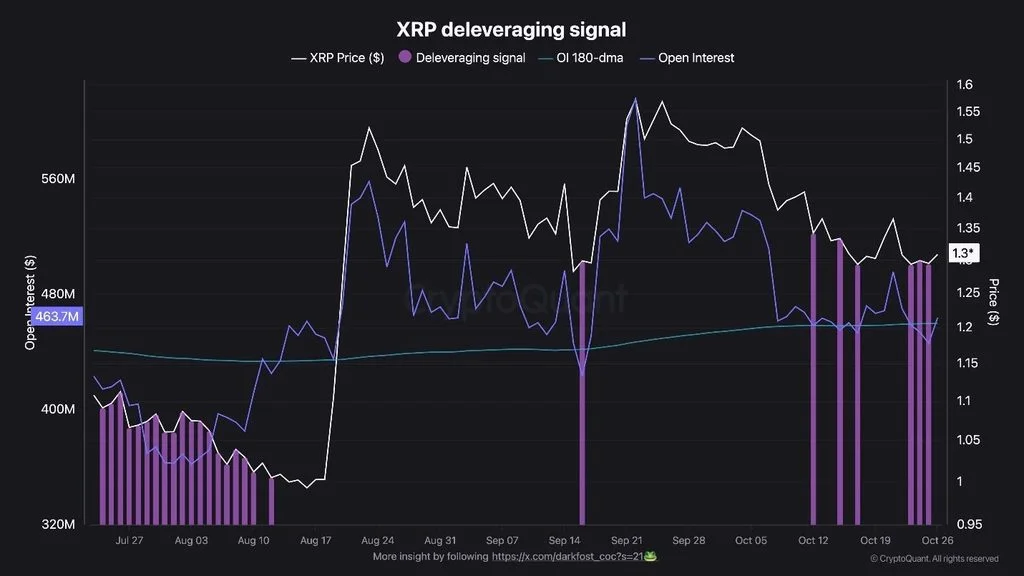
Derivatives data adds another potential source of relief. CryptoQuant analyst Darkfost said XRP open interest on Binance had dropped to $445 million, below its 180-day average of about $460 million. Since September 22, open interest has fallen nearly 28%, while XRP’s price has declined 17%. Open interest measures the value of outstanding futures positions, so a decline suggests traders have reduced exposure. It doesn’t tell us, on its own, whether they’ve closed bullish or bearish positions.
Darkfost attributed the decrease partly to lower prices shrinking the value of outstanding positions and partly to liquidations during the sell-off. In his view, the reduction in leverage could ease pressure on XRP futures. In markets with heavy derivatives activity, crowded positions can intensify price swings when traders are forced to close them; less exposure can reduce that particular source of pressure. But it can also mean fewer traders are positioned to amplify a move higher. The signal is about changing conditions in the futures market, not a direct forecast for spot prices.
He also pointed to earlier periods when open interest fell before sharp gains: XRP rose 32% after a mid-September episode and 72% following a decline in mid-August. Those examples offer context, though they don’t establish that another rally will follow. Past rebounds show that falling open interest can precede a change in direction, but the same pattern can occur without a comparable recovery. Here's the thing: the timing and cause of a decline matter, and the figures cited here don’t remove that uncertainty.
“This deleveraging dynamic is a rather positive signal as it suggests that pressure on XRP futures is gradually easing,” the analyst said.
Support remains the immediate test
Martinez said a TD Sequential buy signal had appeared on XRP’s three-day chart. The previous three comparable signals preceded rebounds of 31%, 24% and 18%, but this setup depends on the token holding support. The historical examples may catch traders’ attention, yet a handful of past signals can’t establish what the next one will do. In this case, Martinez’s own framing puts the support test first: “Hold it, and XRP could rebound toward $1.40. Lose it while whales continue taking profits, and $0.98 could be next,” Martinez said.
That makes the current price action a practical check on the bullish readings elsewhere. Large holders may be accumulating and futures exposure may be easing, but neither signal can prevent a decline if selling overwhelms demand near support. And yet, if XRP holds its ground, those same shifts could help traders argue that pressure is easing. The market still has to show which interpretation fits.
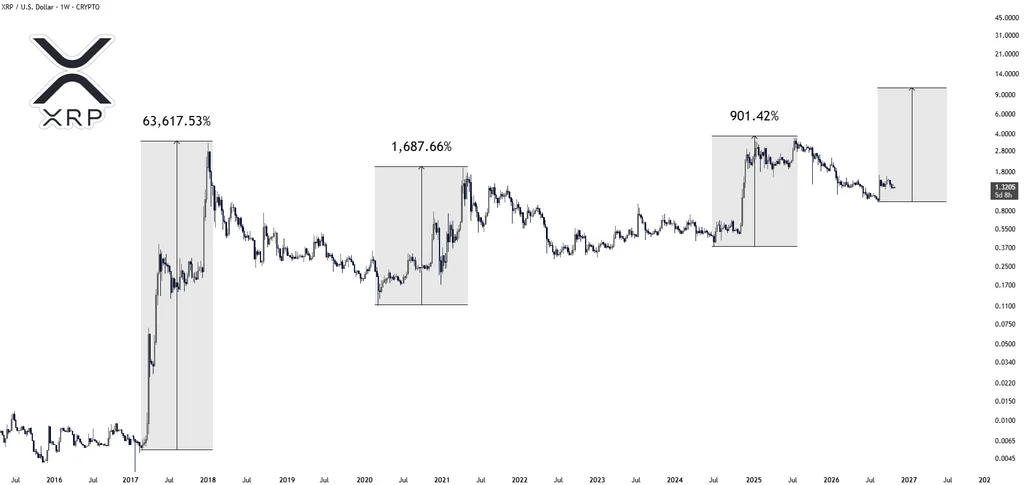
Analyst Joep Gerla sees the extended consolidation as a possible prelude to a larger move. He compared the current pattern with earlier consolidation periods followed by rallies of 63,617% in 2017–2018, 1,687% in 2020–2021 and 901% in 2024–2025. Gerla described those episodes as precedents for expansion, while stressing patience ahead of a breakout. The scale of those historical moves makes the comparison striking, but it doesn’t make them a reliable template for what comes next. Consolidation can precede a breakout; it can also continue or resolve downward.
What the conflicting signals mean
This is more significant than it looks, but the significance lies in the disagreement among the indicators. Whale accumulation offers a sign that some large holders are adding exposure; rising exchange balances and Martinez’s warning point to possible supply; falling open interest suggests traders are shedding futures positions. Each tells us something different about market behavior. None settles the direction of XRP’s next move.
If you're working in this space, the useful distinction is between a signal that describes positioning and one that confirms a price trend. Holdings and open interest can help explain who may be exposed and where pressure might be building. Price still has to validate the recovery case by holding support and moving through the levels analysts have identified. The numbers here are underwhelming as a standalone bullish case: they provide reasons for interest, not proof of a turning point.
At press time, XRP traded at $1.31, up 2.13% over 24 hours. That daily gain is modest context beside the larger questions raised by the data. For now, the $1.30 pivot and support level are the near-term tests; whale accumulation and lighter futures exposure offer reasons for optimism, but price action has yet to confirm a recovery. Still, no confirmation yet.


Discussion
Sign in to join the discussion.