Bitwise’s sentiment index sank to -1.88 standard deviations as Bitcoin fell, crypto ETPs shed $2.1 billion, and markets priced in tighter policy.
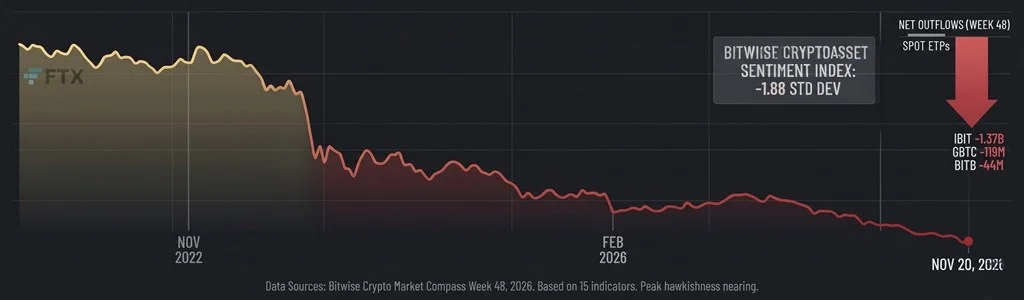
Crypto markets entered a sharp risk-off stretch in November, with falling prices, heavy fund withdrawals and rising expectations for tighter monetary policy converging at once. Bitwise’s Cryptoasset Sentiment Index reached -1.88 standard deviations on November 20, 2026, one of its three weakest readings since FTX collapsed in November 2022. The reading captures how far sentiment had moved from its recent norm, but it doesn’t explain the cause on its own. Here, the report points to pressure from both crypto-specific selling and a broader retreat from risk.
Bitcoin lost nearly 10% over the week covered by Bitwise’s week 48 report, trading near $60,000 before touching $55,130 over the weekend. Ether fell 14%, while XRP and Solana each dropped 9%. U.S. equities weakened in parallel: the Nasdaq Composite declined 10% and the S&P 500 fell 8.6%. That simultaneous slide matters because it complicates the familiar story of crypto moving on its own. The losses suggest investors were reducing exposure across several risk-sensitive markets at once.
Risk aversion reaches across markets
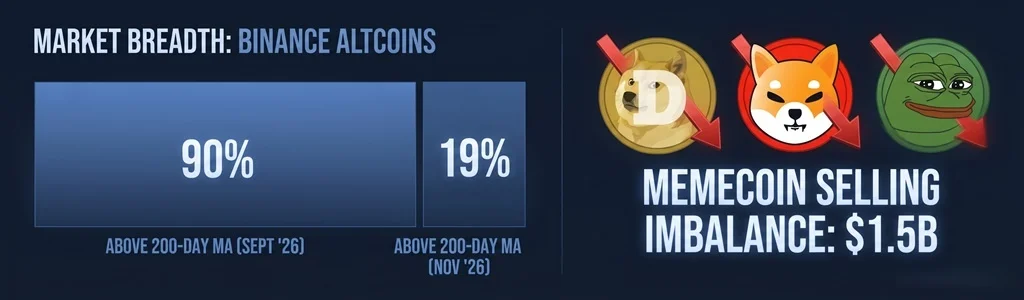
Only four of the sentiment index’s 15 components remained above their short-term trends. The Crypto Fear & Greed Index also stayed in extreme fear territory, reinforcing the picture of a market where optimism had thinned across multiple measures. Bitwise attributed much of the pullback to the unwinding of artificial intelligence-linked trades and expectations for tighter monetary policy, rather than the Binance hack weeks earlier or a stronger U.S. dollar. That distinction matters: it frames the decline as part of a wider repricing of risk, not simply a reaction to a single crypto event.
Broader risk measures showed the same strain. Bitwise’s Cross Asset Risk Appetite indicator fell from -0.51 to -1.11 after reaching -1.14 midweek, levels comparable to the yen carry trade unwind in mid-2024 and the tariff-linked sell-off in early 2025. The comparison gives a sense of the episode’s severity, though it doesn’t establish that the causes or consequences will match those earlier periods. The VIX closed at 35.89 on November 20, its highest close of the year, though below peaks of 38.57 in August 2024 and 52.33 in April 2025. Investors were pricing in a rougher ride across markets.
Rate expectations and fund withdrawals
Interest-rate expectations added pressure. Bitwise’s report, published November 23, said October 2026 Federal Open Market Committee minutes showed nearly all participants anticipating further tightening. Governor Christopher Waller had raised the possibility of a 50-basis-point increase in December. Federal funds futures put the odds of a December hike at 93%, with a 63% probability assigned to two additional hikes by January 2027. Those figures describe market expectations, not a decision already made by the Fed; they show how much policy risk traders were incorporating into prices.
Crypto investment products recorded substantial outflows during the week. Global cryptoasset exchange-traded products lost $2,107.9 million net, while U.S. spot Bitcoin ETFs saw $1,843.1 million in net withdrawals. BlackRock’s IBIT accounted for $1.37 billion of the Bitcoin ETF outflows, Grayscale’s GBTC for $119.3 million and Bitwise’s BITB for $43.6 million. U.S. spot Ether ETFs shed another $288.4 million. The scale and breadth of withdrawals point to investors pulling back through familiar market channels, though weekly flows alone can’t tell whether those investors have exited for good or are waiting for conditions to settle.
Bitwise argued that the Federal Reserve may be nearing peak hawkishness. The 10-year Treasury yield stood at 4.95%, against 4.66% for the 2-year, leaving a 29-basis-point spread. The firm said a steep December increase could invert the yield curve; in past cycles, it said, inversion has typically been followed by a pause and then rate cuts. The Fed has not announced a pause. That gap between a market narrative and an actual policy decision is where uncertainty remains.
Bitcoin holders absorb heavy losses
On-chain data through November 20 showed Bitcoin’s supply in profit falling from 59.1% to 43.2% in 14 days. Bitwise estimated that about $953 billion in invested capital was sitting on unrealized losses. Realized losses over seven days reached $5.3 billion, below the roughly $5.7 billion recorded in November 2025 and $9.1 billion in February 2026. These measures describe different kinds of pressure: unrealized losses reflect positions marked below their purchase value, while realized losses capture coins sold at a loss. Together, they show a large pool of holders under strain, even as the realized figure remained below those earlier episodes.
Derivatives positioning shifted as traders adjusted exposure. Bitcoin perpetual futures open interest fell about 4.5% to roughly 439,000 BTC, while combined liquidations hovered near $4.9 billion. Options open interest moved in the other direction, rising about 18.5% to around 548,100 BTC. Commercial traders’ net short position on CME declined from 11.11% to 7.28% of open interest. The mix resists a simple reading: futures exposure contracted, options activity expanded, and the CME short position narrowed. In a fast market, those changes can reflect hedging and repositioning as well as directional bets.
What the signals mean next
Bitwise said sentiment readings this low have historically preceded positive returns over the following 12 months, while cautioning that sentiment alone cannot time a market. That history may be encouraging, but it doesn’t settle what happens next. This is more significant than it looks: the report combines a deeply negative sentiment reading with heavy withdrawals and weakening prices, so a recovery signal based on sentiment has to be weighed against evidence that investors are still reducing exposure.
Its report put Bitcoin’s average realized price near $53,500, making price action around that level, weekly ETF flows and the Federal Reserve’s December meeting the next indicators to watch. If you’re working in this space, the practical question is whether selling pressure eases as those signals develop, or whether policy expectations keep weighing on risk appetite. (And this is the part most people overlook: several indicators can point in different directions at once.) Sentiment may be stretched. The timing remains uncertain.

Discussion
Sign in to join the discussion.