Bitcoin’s hash rate is down 8% year over year as weak mining revenue prompts shutdowns, while a difficulty rebound could arrive November 26.
Bitcoin’s mining power has slipped into its first year-over-year decline since China’s 2021 mining ban, but the cause this time is economic pressure rather than a government order. Glassnode put the network’s hash rate 8% below its level a year earlier on November 24, 2026. It had remained below that benchmark since late July, suggesting the decline wasn’t a brief interruption.
Hash rate measures the computing power miners are directing toward Bitcoin. It isn’t a direct count of machines: changes can reflect operators switching equipment off, bringing it back online, or moving capacity between facilities and uses. The sustained annual drop points to a tougher operating environment, though the measure alone can’t show which miners are struggling or how many machines have left the network.
Bitcoin was trading near $60,000, 52.6% below its October 6, 2025 peak of $126,080. For miners, the pullback has coincided with compressed revenue per unit of computing power. Luxor reported hashprice of $29.36 per petahash per second per day, down from $30.27 a week earlier. It had touched roughly $27.70 on November 20, matching June’s low.
Hashprice gives miners a way to track expected revenue against the computing power they contribute. It helps explain why a falling Bitcoin price can hurt mining even when the network keeps producing blocks: each unit of computing capacity earns less, while electricity and equipment costs continue to shape whether that work pays. The figure is a broad gauge, though. An operator’s actual economics depend on costs that vary from site to site.
At around $29, mining revenue is at or below break-even for many operators, depending on electricity prices and equipment. That pressure is already changing who can profitably contribute computing power to the network. This is more significant than it looks: as margins tighten, the industry’s overall capacity can become more sensitive to energy costs and changes in Bitcoin’s price.
Older rigs face shutdowns
The April 2024 halving cut the block reward from 6.25 BTC to 3.125 BTC. Because miners receive fewer bitcoins for each block they mine, the halving raised the bar for earning a profit unless other parts of the business made up the difference. Combined with Bitcoin’s retreat from its 2025 highs, that reduction has left less efficient machines struggling to cover operating costs.
Some miners have switched off older rigs; others have redirected power infrastructure and data centers toward artificial intelligence and high-performance computing. That shift reflects a practical calculation: facilities and power access can have value beyond Bitcoin mining, especially when mining revenue is weak. But changing a site’s use doesn’t automatically mean every mining operation can make the same move; the economics depend on the facility and the alternative work it can support.
Public miners have also taken different steps since September 2026. MARA raised about $1.1 billion through Bitcoin sales and put $750 million toward loans backed by the cryptocurrency. Riot sold 20,264 BTC through September, primarily to fund data center development.
Those decisions show miners managing more than day-to-day operating costs. Selling Bitcoin can provide cash for debt payments or development, while building data center capacity may give a company another source of revenue. The tradeoff is that these choices also affect how much bitcoin a miner holds and how much capital it can direct toward its original business.
These choices point to a broader adjustment underway in the sector: miners are managing both lower revenue and the value of the power and facilities they control. Here's the thing: the decline in hash rate doesn’t mean every operator is making the same decision. Some are shutting down equipment, while others are trying to reposition assets for different workloads.
Hash rate rebounds ahead of the next adjustment
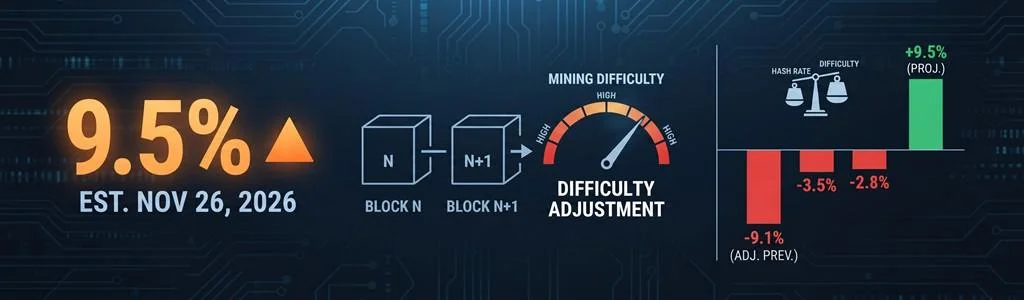
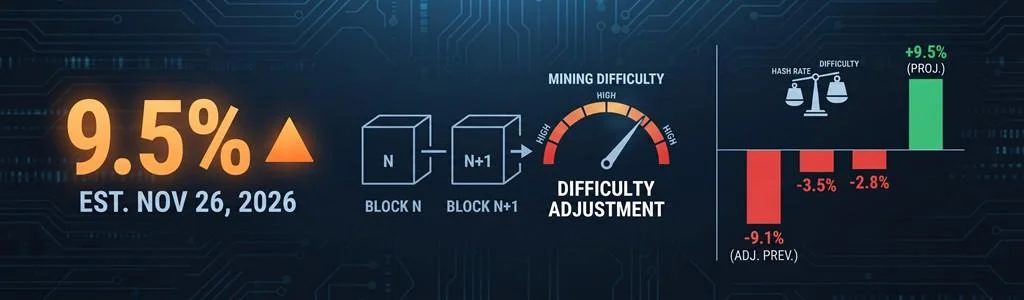
Bitcoin resets mining difficulty every 2,016 blocks, or roughly two weeks, to keep block production near a ten-minute average as computing power changes. When more computing power joins the network, difficulty can rise; when it leaves, difficulty can fall. The adjustment is part of how Bitcoin responds to changing participation, but it doesn’t guarantee that mining will be profitable for the operators providing that power.
The previous adjustment lowered difficulty by 9.1%, the third reduction greater than 9% in 2026, according to mempool.space data. A reduction makes it easier for miners to produce blocks with a given amount of computing power. That can improve the economics for those who remain active, although the benefit depends on what happens to Bitcoin’s price, fees, and operating costs.
After that cut, Luxor recorded a 7.8% rise in the seven-day average hash rate in the week before November 24. The next recalculation is expected around November 26, and Luxor estimates difficulty could rise about 9.5% if the current pace of block production continues. The rebound suggests that computing power has returned since the prior adjustment, but a single week’s increase doesn’t settle whether that level can be maintained.
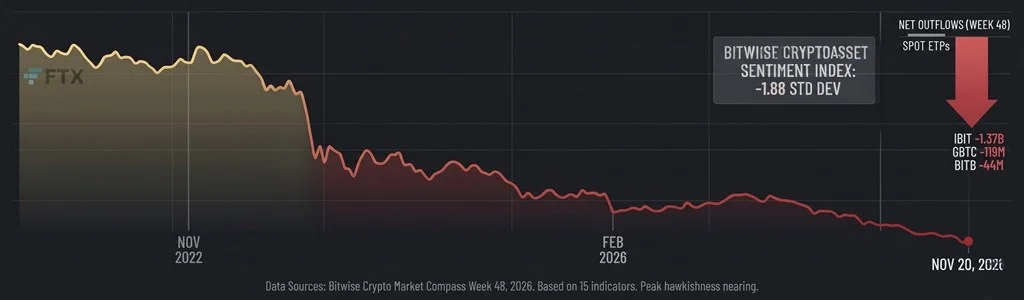
Bitcoin demand was also under pressure: U.S. spot Bitcoin exchange-traded funds saw net outflows of $2.37 billion over five days, including $569.7 million on November 23, and $4.91 billion over the month. Those flows describe investor activity in the funds, not mining revenue directly, but they add context to a period when Bitcoin’s price and miners’ earnings are both under strain.
What the next adjustment can show
With Bitcoin around $60,004, the coming difficulty adjustment will show how much recent hash rate has returned—and whether miners can sustain it at current revenue levels. A projected increase would confirm that block production has run ahead of the target pace since the previous reset. It wouldn’t, on its own, show that the returning capacity is earning an adequate return.
If you're working in this space, the useful signal is the relationship between hash rate, difficulty, and hashprice over time. Each measure answers a different question: how much computing power is present, how hard it is to mine, and what that power is earning. Taken together, they offer a clearer view of whether the recent rebound reflects durable participation or a short-lived response to easier conditions. And yet, the cost differences between operators mean the same market conditions can still produce very different outcomes.
The broader test is whether miners can keep operating while revenue remains compressed. Some older machines may stay offline, and some companies may put more emphasis on data center development. A changing mix of participants. The next adjustment will offer a timely reading of network activity, but the longer-term picture will depend on whether mining revenue can support the equipment and power costs required to keep that capacity online.

Discussion
Sign in to join the discussion.