Altcoins have fallen 34% from their September 2026 peak, while weakening market breadth and a $1.5 billion sell imbalance point to subdued risk appetite.
Altcoin weakness is broadening beyond a handful of speculative tokens. Since its September 2026 peak, the TOTAL2 index, which tracks crypto assets excluding Bitcoin, has fallen 34%, wiping roughly $408 billion from market capitalization, according to Darkfost’s analysis on CryptoQuant. That figure reflects lower market valuations, not an equivalent amount of cash withdrawn by investors. Market capitalization is calculated from prices across an asset’s circulating supply, so a price decline can erase a large amount of measured value without that sum changing hands in sales. Still, a loss on this scale signals that buyers are assigning substantially less value to the altcoin market than they did at its peak.
The pullback comes as Bitcoin’s recovery loses momentum. A break below $60,000 could add pressure to smaller crypto assets, leaving altcoins exposed to both weaker market breadth and further declines in the largest cryptocurrency. Bitcoin often shapes sentiment across the sector, but the available figures don’t establish that every altcoin will respond in the same way. The more immediate concern is that weakness is appearing across many tokens at once, making it harder to treat individual price gains as evidence of a durable turn.
Few Binance-listed altcoins hold above long-term averages
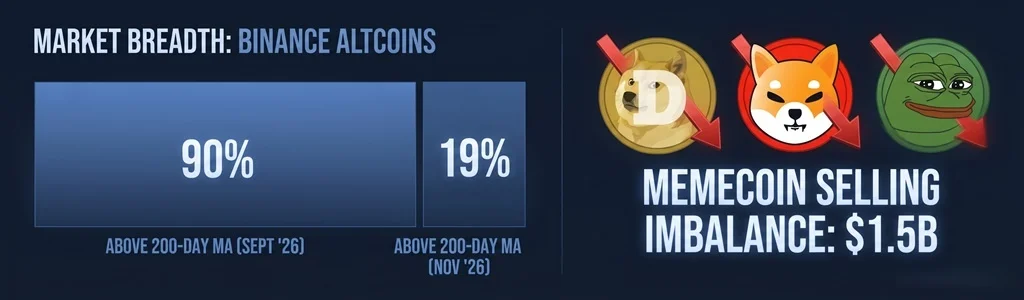
A sharp drop in the share of tokens trading above their 200-day moving average points to weakness across the sector. In September, nearly 90% of altcoins listed on Binance were above that measure. By November 24, 2026, the share had fallen to 19%, putting 81% below their long-term average. A 200-day moving average smooths short-term price swings, so falling below it can indicate that recent prices have weakened relative to a longer stretch of trading. It doesn’t, by itself, tell traders when a decline will stop.
The size of the change matters. When nearly nine in ten listed tokens are above the measure, strength is broadly distributed; when fewer than one in five are, the market’s gains are much narrower. That breadth reading makes isolated rallies harder to interpret: gains in a few large tokens may not signal a wider recovery. This is more significant than it looks, because a market can appear active while most of its assets remain below longer-term trends.
For market participants, the key question is whether more assets can regain those trends. A sustained improvement in breadth would suggest that demand is reaching beyond a small set of tokens, though the cited snapshot can’t establish whether such a change is beginning. If you’re working in this space, the distinction between a rising headline index and broad participation is practical: the two can point to very different conditions beneath the surface.
Memecoins lose ground as selling outweighs buying
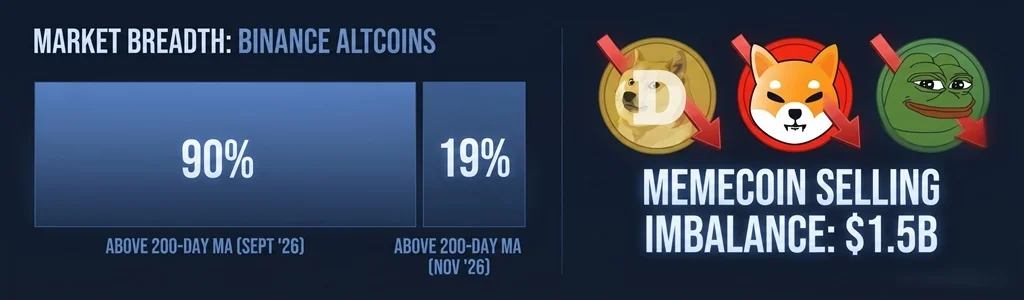
Memecoins’ share of altcoin market capitalization has shrunk from nearly 11% in November 2024 to 2% as of November 24, 2026, an 82% relative decline. Binance trading data show a cumulative $1.5 billion imbalance favoring sell orders, with the weakening trend extending back to October 2025. These figures describe a marked loss of standing within the altcoin market and a persistent skew in the cited order data. They don’t show that every memecoin has moved alike, or that the full market’s trading activity can be reduced to one exchange measure.
The shrinking share also needs context. Market share can fall because a segment’s value declines, because other assets hold up better, or through some combination of the two. The figures point to relative weakness, but don’t isolate how much of the change comes from each cause. And this is the part most people overlook: a falling share says where memecoins stand compared with the rest of the market; it doesn’t, on its own, explain why buyers and sellers are changing their positions.
Other signs point to cooler demand for the segment. Bitwise suspended its Dogecoin exchange-traded fund in September 2026 after about ten months of trading, while PEPE futures volume has dropped, indicating less speculative activity in derivatives. Those are different signals: one concerns a product’s trading status, while the other concerns activity in a derivatives market. Taken together, they fit a retreat from memecoin exposure, though they don’t establish a single cause for it.
What the weakness could mean next
These measures fit a broader retreat from high-volatility assets, but a low market share alone doesn’t establish that memecoins are undervalued or that a rebound is near. Nor does one breadth snapshot show whether the market has reached a floor. The numbers describe current strain; they don’t provide a timetable for recovery.
Here's the thing: the next useful evidence is likely to come from whether TOTAL2 can stabilize and how Bitcoin behaves around $60,000. If Bitcoin weakens further, smaller crypto assets could face another test; if it steadies, the breadth figures will still matter in judging whether support extends beyond a few names. A recovery would look more convincing if more altcoins regain their longer-term averages and the market’s gains spread out. For now, a narrow rally.

Discussion
Sign in to join the discussion.