Bitcoin is down about 16% from its 2025 close, raising the odds of its first back-to-back annual loss.


Two Losing Years in a Row?
Bitcoin is on track for something it has never done: two calendar-year losses in a row. Peter Schiff, one of its loudest critics, flagged the possibility on X, and the numbers back him up. My read is that if the market can't stage a quick recovery before year-end, 2027 starts with the same problem.
Here's why a streak like this draws attention. Bitcoin's price history is full of violent swings, which makes it easy to lose track of where one year ends and the next begins. A calendar-year test cuts through that noise. It's also the yardstick most readers will reach for when they hear a year went badly, so it carries weight whether or not it's the most rigorous measure available.
Schiff posted on X:
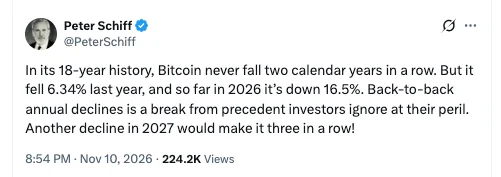
His core point is simple. Bitcoin has never posted consecutive calendar-year declines across its roughly 18-year history. It fell about 6.3% in 2025, and it's already down roughly 16.5% from the year-end level, trading near $73,000 against a close around $87,500. The year opened near $86,000, so the slide has been steady rather than sudden.
I'd push back on one thing before going further. A 6.3% decline is small by Bitcoin standards, and that's exactly why it deserves attention rather than dismissal. Sharp crashes tend to end quickly, one way or another. Slow fades are harder to call, and they can drain momentum long after the headlines move on, which is the pattern to watch here.
Here's the thing: the statistics hold. Bitcoin started 2025 around $93,400 and finished near $87,500. It hit an all-time high of about $127,500 in October but couldn't keep those gains through December. That fade set up the current drawdown.
That said, the figures in the piece don't line up neatly. The $86,000 and $93,400 numbers are both offered as opening levels, and the piece doesn't reconcile them. If you're repeating any percentage from this debate, check which base it's measured from. Shaky baselines are a common way for an argument to look stronger than it really is.
Does the Losing-Streak Argument Hold Up?
Bitcoin's down years have historically come in isolation, and the rebounds have tended to be fast. The 2014 drop of roughly 56% to 58% gave way to gains in 2015. The roughly 73% to 74% decline in 2018 was followed by a recovery in 2019, and the 64% fall in 2022 led into a rally in 2023.
That pattern is the core of the bull case. Bitcoin rarely stays down for two years, and most of its years finish positive. The trouble is that 2026 isn't showing the bounce that usually follows a sharp drop, and 2025 was only a shallow decline, nearly flat by the standards of past crashes. The usual rhythm would point to a weak 2026 and a stronger 2027. Schiff's warning is that the rhythm might not hold this time.
The contrast with those earlier years is stark. Deep crashes tend to reset positioning, forcing a hard reassessment of who's holding and why. Shallow drifts often don't, and they leave the market in a holding pattern that can last longer than anyone expects. That's the mechanism that makes a second down year harder to wave away than a single bad one.
Remember, though, that rebound patterns come from a small sample. Bitcoin has only a handful of calendar years to draw from, and the cycles behind them were shaped by very different market conditions. Treating past recoveries as a law of nature is the kind of inference I'd be wary of. A pattern that has held a few times isn't the same as a pattern that must hold.
And yet, the bull case has real logic behind it. A market that keeps recovering gets treated as resilient, and that perception can pull buyers back in on its own. Supporters are essentially betting on that feedback loop. Whether it works again depends on conditions nobody can read from a calendar.
Schiff's Track Record Cuts Both Ways
Schiff has long argued that Bitcoin has no intrinsic value and isn't a store of value the way gold is. Critics say he's most vocal when Bitcoin is falling. Lately, that criticism has focused on his silence during rallies, including the run from around $57,000 earlier this year to $86,000 just a few weeks ago.
Social media users have already resurfaced older posts in which he said Bitcoin wasn't worth buying:

Here's my take on the messenger problem. Skepticism about Bitcoin is a legitimate position, and a critic who's sometimes right about bubbles is worth hearing. But a record of leaning bearish is a weak test of any single call, since a stopped clock is right twice a day. The useful question is whether the 2026 numbers do the work, not whether the person making the argument has a consistent history.
The next six weeks will decide whether this becomes a streak story. A year-end rally would break the pattern Schiff is pointing to. Another leg down would make his call look less like contrarian theater and more like simple arithmetic.
What Happens Next
If the market does recover before December, the streak argument loses most of its force, and the question shifts to whether 2026 can build on that bounce. If it doesn't, the debate moves somewhere harder. The defenders of Bitcoin would have to explain why a slow fade is temporary when past slow fades weren't a feature of its history. Neither outcome is settled, and anyone claiming certainty in either direction is selling something.
There's also a bigger story here. Bitcoin's narrative has leaned heavily on its tendency to recover, and that tendency is part of why people hold through drops. If the recovery pattern weakens, the argument shifts from timing to fundamentals, and that's a far less comfortable conversation for its supporters. Not a crash. A drift.
What This Means If You're Watching the Market
If you're following this market, the useful question isn't whether Schiff is right. It's what would have to happen for his claim to fail, and how you'd recognize that early. A year-end rally would do it. So would a sustained move back toward the roughly $86,000 level the piece cites, since that would erase the weakness the streak argument depends on.
This isn't a call on where the price goes, and nobody writing honestly about a market this volatile should pretend otherwise. What the numbers do show is that the bull and bear cases now rest on the same few data points, read in opposite directions. That's a reason to slow down, check your baselines, and be skeptical of anyone who sounds too sure in either direction.


Discussion
Sign in to join the discussion.