Flare co-founder Hugo Philion says XRP's value shouldn't hinge on Ripple, while a $10 technical call implies an 809% climb from $1.10.
Flare co-founder Hugo Philion wants XRP holders to stop treating Ripple as the token's only story. His timing is awkward for the bulls. XRP has lost about 51% over the past year and was hovering near $1.10 at the time of writing. That's a rough stretch for any asset, and it's rougher when the pitch is that the token should be judged on more than one company's decisions. Notice also that the alt text on the lead image promises a "$3 price explosion" and a push toward stablecoin dominance. Nothing in the body backs either claim, so keep that gap in mind as you read.
Three Questions for the XRP Community
In a post on X, Philion argued that much of the current fear, uncertainty and doubt comes from speculation about what Ripple will or won't do next. Here's the thing: fear like this tends to attach itself to one visible actor, because a company with announcements and executives is far easier to watch than a diffuse group of holders. The community, he says, has handed Ripple too much weight, creating the impression that XRP's value and long-term prospects rest on one corporate player. That's a fair critique of how many tokens get discussed, even if it's a stance that happens to suit a project like Flare.
He put it plainly in one line: "XRP's value and narrative should never have been perceived as being based solely on the actions of one player," Philion said. I'd read that as a concession as much as a pitch. It acknowledges that the market story has leaned heavily on Ripple, which the rest of the piece itself suggests. Asking holders to unwind that habit is easy to say and much harder to do, and the article doesn't show how far the market has actually moved on.
His point is that XRP has always had more range than Ripple's activity, and that gap is part of why Flare exists. In his view, widening what holders can actually do with the token is the way to strengthen its utility, its market story and its long-run value. That's a tidy argument. It also quietly shifts responsibility from the issuing company to the people holding the asset, which is either empowering or a convenient way to make the bear case someone else's problem, depending on where you stand.
He put three questions to holders. What are you doing to put your XRP to work? How do you show its value to people who haven't bought in? And what steps are you taking to turn the asset from a speculative holding into usable capital? Those are good questions, and I'd rather see them asked than ignored. Still, a question about putting an asset to work is only useful if there's somewhere to put it, which is exactly what the next part of his argument tries to supply.
Answering those, he argues, won't come from waiting on Ripple's next partnership, product or adoption announcement. Holders and developers have to build the financial applications themselves. Flare is his pick for that work, a route to expand what XRP can do and to pull its value proposition away from Ripple's corporate decisions. If you're holding XRP and you've been waiting for the next press release, this is an uncomfortable message, because it asks you to become a participant rather than a spectator. (And this is the part most people overlook: the article never names a live application or says whether any have gained traction. That's the detail to chase.)
A Weak Chart Sharpens the Questions
Philion's remarks come as frustration over XRP's price performance is building. The prolonged slide has revived a harder question: whether the token's next recovery can come from anywhere other than Ripple's business activity. Frustration tends to produce exactly this kind of reframing. When a price falls, people look for a cause they can point at, and a company with a visible roadmap and a public face is an easy target. The shift from "why is it down?" to "who controls its future?" is the more useful question, and it doesn't have a quick answer.
That scrutiny has reached Ripple CTO Emeritus David Schwartz, who was recently pressed about XRP's disappointing run. Schwartz pushed back on the idea that he could influence the token's market value, explaining that his ability to move the price is extremely limited. I find that answer more credible than the alternative. Executives who claim they can steer a token's price invite exactly the blame holders are now trying to escape, so disclaiming influence is at least consistent with Philion's argument. It also cuts against a lot of price commentary, which treats corporate announcements as levers that move the chart on command.
Dark Defender Says the Structure Still Holds
Technical analyst Dark Defender isn't backing away from his double-digit call. In a recent X post, he insisted the latest decline hasn't broken the setup behind his broader thesis. That's a common move among chart-based analysts: when price moves against a call, the call gets reframed as a path rather than a prediction. It's worth separating the two, because a path can absorb a lot of pain before anyone can say it was wrong.
"Nothing has changed in the structure," he wrote, pointing to the $1.21 and $1.12 support levels he flagged in his October 25 analysis. Those levels matter because they define what "still intact" actually means. If price holds above them, the thesis survives. If it closes decisively below, the argument gets much harder to make. The source material doesn't spell out what would invalidate the structure, which is the detail I'd want before trusting the call.
In his framing, the pullback toward those zones is part of the path he had already mapped. Moving down to support, he argues, doesn't automatically signal a breakdown of the structure behind his longer-term $10 target. Technically, that's defensible. Practically, it's hard to falsify until a line actually gets crossed. Support levels are useful reference points, but they're also places where reasoning can quietly bend after the fact.
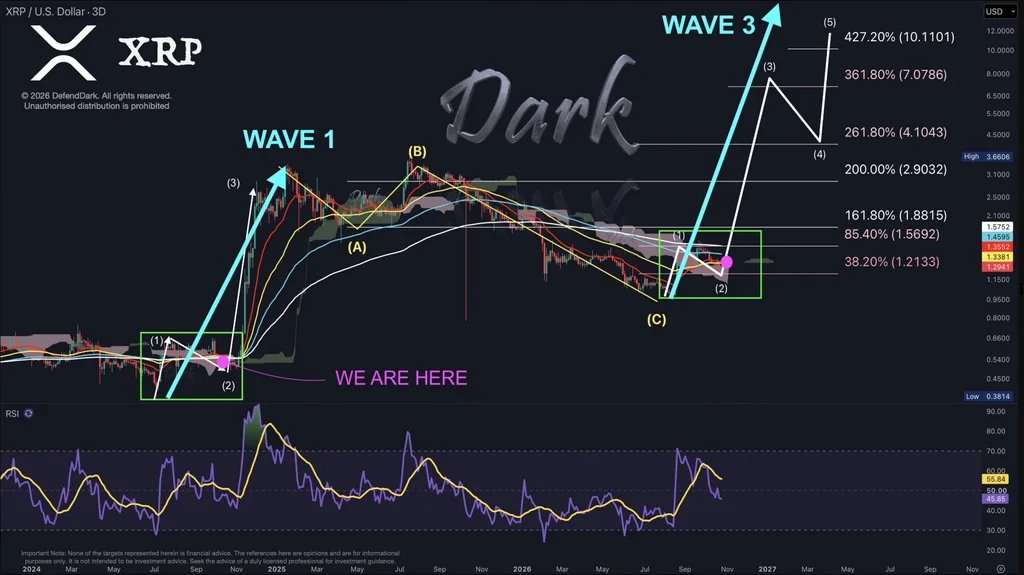
His earlier Elliott Wave chart outlined a potential rally toward the $10.1101 region. Getting there from current levels is a steep climb. At $1.10, XRP would need to rise roughly 809% to reach $10, and about 819% to reach $10.1101. Not a bounce. Put it next to the 51% the token has already shed over the past year, and the scale becomes clearer. Reaching $10 means roughly nine times today's price, which is a different category of claim from a recovery.
The scale also becomes clearer in market-cap terms. With roughly 63.52 billion XRP in circulation, a $10 price implies a market capitalization of around $635.2 billion. At $10.1101, that figure climbs to roughly $642.2 billion. Here's the thing: a few cents of difference between two chart targets translates into several billion dollars of market value. Small-looking numbers on a chart can hide very large capital requirements, and that's worth remembering whenever a target gets quoted without context.
What This Means for Holders
Put the pieces together and the article describes two competing theories of XRP's future. One says the token's value is tied to what Ripple does, so a recovery depends on its next announcement. The other, which Philion favors, says holders and developers should build uses for XRP themselves, with Flare as one vehicle. Price data can't settle which theory is right, because both can coexist with a falling chart in the short run. If you're working in this space, the thing to watch is whether any application built on the second theory produces usage that shows up outside the crypto community.
I'd put this in the "more significant than it looks" category, though not for the reason the bulls want. The shift Philion describes is really about who gets to define a token's story, and that's a legitimate question for any asset whose value depends heavily on a single issuer's behavior. And yet the evidence for a broader ecosystem is thin in what we have here. Market direction isn't something anyone in this piece can predict, and I won't pretend otherwise.
Looking ahead, the test is simple, even if the answer isn't. Holders who want the second theory to work will need applications people actually use, and developers will need reasons to choose this route over others. Similar token ecosystems have typically moved toward utility over time, but "typically" is doing a lot of work in that sentence. Until a concrete product shows real usage, Philion's three questions will remain the right ones to ask, and the $10 target will remain the gap everyone argues about.

Discussion
Sign in to join the discussion.