Pons lets creators price memecoins against Robinhood Stock Tokens. Early data shows heavy trading, but lasting demand is still the open question.


Memecoin launches aren't where you'd expect tokenized equities to find a job. On Robinhood Chain, Pons is testing exactly that. Creators launch a token priced against an asset tied to Nvidia or another public company, and that asset becomes part of how the new market trades, collects its reserve, and eventually graduates to Uniswap.
The mechanics are simple. A creator picks a reserve asset, and buyers trade against it on a bonding curve. When the reserve reaches its target, liquidity moves into a Uniswap pool. Robinhood's Stock Tokens provide economic exposure through tokenized debt securities, and they carry no shareholder rights. A memecoin paired with one doesn't become a slice of the company. What changes is where the stock-linked asset shows up: in markets built by outside developers rather than inside Robinhood's own app.
That's the part worth paying attention to. Pons is a working example of a developer using a tokenized equity as a building block, and it grew into one of the chain's busiest applications in just over two months. The real question is what keeps people coming back once the launch rush fades.
Robinhood Chain Opens the Door to Builders
Robinhood brought a large consumer business into its onchain push. In its mainnet announcement, the company said it served nearly 28 million customers across 38 countries. Stock Tokens were available through Robinhood Wallet in more than 120 countries, subject to local restrictions. The Arbitrum-based chain opened to independent builders, with Uniswap and Pleiades among its launch partners.
Activity picked up across the wider network. On its second-quarter earnings call, Robinhood reported more than $12 billion in DEX volume after the mainnet launch. At a September investor conference, CEO Vlad Tenev said about 200 Stock Tokens were live and that trading across the chain had recently reached billions of dollars a day. That backdrop matters, because it's the environment in which projects like Pons are trying to build markets around tokenized assets.
From Challenger to Heavyweight
Pons began operating on July 14, 2026. In a CoinGecko late-July snapshot, Pons accounted for 37.2% of all tokens launched on Robinhood Chain between July 13 and July 27, after the rival launchpad Noxa paused new launches.
The real surge came after a new V2 deployment on August 3, 2026. Bitquery's reconstruction of V2's first 32 days, running through September 3, shows 207,893 launches, $736 million traded on bonding curves, and at least $2.14 billion traded after tokens graduated to Uniswap. Momentum built late in the window. Daily curve volume rose about 55-fold over 11 days, while daily launches climbed roughly 17-fold.
That growth reached revenue too. According to CoinGecko, Pons overtook Pump.fun in daily protocol revenue on September 2, 2026, with $1.1 million. Stonkfun took its own daily lead four days later with $1.5 million, a sign of how fast new launchpads were piling into the same niche.
Activity hasn't faded as quickly as the launch headlines might suggest. A DefiLlama snapshot from September 28, 2026 showed $2.45 billion traded on V2 bonding curves over the previous 30 days, including $231 million in the final week. Those figures exclude trading after graduation. They show activity extending past the initial burst, though they don't tell us whether the pace will hold.
Why the Reserve Choice Matters
The reserve menu is what separates Pons from a typical launchpad. Creators can price a new token against ETH, a dollar stablecoin, or a tokenized asset. If the token graduates, that reserve becomes one side of the Uniswap pool. So someone who arrives to trade a memecoin can end up trading against a Stock Token without ever setting out to buy stock exposure.
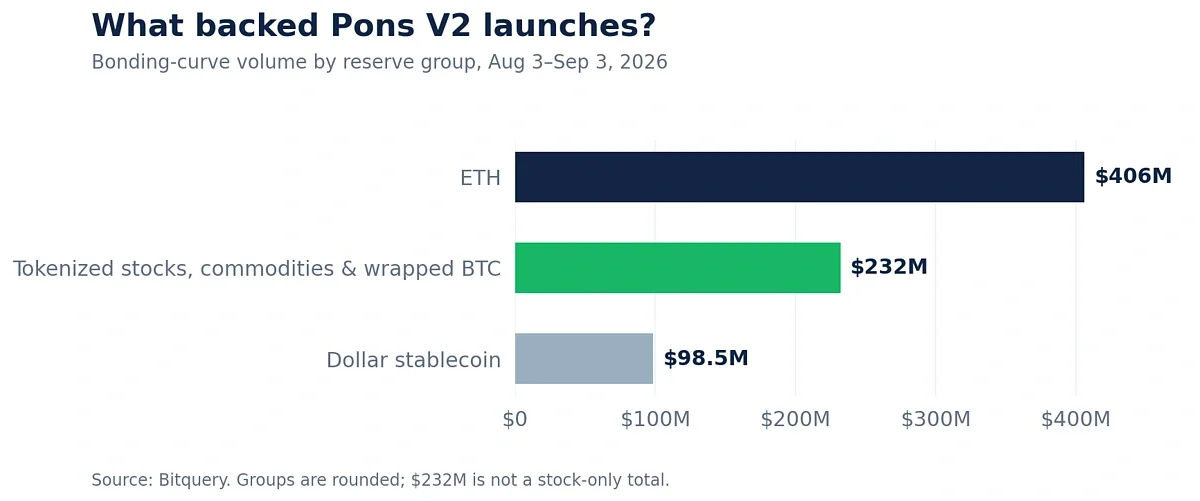
Creators have taken to it. In Bitquery's first 32 days of V2 data, 73,896 of 207,893 launches used a reserve other than ETH or the dollar stablecoin. Those launches generated $232 million of the $736 million traded on Pons' curves, close to one dollar in three. The category spans tokenized stocks, commodities, and wrapped bitcoin. Nvidia was the most popular reserve, followed by a SpaceX tracker, Trump Media, and SPY.
Figure 1. Alternative reserves accounted for nearly a third of Pons V2 curve volume, with tokenized stocks included alongside commodities and wrapped bitcoin.
Two graduates show where a stock-linked launch can lead. Orbio.so (ORBIO) launched against Nvidia's Stock Token and graduated to Uniswap. CoinGecko recorded its market cap rising from $13.6 million on September 15 to $87.5 million on September 28. Orbio says it converts half of token trading fees into AI inference credits for holders, and its dashboard reported roughly 547,000 gateway requests served by September 30.
Longbow (BOW) launched against the SPY Stock Token, which tracks an S&P 500 ETF. Its team reported 57 lending markets and more than 1,000 users in its first 30 days. A September 30 DefiLlama snapshot showed $4.37 million locked in its markets and about $857,000 in active loans. Lending gives the Longbow story a second act beyond the token's trading.
An Application Economy Takes Shape
Pons is already producing application-level economics. Bitquery measured $11.8 million in fees charged during the 32-day cohort. About $9.7 million went to holders of launch fee rights, spread across 103,904 recipients. For a young launchpad, that's a tangible flow, even though individual recipients earned very different amounts.
The model creates activity at several layers. Pons collects application fees, a graduated market generates Uniswap swap fees for liquidity providers, and every transaction pays gas on Robinhood Chain. Those streams land with different participants, so curve volume and secondary turnover read better as market activity than as a single revenue line. The broader point is that Pons adds new markets, new liquidity, and new transactions to the chain.
The PONS token sits apart from this machinery. Bitquery found that it predates the audited V2 launches, and it isn't listed in the V2 creation registry or referenced by the factory, router, or fee contracts. Whether V2 activity funds any PONS buybacks or burns, and through what mechanism, is still unclear.
Launch Volume Versus Durable Markets
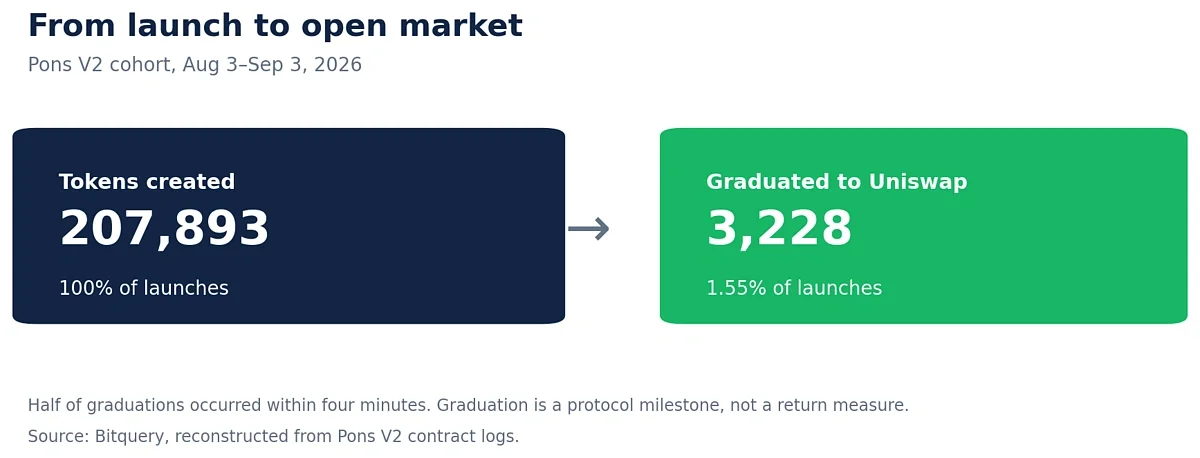
Most launches never reach the open market. Bitquery counted 3,228 tokens that filled their reserves and graduated to Uniswap, or 1.55% of the 207,893 created. Half of those graduations happened within four minutes, a sign of how fierce the competition is at launch. Graduates went on to generate at least $2.14 billion in trading, roughly three times the volume on Pons' curves. The handoff into Uniswap works at scale. The public data doesn't show whether stock-reserve launches graduated or kept liquidity at a different rate.
Figure 2. Most V2 launches did not reach Uniswap; the graduates generated substantial secondary trading.
The first month produced a large field of experiments and a much smaller set of markets with real secondary activity. In Bitquery's cash-flow measure, 66.8% of 314,736 trading addresses withdrew less reserve value than they deposited, with unsold tokens valued at zero. Among 2,339 graduates with sufficient trading history, the median price at the study cutoff sat 85% below its first-hour level. These snapshots don't measure final returns. They do show why discovery, retained liquidity, and participant outcomes will decide whether Pons matures.
Here's the thing: the commercial opportunity lies in repeat use. A Stock Token can be the asset a trader needs to enter a new market, the reserve a curve accumulates, and the asset paired with the token after graduation. That keeps Robinhood's assets moving through third-party activity, and it gives Pons more ways to set a launch apart. Whether that turns into recurring demand depends on which markets stay useful after the novelty of new tokens wears off.
That's the test to watch. A like-for-like comparison of stock-reserve pairs at seven and 30 days would show which markets still trade, how much liquidity remains, and whether traders return. Setting those patterns against ETH and stablecoin launches would reveal whether the reserve choice actually changes how long a market lives. Returns after costs, and the value of unsold holdings, would answer a separate question about who benefits.
Pons has turned Robinhood's Stock Tokens into working parts of independent crypto markets. Its flexible reserve menu lets creators choose how a token launches, gives traders a new way to use stock-linked assets, and carries successful pairs into Uniswap. That's a concrete result for both Pons and Robinhood Chain. The next step is converting early momentum into recurring markets with retained liquidity and better outcomes for participants. The first cohort proves the use case. Durable adoption is still ahead.


Discussion
Sign in to join the discussion.