Bitunix pitches deep order books and tight spreads as its main draw for perpetual futures and spot traders, with up to 200x leverage on eligible contracts.
Bitunix is making one argument louder than most of its rivals: liquidity, not interface polish, decides whether a trader gets filled at a fair price. The platform runs spot and perpetual futures markets and says it offers up to 200x leverage on eligible contracts, where local rules allow it. That qualifier carries weight. Product availability varies by jurisdiction, and high-multiple perpetuals sit among the riskiest products a retail account can touch.
Where the Platform Fits
Bitunix says it lists more than 1,200 markets across USDT-M, USDC-M, and coin-margined perpetuals, plus over 400 spot assets. Bitcoin, Ethereum, Solana, and BNB are among the tradable assets. The company, established in 2021 and registered in Seychelles, says it serves traders in more than 150 countries and regions.
Those numbers put it in a crowded field. Competition in crypto derivatives is intense, and most venues now advertise similar pair counts and fee schedules. What separates them in practice is how deep the order book runs when volatility spikes, and how much slippage a position absorbs on the way in and out. Bitunix is betting that its answer to that question is strong enough to win share.
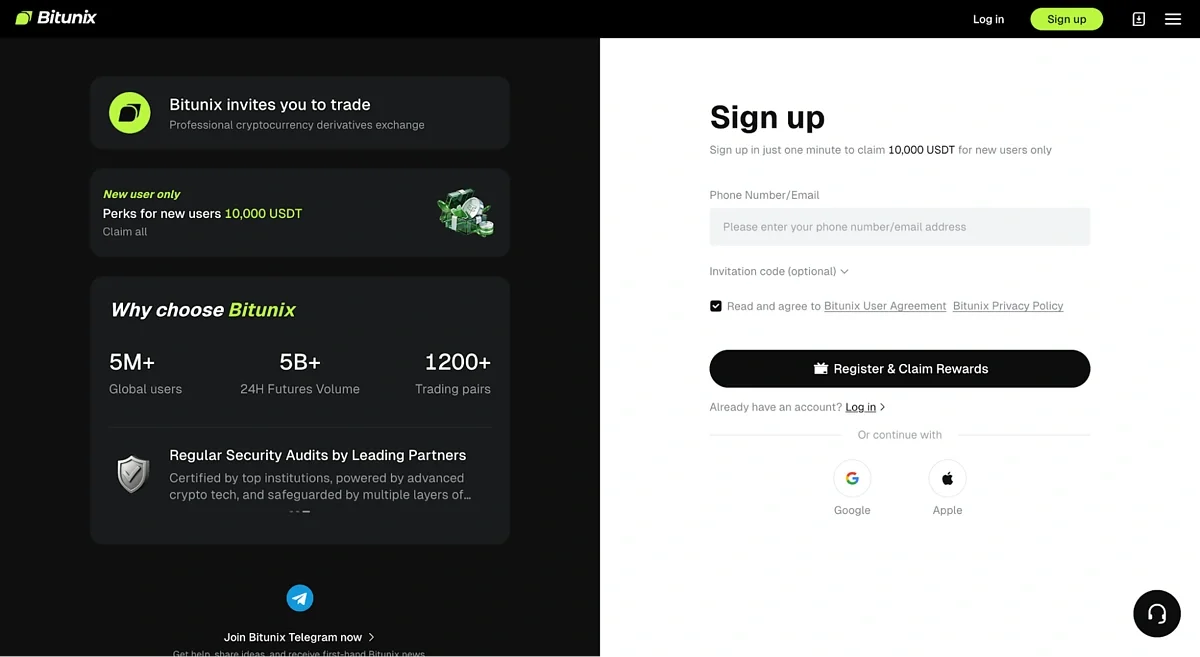
The company reports 5M+ registered users and more than 5 billion USDT in daily trading volume. It cites a top-10 position among derivatives venues on CoinGlass, a #11 ranking on CoinGecko, and strong inflow performance on DeFiLlama. Those are third-party data platforms, but the rankings come from Bitunix's own citations, so they're worth checking against the live dashboards before you lean on them.
The Liquidity Argument
Here's the thing about liquidity claims: they're easy to make and hard to verify from the outside. Thin books force traders to widen their acceptable slippage, and the gap between bid and ask grows when few resting orders sit near the mid price. Anyone who has tried to close a size position during a fast move knows the cost.
Bitunix says it pools liquidity from independent market makers, retail traders, and institutional participants. The idea is that aggregated flow keeps spreads narrow and execution smooth on major pairs. That's a reasonable design goal, and it's the right one to optimize for if you're trying to win professional volume. Whether the spreads hold during a liquidation cascade is the question that matters, and a press description can't answer it.
The company also says it runs market surveillance and risk management systems to deter fraud and manipulation. It describes its price feed and liquidation mechanics as built for accuracy and platform stability. Those are the right systems to describe. Traders should ask how the liquidation engine behaves under stress and how the platform's price feeds are sourced, because those mechanics decide who gets hurt in a fast market.
Product Features Worth Knowing
Multi-Network Deposits
Bitunix supports deposits across several blockchain networks, including Ethereum, Bitcoin, Solana, and Cardano. Multi-network support lowers friction for users who hold assets on different chains, though it also means the network chosen for a deposit has to match what the platform expects. A mismatched transfer is still one of the most common ways users lose funds on any exchange.
Spot, Futures, and Trading Tools
Crypto trading is the core business. Spot users can place market or limit orders, and the platform offers convert and dollar-cost averaging tools alongside them. On the derivatives side, Bitunix pairs perpetuals with copy trading, a futures grid, and a set of order tools it calls Chart Trading 2.0, which includes Super Alert, Fixed Risk, and Multi-Trade. Minimum notionals start at about $10 on listed products, which keeps entry cheap for smaller accounts.
VIP Tiers and Referrals
Fees scale with activity. VIP status depends on 30-day trading volume or the value of asset positions held on the platform. VIP 1 starts at a 300 USDT equivalent threshold, and the company says VIP 8 can qualify for 0% maker fees on eligible tiers. Referral rebates can reach 40% of transaction fees for invited users who register and trade. Fee schedules change, so the live table is the one to trust.
Support and Community
Customer support runs through a help center covering deposits, withdrawals, and spot and futures trading, plus a chatbot and 24/7 automated assistance. Bitunix says live agents respond within about a minute. It also runs weekly live sessions on Telegram and AMA sessions on Twitter.
Fees in Practice
On spot markets, Bitunix lists a maximum fee of 0.1%, with a 0.08% maker fee and a 0.1% taker fee. On futures, the stated maximum is 0.06%, split into a 0.02% maker fee and a 0.06% taker fee. Higher VIP tiers reduce those rates. VIP 7 pays a maximum of 0.0325% on spot and 0.03% on futures, according to the company's figures.
Fees on deposits and withdrawals depend on the asset and the network used. Withdrawal costs are listed per token in the platform's help center, and they can outweigh trading fees for smaller transfers, so check them before moving funds.
Trust Signals and Their Limits
Bitunix publishes a Merkle-tree proof-of-reserves report. In its most recent snapshot, it reports reserve coverage of 156% for BTC, 108% for ETH, and 105% for USDT, with roughly $239 million in audited reserve value. The company also cites custody work with Fireblocks, a $50 million USDC Bitunix Care Fund, and ISO/IEC 27001:2022 certification.
Proof-of-reserves reports are a useful transparency step, but they show assets at a point in time. They don't reveal liabilities, the terms of custody arrangements, or how a platform would behave in a bank run. Treat the certifications and reserve figures as a starting point for due diligence, not a verdict.
The company also reports a regulatory footprint that spans U.S. FinCEN money services registration, Canadian FINTRAC MSB status, AUSTRAC in Australia, and several other jurisdictions, with more applications pending. Registration status can change, and availability for any given user depends on where that user lives.
Getting Started and Staying Cautious
Registration takes a few steps. Users sign up with an email address or a mobile number, verify the code sent to them, and then fund the account. Identity verification applies when users request withdrawals, use fiat services, or seek higher limits. Mobile apps are available on the Apple App Store and Google Play, so traders can manage positions away from a desktop.
The bigger question for any derivatives trader is how much risk the account can absorb. At 200x, a small adverse move can wipe out a position. Liquidity claims don't change that math. Start with small size, learn how the liquidation price is calculated on each contract, and watch how spreads behave during volatile sessions before committing serious capital.
Bitunix is clearly aiming to become a deep-liquidity venue for active traders, and its fee tiers, referral structure, and reserve disclosures are built around that goal. If the spreads and fills hold up through the next sharp market move, the pitch will look stronger. Until then, the claims are worth testing with your own money, in small amounts, and not taking on faith.


Discussion
Sign in to join the discussion.