Bitcoin fell 56% from its October 2025 peak as outflows topped $6 billion, while Grayscale describes the downturn as unusually long but shallow.

A bear market defined by time
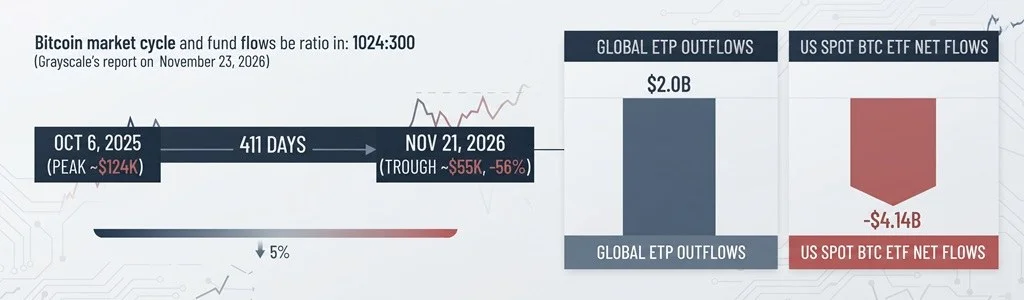
Bitcoin’s current downturn stands out for how long it has lasted, rather than how far prices have fallen. Grayscale research head Zach Pandl’s report counts at least 411 days from the October 6, 2025 peak through November 23, 2026. By the firm’s records, that makes this the longest bear market and the shallowest by percentage decline.
That combination complicates the usual shorthand for a market cycle. A prolonged decline can weigh on confidence even when its peak-to-trough loss is smaller than in earlier downturns. The duration says something about how slowly prices have recovered; the drawdown says something different about the scale of the fall. Neither measure, on its own, tells investors when the downturn will end.
The price decline and its limits
Bitcoin reached a daily high near $124,824 on October 6, 2025, then fell to an intraday low of $55,254 on November 21, 2026, a 56% drawdown. By the time Grayscale published its analysis, the price had recovered to about $62,000. That rebound offers a snapshot of the market’s movement, not evidence that a lasting recovery is underway.
Grayscale gave no date or price target for a durable recovery. That restraint matters: a move up from an intraday low can ease immediate pressure without settling whether buyers are returning in force. For readers tracking the cycle, the distinction is between a temporary bounce and a change in the conditions behind the downturn.
LATEST:
Grayscale says this is now Bitcoin's longest bear market on record after BTC fell to $55K but also the shallowest, lasting at least 411 days but with only a 56% drawdown. pic.twitter.com/lwvXGYnIBU
— CoinMarketCap (@CoinMarketCap) November 24, 2026
Outflows and positioning point to strain
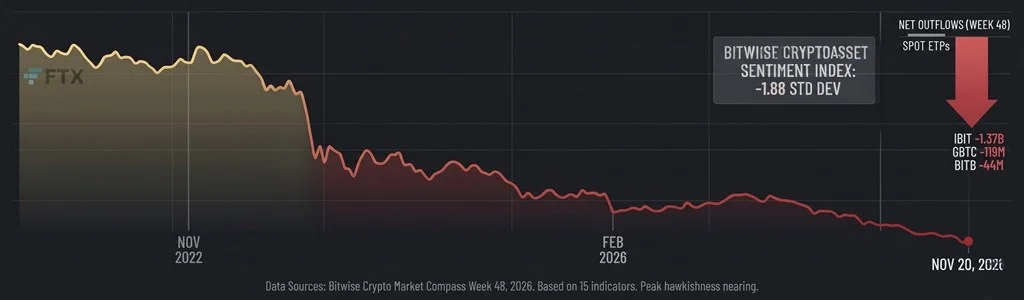
Investor flows have weakened alongside prices. Global digital asset exchange traded products recorded more than $2 billion in recent outflows, while U.S. spot Bitcoin ETFs saw $4.14 billion in net outflows through November 23, 2026. Together, the two categories shed more than $6 billion.
Those figures point to a meaningful withdrawal of capital from products that had provided investors with a route to digital asset exposure. They don’t establish why each investor sold, or whether the money has left the market entirely. Still, when outflows persist during a downturn, they can make a sustained recovery harder to read: price weakness and fading demand may reinforce each other.
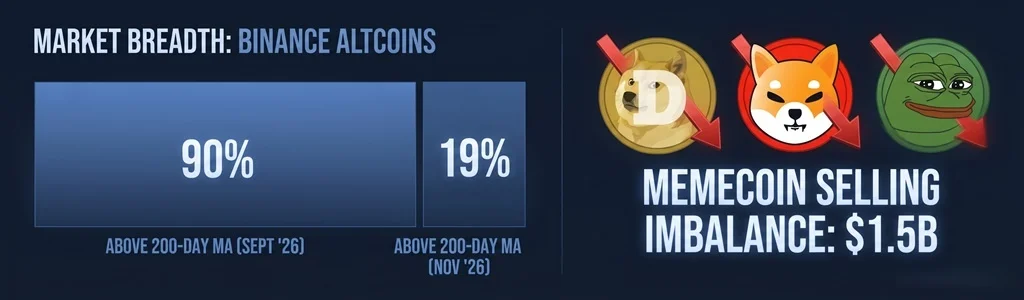
Grayscale also points to rising stablecoin redemptions and Bitcoin futures open interest falling toward levels last seen in summer 2026. Redemptions and lower open interest describe different parts of market activity, but both suggest that some participants are pulling back or reducing exposure. The firm says these shifts coincide with technical indicators and market measures signaling oversold conditions.
Oversold readings can describe how far or how quickly a market has fallen; they don’t guarantee that prices have reached a floor. That’s the practical limit of the signal. It may help explain why a rebound is plausible, while leaving the question of durable demand unanswered.
Technology sentiment adds another variable
Grayscale’s near term outlook puts more weight on uncertainty around artificial intelligence than on blockchain fundamentals. Its report cites developments since early November 2026, including midterm election results that could affect data center construction, temporary leadership changes at Nvidia, service and organizational outages, Anthropic’s planned initial public offering, and reports of AI models making progress on mathematical problems.
The list brings together policy, corporate, operational and technical concerns. Their common thread is uncertainty over how fast the AI sector will expand and how that expansion might affect expectations for related assets. Grayscale isn’t presenting these developments as a single cause of Bitcoin’s decline; it’s treating them as part of a broader set of signals that could shape market sentiment.
The firm remains optimistic about AI driven productivity gains and public networks, while acknowledging near term risks for assets connected to the sector. It describes public blockchain fundamentals as solid and says current valuations may present opportunities for medium and long term investors. That view leaves a clear tension: favorable long range expectations can coexist with weak prices and unsettled short term sentiment.
Institutional ownership may help explain the drawdown
The period before the downturn included broader institutional access through U.S. spot Bitcoin ETFs. Grayscale suggests that a wider institutional holder base may be associated with the pullback’s relatively limited percentage decline, while stopping short of assigning the shallow drawdown to any single cause.
This is more significant than it looks, but the evidence should be read carefully. A growing pool of institutional holders could help explain why the decline has been less severe than the length of the downturn might suggest. It doesn’t show that institutions have insulated Bitcoin from selling pressure, especially with ETF outflows now part of the picture.
Wealth management platforms continued buying Bitcoin ETPs for nine straight quarters through September 30, 2026, accumulating exposure equivalent to 144,307 BTC. That steady demand sits alongside debate over realized losses among long term holders and Bitcoin’s sensitivity to changes in liquidity and technology stocks. If you’re working in this space, the mix matters: earlier buying establishes a record of demand, while current flows show whether that demand is continuing.
What to watch next
Weekly ETF and ETP flow reports for the week ending November 27, 2026, will offer the next clear read on institutional positioning. One week of data won’t settle the larger question, but it can show whether recent outflows are continuing or easing. And yet, flows are only one part of the picture.
The cycle’s defining feature remains the unusual combination of record duration and a comparatively restrained decline. The firm’s analysis points to weak investment flows, softer futures positioning and technology related uncertainty, alongside its view that blockchain fundamentals remain solid. A long wait for recovery. Whether that gap between current market pressure and longer term optimism closes will depend on evidence the report doesn’t yet provide.

Discussion
Sign in to join the discussion.