ULTRA TX introduces synchronized composability for L1 and L2 blockchain interactions, streamlining transactions and enhancing user experiences.

Understanding Synchronous Composability with ULTRA TX
This section shines a spotlight on a topic that's likely to redefine how layer 1 (L1) and layer 2 (L2) solutions interact within blockchain networks: synchronous composability. At the heart of this transformation is ULTRA TX, a concept proposed by Gwyneth, which introduces a novel architecture allowing blocks on both L1 and L2 to become programmable and composable.Key Overview of ULTRA TX
To break it down, ULTRA TX signifies a substantial L1 transaction that serves as the linchpin for each L1 block—though it’s worth mentioning that enforcement of this mechanism is still forthcoming. This transaction accommodates a comprehensive range of elements, which includes account-abstracted transactions and multiple L2 blocks. These are orchestrated by a master builder, which not only compiles these interactions but also integrates the outputs from any cross-chain operations. Gwyneth emerges as the enabling execution framework, leveraging a modified REVM (Ethereum Virtual Machine) that’s designed to work in tandem with a block builder relying on Reth. It manages to bridge execution between L1 and L2, effectively allowing simulation and later on-chain replay of these actions in a cohesive manner. This ushers in an era of synchronous composability—where transactions across various layers can occur simultaneously and verifiably, enhancing atomicity without necessitating a change in L1 protocols.The Underlying Issues Driving this Innovation
The need for this system stems from the current challenges in cross-chain user experiences. Presently, processes are characterized by fragmented interactions, where transactions are dependent on asynchronous confirmations—the infamous "hope it lands" approach. This results in several pain points: - It's not possible to enforce invariants across transactions easily. - Inter-layer calls requiring return values are cumbersome and inefficient. - L2s have a vested interest in collective settlement, desiring to confirm transactions and share data seamlessly with every L1 block. The ultimate goal with ULTRA TX is to redefine how these blockchains interact, creating a fluid environment where L1 and L2 can operate as a single, programmable entity—effectively a "programmable container" for transactions that are executed, communicate, and finalize in an atomic manner.Key Components and Their Roles
The architecture of ULTRA TX involves several pivotal components: - **Custom REVM (Gwyneth REVM)**: This modified version runs transactions across multiple chains in a unified process while recording a comprehensive journal of operations. - **ULTRA Block Builder**: Tasked with selecting and executing transactions across both L1 and L2, this component maintains fee limits, compiles evidence, and prepares ULTRA payloads. - **Stateless Validator**: This unit transforms execution traces into succinct proofs, enabling verifiers to re-execute without accessing the entire state. - **Block Proposer**: This element organizes everything into an EIP-4844 blob before submitting the ULTRA transaction to L1. - **Execution Extension (ExEx)**: This watches over L1, interprets ULTRA payloads, recreates L2 blocks via the Engine API, and manages any potential reorgs. - **SimpleMultiChainDB & Global Nodes Map**: This lightweight layer ensures the REVM has read/write capabilities across numerous chains, seamlessly connecting separate processes.How ULTRA TX Operates: A Step-by-Step Breakdown
Here's how ULTRA TX operates in real-world scenarios: - **Gathering Inputs**: Initially, pending L1 account-abstracted transactions and L2 transactions pool together for execution. - **Local Execution**: The builder runs these inputs through the Gwyneth REVM, simulating cross-chain interactions as needed. - **Recording Transactions**: A meticulous journal keeps an account of all changes, which ultimately create the proofs necessary for verification. - **Packaging the Data**: Once the execution meets the predetermined gas and byte constraints, the builder compiles an ULTRA payload that includes all significant transaction diffs and their associated proofs. - **Proposing to L1**: Finally, the proposer sends this ULTRA payload as an EIP-4844 transaction to the L1 rollup contract. This series of processes culminates in every L2 receiving a block that's intricately linked to its corresponding L1 transaction—syncing their operations in a manner previously thought unattainable.A Practical Example
Consider Alice, who attempts to swap token X for token Y across L2s A and B, contingent on a successful L1 rebalance. Through her interactions: - She initiates a transaction on L2-A. - As her contract prompts an inter-chain swap, the actions simultaneously trigger necessary processes on L1. - Ultimately, if her conditions are met, not only does the swap complete, but the required adjustments to L1 are executed within the same ULTRA transaction. Alice experiences this whole series of interactions as a singular, atomic outcome, illustrating the power and efficiency of synchronous composability facilitated by ULTRA TX.Developer Insights: Moving ERC-20 Tokens Across Layers
For developers looking to implement cross-chain token transfers, the practicalities offered by the ULTRA framework are significant. For example, consider a function designed to move ERC-20 tokens from L2-A to L2-B. With defined smart contract calls, Gwyneth handles the routing of accounts and token minting during the operational phase. This nuanced control allows for clear, enforceable cross-chain logic, ensuring that actions on one layer directly correspond to expectations on another. Moreover, replays enforce fidelity to these expectations, maintaining atomicity and consistency.Ensuring Security Through Atomicity and Validation
The ULTRA framework offers robust safety mechanisms: - Each operation is contained within a unified proof structure, maintaining perfect integrity. If any component doesn’t align, it triggers a full revert, safeguarding the entire transaction process. - The ordered placement of ULTRA transactions within blocks allows the latest L1 state to be referenced accurately by any subsequent processes. - Additionally, the system has built-in provisions for handling L1 reorgs, allowing L2s to revert to their appropriate states as necessary. - Thanks to the use of witnesses, verification can be conducted independently without needing the entire state, helping catch any inaccuracies or fraud.What Remains Unaffected
Notably, ULTRA TX is designed to operate without necessitating a hard fork of L1. It achieves its objectives through contract-enforced rules and comprehensive proofs. Builders will need to enhance their efficiency in executing and generating witnesses for competitive advantage while still aiming for real-time validations that sync within stringent time frames.Visual Explanations of Transaction Flows
For those who thrive on visual learning, several diagrams illustrate various transaction flows across layers, mimicking the real-time backend operations that occur through the ULTRA TX pipeline. Each scenario provides clarity on how transactions evolve across chains.Example: L1 to L2 WETH Transfer
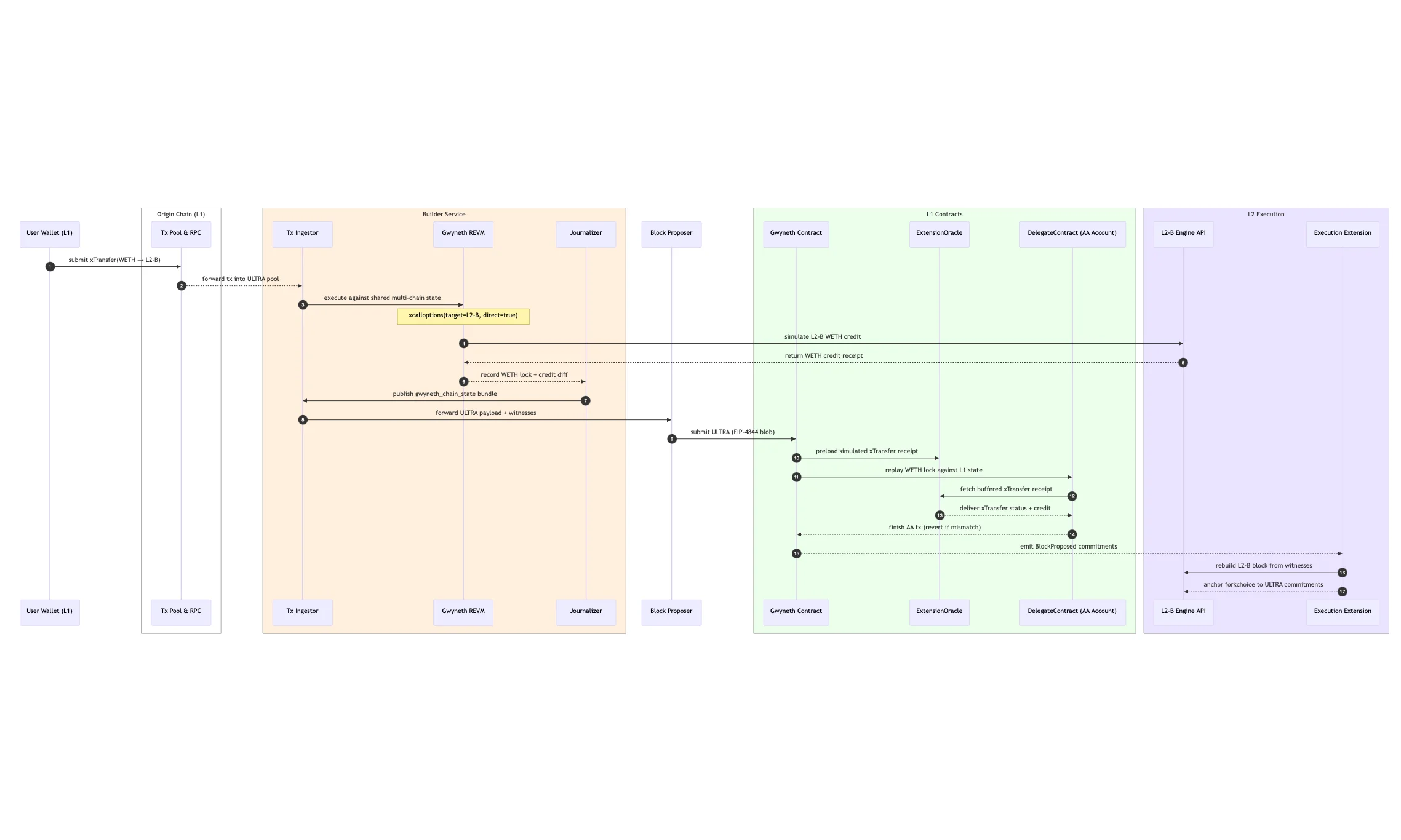 Key takeaway: Synchronization allows for the simultaneous locking of WETH on L1 while crediting L2-B, ensuring the ExtensionOracle accurately reflects recorded actions.
Example: L2 to L1 WETH Transfer
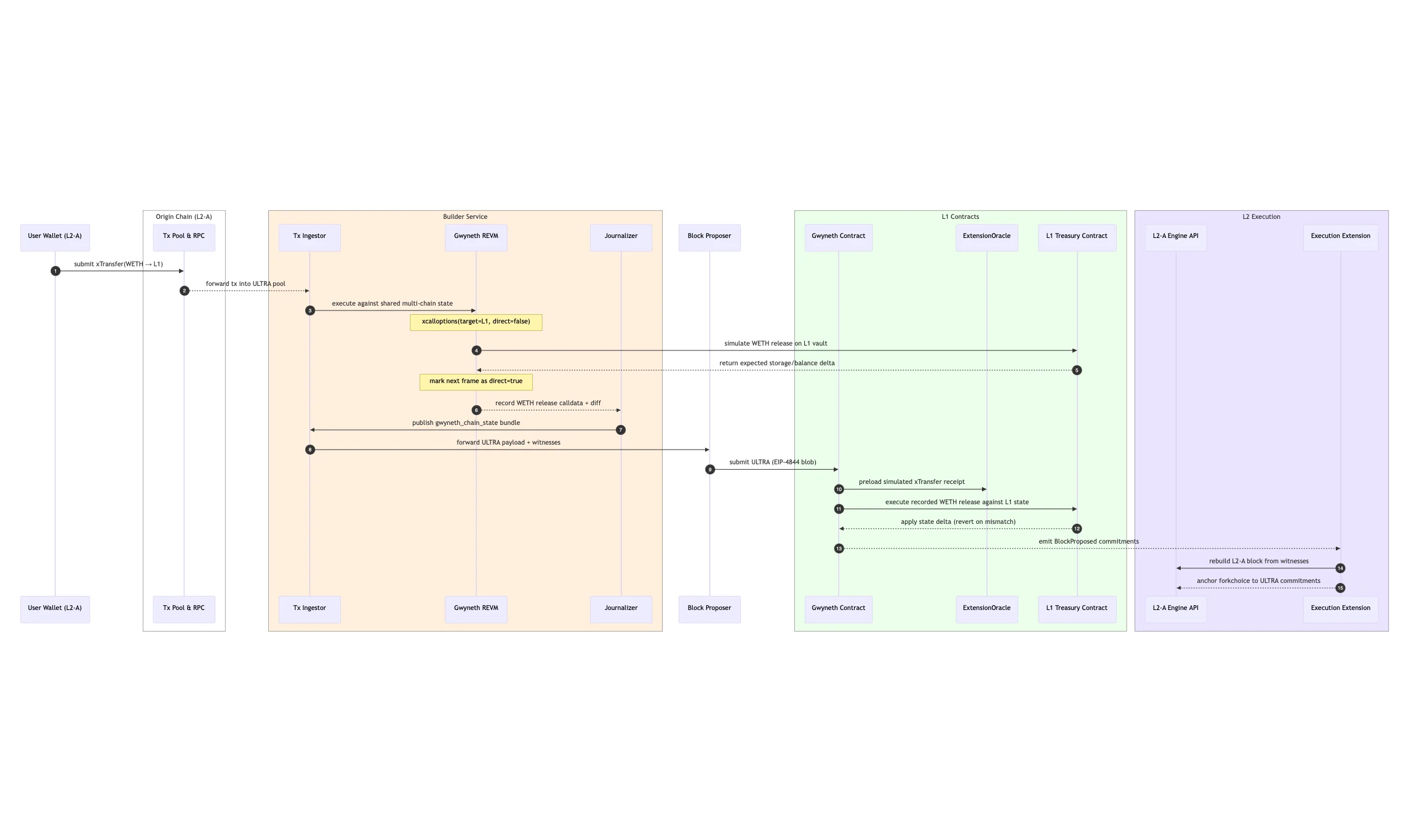 Key takeaway: Transfers from L2 directly affect the L1 vault within the same ULTRA container, maintaining rigorous checks throughout the transaction lifecycle.
Example: L2 to L2 WETH Transfer
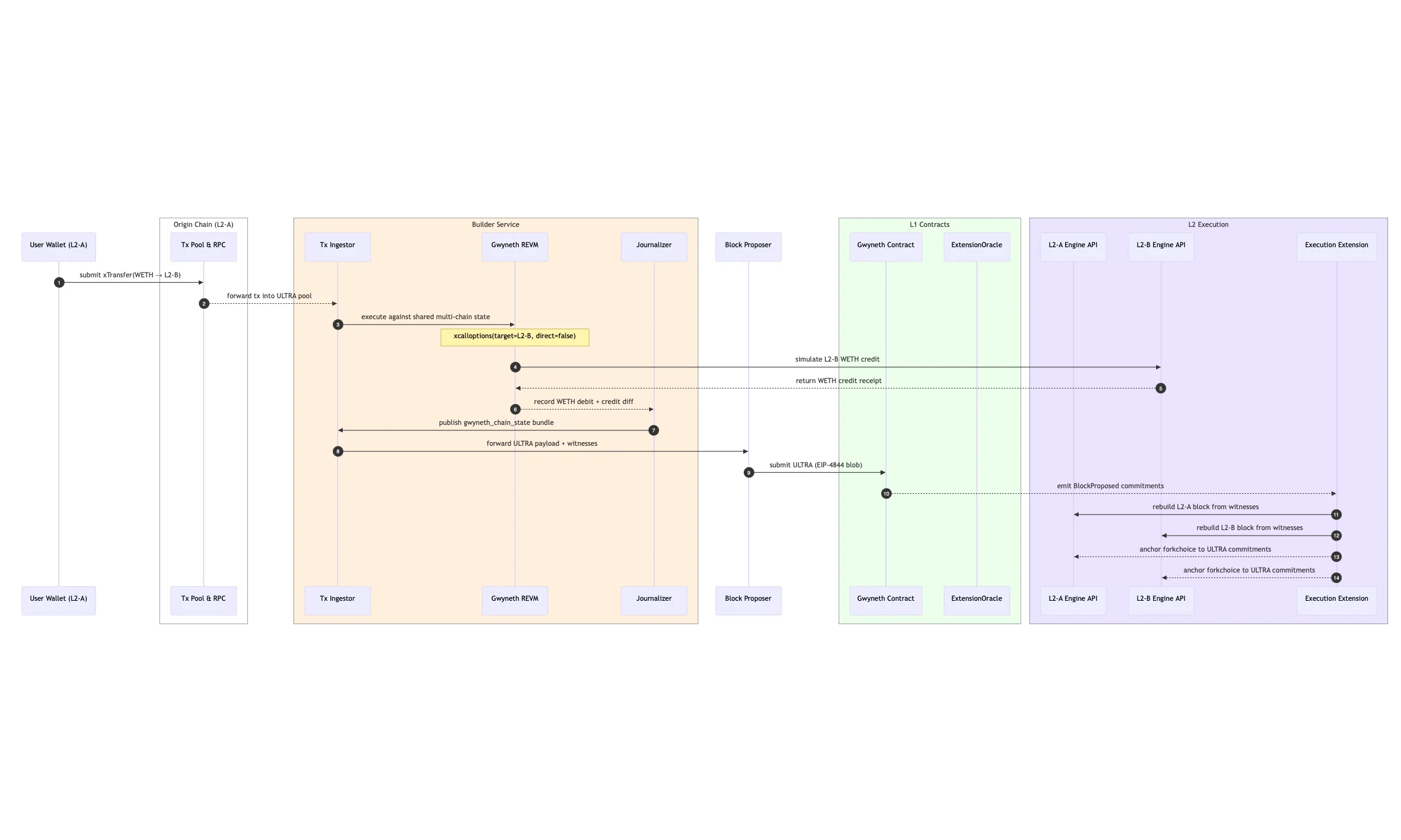 Key takeaway: Transactions between L2s leverage the same builder journal, ensuring smooth debiting and crediting processes without requiring L1 intervention during the sequence.
FAQs About ULTRA TX
Questions arise frequently, and it’s essential to clarify: - **Q: Why must ULTRA be prioritized at the top of the block?** A: This positioning is necessary so all transactions can access the latest L1 state, creating a more coherent transaction flow. - **Q: Can conventional L1 transactions still be integrated?** A: Absolutely, these transactions can be added within the ULTRA container as account-abstracted transactions, allowing flexible execution as deemed fit by the builder.The complexity of L1→L2 interactions is often underestimated. Understanding how they work can be pivotal for developers and protocol designers. When it comes to calls that return values, the process involves simulation—a mechanism where the builder captures outputs. This is an essential part of the on-chain replay conducted by the ExtensionOracle, which ensures that those outputs are retrievable when needed.
Now, think about how this structure handles scenarios like an L1 reorg. It's not just a standard reset; the ExEx system plays a critical role here, re-aligning each L2 chain to the latest approved version of the L1 block. This ensures that the integrity of transactions is maintained, but it also highlights an often-overlooked aspect of blockchain architecture: the fluidity needed for cohesive operation across layers.

Discussion
Sign in to join the discussion.