Linked Accounts empowers organizations to manage finances more effectively by segmenting funds while maintaining a unified treasury view.
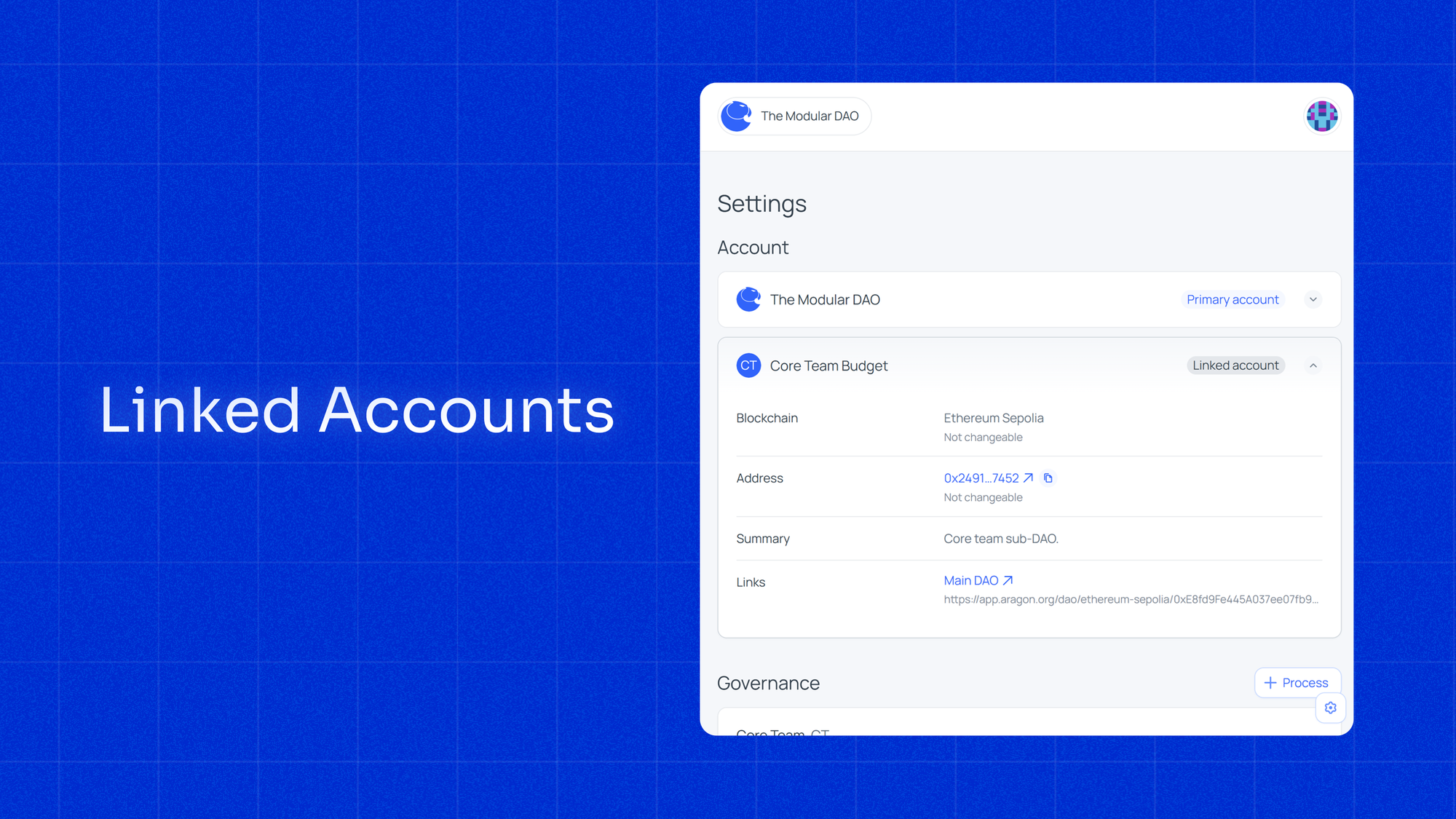
Organizations typically operate with multiple financial accounts, each serving distinct purposes and stakeholders. Having dedicated budgets for payroll, incentives, and long-term reserves is essential for clarity and efficiency. Yet, when these funds reside within a single on-chain treasury account, tracking their allocation can become cumbersome, leading to manual accounting issues and limited visibility for stakeholders.
Linked Accounts addresses this challenge head-on.
By allowing organizations to create separate accounts for different financial needs, Linked Accounts facilitates a clearer segmentation of funds while maintaining an overarching view of the organization's financial health. Different account types can serve distinct functions—such as operations budgets, rewards pools, or grant programs—without sacrificing governance and treasury visibility.
What’s New
Purpose-Specific Treasury Accounts
Organizations can now efficiently allocate their funds into accounts specifically tailored to their roles. Each account retains its governance structure and permissions while remaining visibly part of the organization. This flexibility is essential for organizations managing diverse financial requirements. For instance, some funds may need to be earmarked for immediate operational costs, while others could be set aside for long-term strategic goals. The ability to clearly differentiate these accounts helps maintain financial integrity and prevents misallocation.

Unified Treasury View
The new dashboard provides a consolidated view of linked accounts, enabling users to see the complete financial picture without manually reconciling transactions. Users can also access the specific balances and transaction histories of each account easily. This unified view is more significant than it looks—it's not just about convenience. Organizations can respond more rapidly to financial changes when they can see their resources laid out coherently, avoiding potential missteps that come from incomplete information.

Smart Proposal Handling
Linked Accounts come with granular permissions, meaning the system automatically filters available actions based on the selected account when proposals are created. This feature prevents inappropriate actions from being proposed and streamlines collaboration across accounts. This is how organizations can better align their governance processes with actual financial activities, reducing the risk of errors and enhancing accountability. If you're working in this space, you know how challenging it can be to maintain clarity between different accounts and their intended uses; this approach could simplify that complexity.
How It Works
Establishing linked accounts does not involve deploying new smart contracts. Instead, a bi-directional acknowledgment on-chain creates a relationship between accounts, unified within a single operational structure. This acknowledgment ensures intentional connections and prohibits spam or impersonation. Here’s the thing: this model minimizes the risks associated with account interactions, ensuring organizations can confidently manage their finances without fear of external disruptions.
Importantly, each organization maintains its autonomy; linking accounts preserves their status as independent smart contract executors with distinct permission systems unless changes are made through governance. This flexibility allows organizations to adapt to changing needs without overhauling their entire system, making it easier to scale operations as necessary.
What’s Next
Linked Accounts lays the groundwork for policy-driven financial automation. When funds are allocated to purpose-specific accounts, systems can more easily automate actions based on the explicit roles of those funds, eliminating ambiguity in governance intent. This capability can transform how organizations approach their financial strategy.
For instance, a portion of protocol revenue could automatically be funneled into a rewards account that executes distribution independently. This model can extend to other operations like buybacks and fund burns, all while remaining integrated within the broader treasury view. (And this is the part most people overlook.) By automating these financial decisions, organizations can focus their resources on growth and innovation, rather than being bogged down in administrative tasks.
Such a foundation paves the way for organizations to implement clearer, more efficient monetary policies that are simple to execute and less prone to oversight. That said, there’s also the challenge of ensuring that these automated processes are transparent and trustworthy, an aspect that organizations need to prioritize.
Implications and Future Outlook
The advent of Linked Accounts represents more than just an advancement in financial technology; it signals a shift in how organizations manage their treasuries and governance processes. With autonomy preserved, organizations can experiment with financial control structures without losing sight of their overall financial health. The introduction of automated, policy-driven actions could significantly reduce human error and enhance operational efficiency. Nevertheless, the underlying algorithms and governance mechanisms must withstand scrutiny to prevent misuse or unintended consequences.
In the near future, expect to see more organizations adopting similar strategies to improve financial agility. Transparency will remain a hot topic; stakeholders will demand clarity on how automated systems make decisions and how funds are being used. Organizations that can bridge this trust gap while effectively utilizing Linked Accounts may find themselves at a significant advantage.
Get Started
For teams keen to adopt Linked Accounts in their on-chain infrastructure, connecting with the Aragon team is a recommended next step. They can assist in setting up and tailoring the system to meet your operational needs.
Organizations interested in automating financial flows, including policy-driven mechanisms, should consider Linked Accounts as the structural bedrock for enhancing their financial processes. Engaging with Aragon can reveal the potential pathways and benefits this new feature offers.


Discussion
Sign in to join the discussion.