Aragon's new user profiles leverage ENS to streamline governance and access control, ensuring seamless integration across multiple platforms.
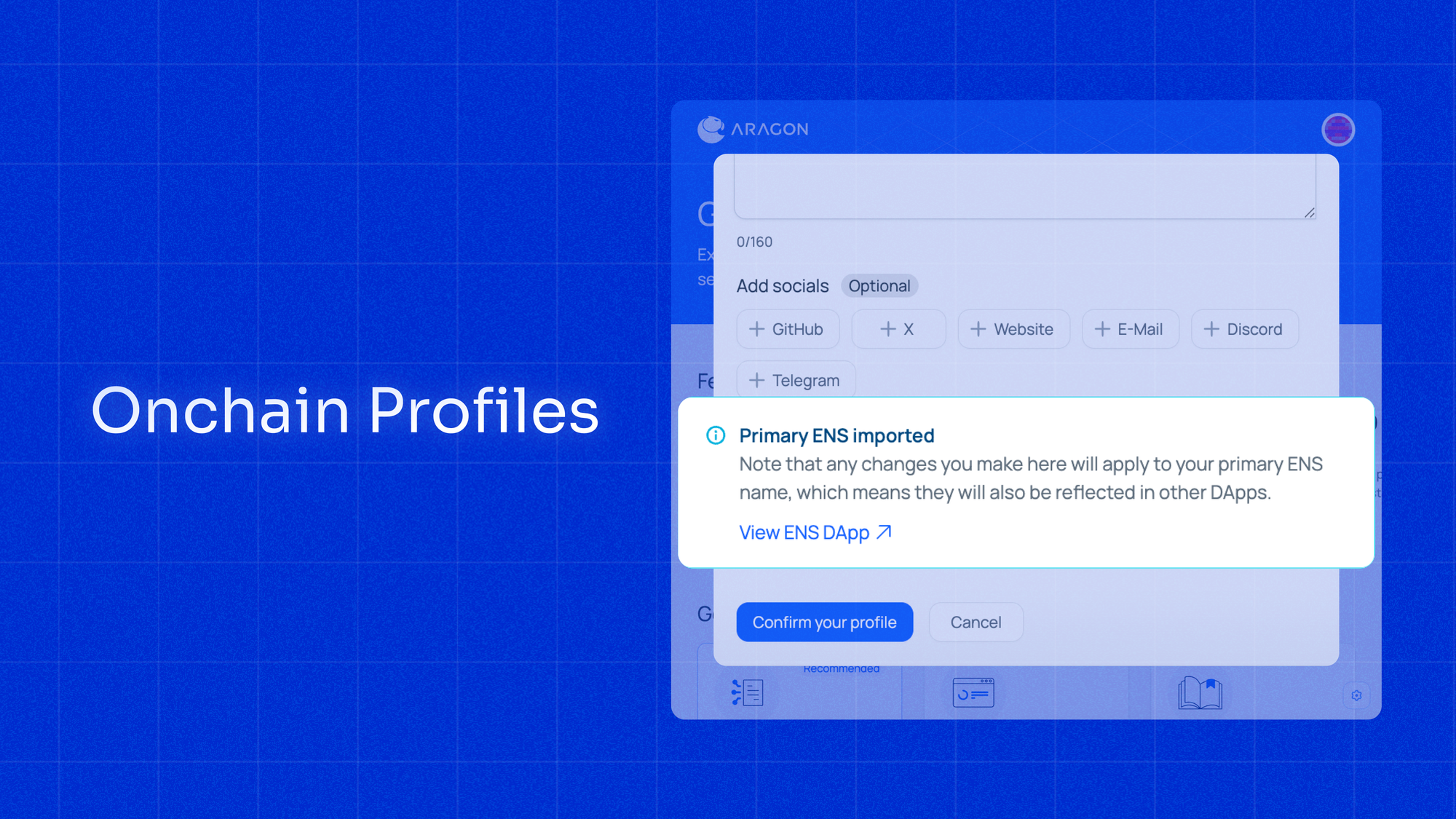
Tracking transactions and approvals in decentralized governance can be challenging when relying solely on Ethereum addresses. This lack of recognizable identifiers complicates access control and operational flows, particularly during critical actions such as multisig reviews and voting. While some platforms offer user profiles, these are often locked within proprietary systems, preventing genuine interoperability when users switch tools or providers.
The Need for Recognizable Identifiers
The struggle to establish clear user identities in decentralized governance systems is a significant barrier to effective collaboration and decision-making. Instead of navigating an array of anonymous addresses, stakeholders benefit from visible identifiers that provide context and credibility. Traditional methods often rely on clunky manual processes for verification and approval, which can introduce delays and confusion. This lack of clarity can hinder efficient workflows, particularly in high-stakes scenarios such as voting on critical proposals. If users could seamlessly identify each other, it might foster better communication and trust. However, the gap often persists, raising questions about how decentralized governance can evolve without addressing identity verification.
Aragon Profiles tackle this issue by utilizing open standards, directly reading and managing Ethereum Name Service (ENS) records through the Aragon app. This new integration allows users to customize their profiles—names, avatars, bios, websites, and social links—while ensuring that governance participants can publish specific delegate statements using an open ENS record format.
Opening Doors for New Users
For those who haven’t registered an ENS, the Aragon app now facilitates the claim of free aragon.eth subnames. This move is critical for broadening access to user profiles and enhancing engagement within governance frameworks. This approach significantly lowers the barrier to entry for newcomers, allowing them to participate in decentralized governance without having to navigate the complexity of registering a full ENS name. It democratizes the process, inviting more participants into what has traditionally been a fragmented and gated space.
What’s New
ENS Profiles Integrated into the Aragon App
The Aragon app now features the ability to resolve and display ENS profile records directly from the Ethereum mainnet. This includes essential user information such as:
- ENS name
- Avatar
- Bio or description
- Website
- Social links
By using ENS as the foundational profile layer, Aragon eliminates the need for a separate proprietary system. This shift allows users to maintain consistent profiles across any ENS-compatible platform. Users can easily edit their records in the Aragon app by signing ENS update transactions directly on the Ethereum mainnet. This approach streamlines the readability of transactions across governance and operational workflows, making it easier for multisig signers to verify participating wallets without cross-referencing multiple tools. This consolidation can significantly reduce errors during critical decision-making processes, where time and accuracy are of the essence.
This development benefits teams beyond Aragon as well; because the profile data is housed within ENS, switching between interfaces or providers won’t require duplicated efforts for users, preserving their profile information across the digital governance ecosystem. This compatibility across platforms is an essential direction for industry growth, as it allows for more fluid interaction within decentralized networks. Relieving users from the burden of transferring data between systems enhances the user experience, opening the door for increased participation.
Delegate Statements Tailored to Tokens
With Aragon Profiles, users can introduce ENS-native delegate profiles, which link to specific statements tied to various networks and tokens through ENS text records. This flexibility allows delegates engaged in multiple governance systems to maintain distinct statements for each token. By minimizing the need to recreate profiles across different platforms, Aragon's design enhances operational efficiency and reduces redundancy.
This method mirrors on-chain delegation, where the state belongs to the token contract rather than to a platform-specific profile model. Importantly, since the format is open, other applications can also potentially support and resolve these records, standardizing delegate context across governance tools. This standardization can encourage collaboration, creating a more interconnected ecosystem while simplifying the delegation process—an often convoluted aspect of governance participation.
Accessibility for New Users
For users without an existing ENS name, the Aragon app simplifies onboarding by offering free aragon.eth subnames. When a wallet is connected, the app automatically verifies the presence of a primary ENS name; if none exists, users can claim their aragon.eth subname. This subname can then be set as their primary identity across ENS-compatible applications. Effectively, this bridges an onboarding gap in governance engagement, making it easier for newcomers to stake their claim in this decentralized environment. While the initiative appears straightforward, its impact on user adoption could be significant—fostering a more inclusive atmosphere for various users. The digital governance narrative often suffers from exclusivity, and Aragon's approach could be an antidote.
Get Started
Aragon Profiles are actively available within the Aragon app. To create or manage an ENS-native profile, claim an aragon.eth name, or configure delegate statements, connect your wallet to the app. For teams looking to improve signer coordination or transition their governance framework, assistance is available—reach out to discuss implementation support.
Future Implications
The introduction of Aragon Profiles is more significant than it looks on the surface. By addressing the identity verification challenges in decentralized governance, it not only streamlines user experiences but also opens up possibilities for broader participation. If the industry can adopt similar open standards, it could lead to more cohesive decentralized governance systems, where users are incentivized to engage rather than deterred by complexity. This could alter how communities form and operate in the virtual space—and this is the part most people overlook. When users can engage effortlessly across platforms with recognizable identities, the potential for collective decision-making could dramatically increase. What this means for you in this space is clear: the frameworks for governance are slowly but surely adapting to be more user-friendly, fostering an environment where every voice can truly count.
Discussion
Sign in to join the discussion.