Streamline DeFi user onboarding by prioritizing activation events and analyzing asset readiness to improve engagement and reduce abandonment.
DeFi applications promise user empowerment and seamless transactions across multiple blockchain networks. Yet, reality often tells a different story. Though users might connect their wallets successfully, they’re frequently left stranded by the complexities of asset management. Imagine this: you've connected your wallet, but your funds are trapped on an unsupported chain or in a token that your target application doesn't accept. You may not have the requisite gas fees needed to perform transactions. It's frustrating and disheartening.
This isn't merely a problem of integrating blockchain assets; it's a more fundamental issue of activating users. These hurdles occur between the moment users connect and when they can finally trade, lend, stake, or provide liquidity. Each additional step creates another potential roadblock, risking the likelihood that a user will abandon the process altogether.
To truly enhance the user onboarding experience, the design must prioritize the desired outcomes first. It’s essential for product teams to reframe their approach by envisioning onboarding as an extension of the user’s journey toward achieving their goals. What can they do once they’re connected? This playbook will guide developers and growth teams on crafting a fluid onboarding strategy that integrates funding mechanics naturally into the user's path.
1. Pinpoint the Activation Event before Crafting the Funding Flow
Every DeFi application has a specific result that signifies user value. For a trading platform, that would be funding an account and executing a trade. In a lending market, it might involve supplying an asset, while for a prediction market, placing an initial bet could qualify. Recognizing this pivotal moment—known as the activation event—allows teams to reverse engineer the onboarding process to make the user experience as intuitive as possible.
While it’s useful to track actions like connecting a wallet or making a deposit, these do not inherently indicate that the user has started engaging with the product meaningfully. By identifying a clear primary activation moment, teams can tailor the onboarding process to guide users more effectively towards that goal.
This clarity also helps avoid the pitfall of measuring the wrong things. High rates of wallet connectivity might mask deeper issues with user activation, where many connected wallets lead to disengagement due to ineffective onboarding.
2. Analyze User Readiness
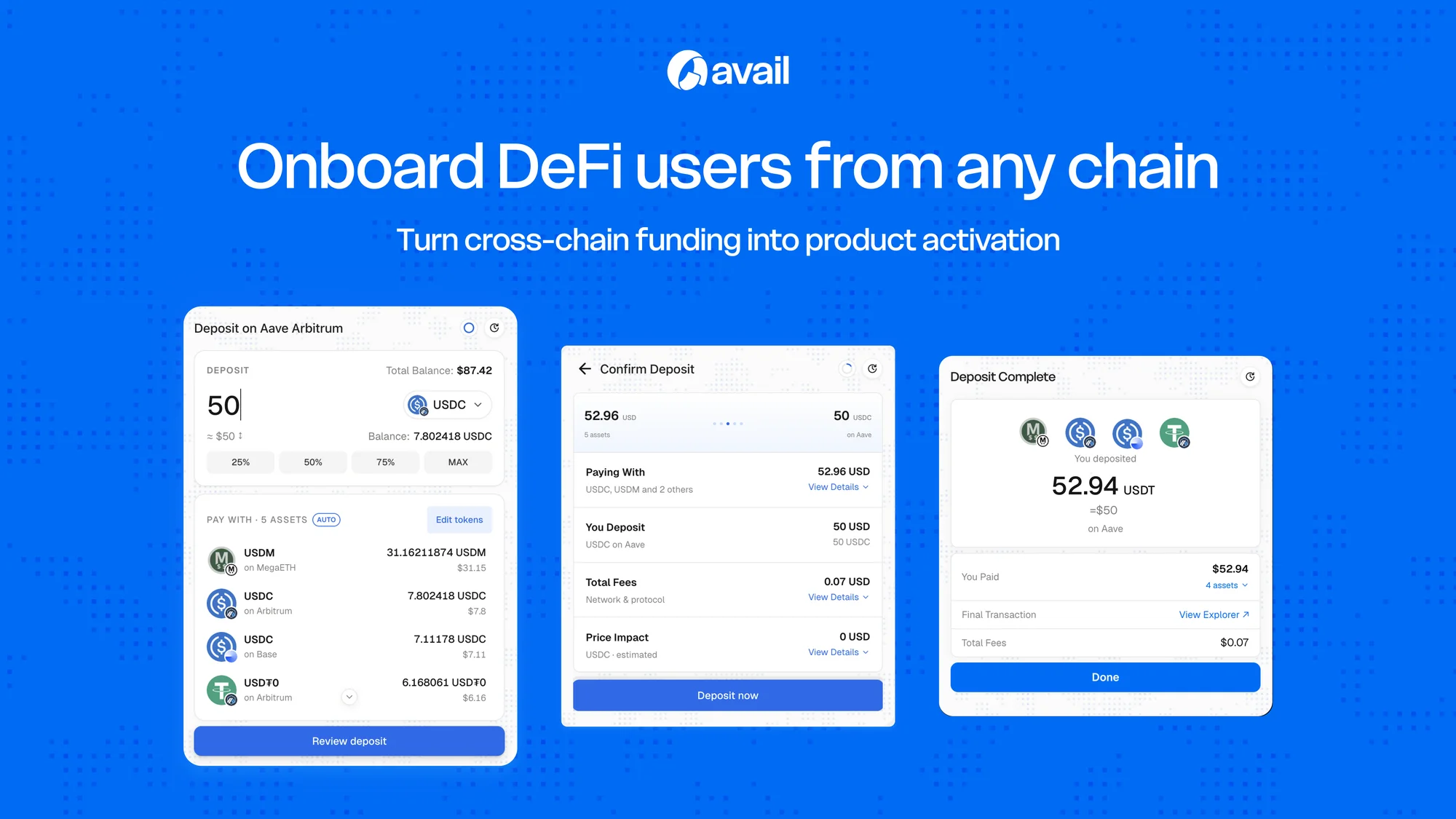
Don't make users choose a source network before assessing their assets. Instead, identify which balances can fund the necessary destination. Users might have diverse assets across their portfolios that, when aggregated, surpass the requirements of a single transaction.
Strategies for improving this aspect include:
- Showcasing eligible balances from supported chains as soon as the wallet connects.
- Clearly distinguishing usable assets from those that aren't supported, so users quickly understand what’s available.
- Displaying the total eligible value, allowing users to see funding potential across multiple sources rather than isolated chain balances.
- Providing clear explanations when a balance can't be used—whether it's unsupported, insufficient, or temporarily unavailable.
- Eliminating misleading empty states that suggest a lack of funds just because the selected network is unfunded.
The approach that Avail adopts showcases a unified balance across all wallet-linked chains, changing the question from "Which chain do you want to use?" to "Which of your balances can help you achieve your goal?"
Sources:
Chain abstraction overview ·
Deposit Widget3. Clarify the Goal before the Path
Users are more likely to engage when they understand the outcome before wading through technical details. Clearly articulate what they’ll receive, how much, on which chain, and what steps they can take next.
For instance, an effective interface might say, “Fund 100 USDC to open your position,” evaporating any confusion that arises when users must navigate through convoluted source options. It’s all about fixing the destination—application, chain, and asset—before presenting various funding sources.
Consider also:
- Displaying expected amounts and fees prior to any confirmation would eliminate unsightly surprises.
- Allowing selection of source balances without burdening users with intricate routing choices will enhance their journey.
- Keep transaction specifics available for those who want to delve into the details, but don’t let it compromise the primary action.
Exact-output funding allows the interface to specify the desired outcome first, detailing the required assets afterward. This approach not only aligns with user expectations but also streamlines the decision-making process.
Sources:
Exact-output swaps ·
Avail Deposits product page4. Integrate Swaps and Fees into the Experience
Too often, user education is mistakenly seen as the solution to wrong-token and gas-related confusion. Instead, it’s generally about how well the app communicates the process. When users are asked to manually switch networks or bridge funds, the responsibility falls on them to seamlessly navigate complexity that should be managed by the application.
For effective user experience, treat these technical details—like necessary conversions and gas calculations—as part of the process, not obstacles. Users shouldn’t have to struggle through unwieldy decisions and operations; rather, they should just confirm their desired outcomes with everything else automatically coordinated in the background.
Understanding User Actions and Next Steps
When users initiate a funding action, the experience shouldn't just funnel them back to a generic homepage. Instead, you want to keep the context they started with, whether that was a specific market, an asset, a vault, or a trade. It’s essential to maintain a flow that is intuitive and acknowledges their previous steps.
For optimal engagement, consider these key strategies:
- **Seamless Navigation**: Ensure users return directly to the precise state of the market or product they were in before the funding process. It’s about continuity; users should feel anchored in their journey.
- **Real-Time Updates**: Automatically refresh balances and relevant positions once a funding action is completed to keep information current and avoid confusion.
- **Pre-Fill Information**: When it's appropriate, refill the amounts or asset selections for users after completion. This not only saves time but enhances the user experience by minimizing repetitive input.
- **Clear Next Steps**: Show single, straightforward actions for users to take next. Phrasing like "Open position," "Supply now," or "Place prediction" can guide them through the following steps.
- **Session Persistence**: Retain enough client-side data to enable users to continue their journey after a refresh or wallet reconnection.
The design of Avail Widgets highlights the importance of lifecycle callbacks, allowing developers to handle user experience dynamism, from initiating an action to addressing errors. This framework doesn't just inform application updates; it also facilitates balance refreshes and analytics gathering, empowering teams to enhance user journeys without complicating components.
Sources:
Widget installation ·
Widget callback guidanceDesigning Resilience in Cross-Chain Transactions
Cross-chain transactions have a tendency to falter at various stages: before signing, during source execution, or even after a route has started. Simply displaying a vague "transaction failed" message can leave users bewildered and uncertain about the status of their funds or the correct next action.
To tackle this issue, interfaces should articulate the specific reasons for failure. Here's what to include:
- **Explicit Status Indicators**: Create distinct states for different types of failures—be it wallet rejection, insufficient balances, or delayed completions. Each state should clearly answer critical questions: What happened? Where are my funds? What’s my next step?
- **Prevent Blind Retry Actions**: Avoid scenarios where users might mistakenly initiate a retry, especially if a transaction is already pending in the background.
- **Maintain Context**: If a quote expires, retain the intended destination and amount rather than starting over from scratch.
- **Provide External References**: When applicable, link to an explorer or transaction history for verifiable information.
- **Support Clarity on Delays vs. Failures**: Clearly differentiate between a recoverable delay and a terminal failure to give users a realistic understanding of their next steps.
By implementing these strategies, you'll not only enhance the user experience but also foster trust in the navigation through complex cross-chain scenarios.
Sources:
Intent lifecycleShifting Focus to User Activation
It’s time to rethink how we evaluate user interactions with DeFi products. Rather than merely measuring successful transaction completions, smart teams should track the entire user journey, starting from funding and ending at the intended product action. This broader lens helps pinpoint issues, such as balance eligibility obstacles or execution failures, while identifying where users are dropping off.
By mapping each step in this journey, teams can uncover valuable insights into:
- **Intent Initiation**: Did users begin their funding process from a meaningful action?
- **Balance Verification**: Were users able to locate eligible balances that could fund their transactions effectively?
- **Quote Presentation**: Was a feasible route laid out clearly and understandably for users to follow?
- **Confirmation Clarity**: Did users receive clear communication when funding was confirmed?
Focusing on activation rather than just completion reveals deeper insights into user behavior, driving more nuanced improvements in the overall experience.It’s clear that the way users interact with financial applications is evolving rapidly, and organizations need to recalibrate their strategies accordingly. Measurement and analysis of user behavior are essential to identify what drives successful outcomes. It's not enough to merely track whether users could complete a transaction; companies must also analyze conversion rates at every step of the process. Each stage should be scrutinized — from user approval to fund transfer and product activation.
Understanding user pathways can shed light on any friction points in the flow. If funds are transferred but the user doesn't engage with the product, that signals not a failure of the technology, but perhaps an issue with onboarding. Effective onboarding is crucial; unless users experience the product’s value soon after onboarding, the investment in new features and flows may yield disappointing returns.
As for integrations, choosing the right method is more than a cosmetic decision. It reflects how comprehensively a team can control the user experience. For quick implementations that maintain a consistent user interface, the Deposit Widget is often the best route. If deeper customization and greater control over the entire user journey is needed, then the Avail SDK strategically positions that possibility. Each option has a role, and the selection should always align with the desired outcome.
Both approaches should focus on specific user needs rather than providing generic solutions. It will be vital for developers to validate their integrations before launch and test them against real user scenarios. Information such as the chains, assets, and exact input/output behaviors should be double-checked to ensure everything functions as intended.
In conclusion, as new applications emerge and user expectations heighten, companies face pressure to provide not just efficient solutions but ones that genuinely resonate with users. Committing to rigorous evaluation and thoughtful integration strategies will ensure that they remain competitive in this climate. If you’re involved in this space, remember that the user experience is paramount. Succeeding in today’s tech landscape is more than delivering a product; it’s about crafting an entire journey that users value.



Discussion
Sign in to join the discussion.