Judge Kaplan has denied Sam Bankman-Fried's motion for a new trial, effectively sealing his 25-year prison sentence amid ongoing legal challenges.
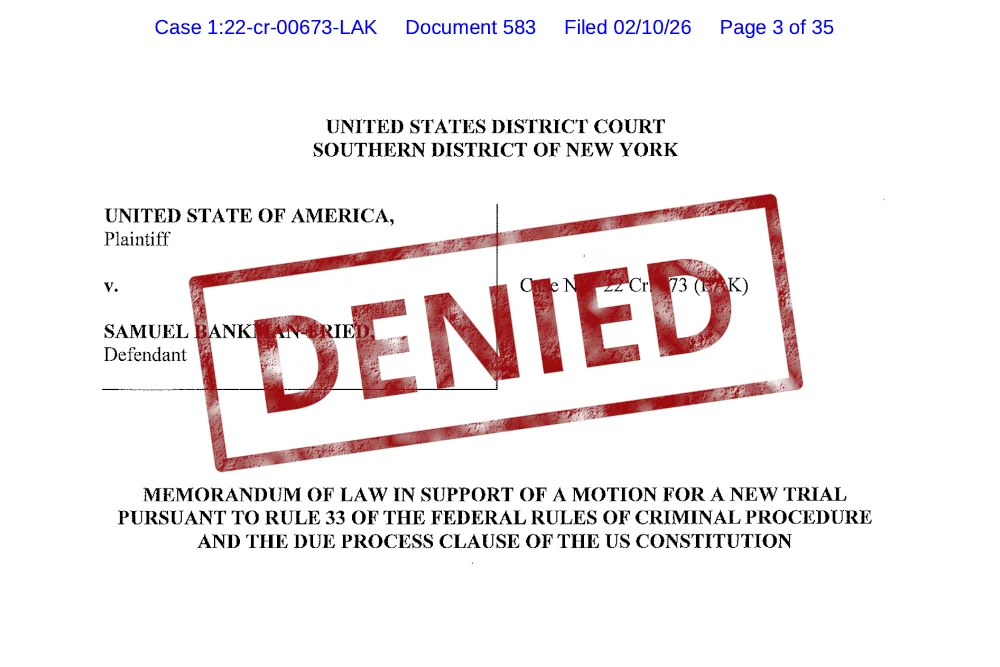
Sam Bankman-Fried's efforts to overturn his conviction have hit a significant roadblock. Judge Lewis Kaplan has dismissed his motion for a new trial, leaving him with limited options to contest his 25-year prison sentence. This decision also casts doubt on his ongoing appeal to the Second Circuit, which legal experts believe is unlikely to succeed.
The former FTX CEO previously sought to withdraw his trial motion, perhaps realizing the uphill battle he faced after several queries regarding the involvement of his parents in drafting his legal documents. However, Judge Kaplan insisted on addressing the merits of the case, emphasizing what he termed Bankman-Fried's calculated attempts to rehabilitate his public image—a strategy the defendant had outlined even before the indictment.
The Motion’s Dismissal
Back in February, representing himself, Bankman-Fried submitted a request for a new trial, even asking for a different judge to oversee the proceedings. However, irregularities, such as communications directed from his parents to the judge's office, prompted Judge Kaplan to demand an affidavit verifying whether Bankman-Fried received assistance from any legal counsel.
In response, Bankman-Fried submitted an affidavit asserting he had no legal help but acknowledged sharing drafts of his documents with his parents, who provided editorial feedback. He concluded his affidavit with a somewhat dramatic request to withdraw the motion for a new trial without prejudice, implying he wanted to keep that option open for future use.
However, Judge Kaplan denied this request and ruled on the motion itself. By not allowing the withdrawal, Kaplan effectively foreclosed any chance for Bankman-Fried to refile the motion later under potentially more favorable circumstances. Kaplan expressed concern that Bankman-Fried wanted to retain the right to refile at a time when the details of the trial might not be as readily available to the court.
Critique of Reputation Management
Kaplan took the opportunity to criticize Bankman-Fried’s "reputation management plan" devised post-FTX bankruptcy and pre-indictment. Documents surfaced during sentencing indicated a detailed strategy to revitalize his image, featuring an agenda that included media appearances on various platforms and a significant online presence to garner public support.
This strategy involved brainstorming ideas that Bankman-Fried himself termed "random probably bad ideas." Some of these included interviews with high-profile individuals and adopting new political affiliations to sway public perception.
Judge Kaplan noted that Bankman-Fried pursued this self-promotional narrative while incarcerated or under house arrest, suggesting a profound commitment to rebuilding his persona. However, Kaplan pointed out that many of the claims Bankman-Fried made in this narrative had been previously dismissed as irrelevant in court.
A Weak Defense
Turning to the specific legal arguments for a new trial, Bankman-Fried relied on Rule 33 of the Federal Rules of Criminal Procedure, claiming newly discovered evidence could warrant a retrial. He referenced potential testimonies from witnesses he believed would exonerate him, alleging threats made by prosecutors that silenced them.
Judging by Kaplan's findings, these witnesses were not new to Bankman-Fried prior to the trial, undermining the argument that their testimonies should be considered fresh evidence. Kaplan also scrutinized self-serving claims by one of the witnesses, Ryan Salame, who attempted to recant his guilty plea after initially cooperating with authorities. The judge emphasized that claims of coercion appeared insincere and unsubstantiated.
Limited Path Forward
With the denial of his trial motion, the path ahead for Bankman-Fried appears increasingly bleak. His options now include a direct appeal to the Second Circuit, which historically have a low success rate, particularly in high-profile cases like his. During oral arguments in November 2025, judges expressed skepticism regarding his claims about FTX's financial standing, with critiques aimed at his defense narrative.
If his appeal fails, Bankman-Fried could theoretically pursue a habeas corpus petition, although this avenue is fraught with challenges and requires demonstrating constitutional violations during the original proceedings. That said, the odds of success in such a scenario are even lower than with normal appeals.
His last glimmer of hope seems to hinge on the possibility of clemency. Despite recent attempts to align himself politically—coupled with ongoing public relations attempts to build support—he faces a significant hurdle: former President Trump, whom he has publicly praised, has already indicated he will not grant a pardon.
With very few legal avenues remaining, Bankman-Fried’s future looks increasingly uncertain, and the skepticism surrounding his claims will only complicate any potential relief from his lengthy prison sentence.



Discussion
Sign in to join the discussion.