Fellowship PAC secures $10 million from Cantor Fitzgerald, linking it to Commerce Secretary Howard Lutnick amidst notable political endorsements and expenditures.
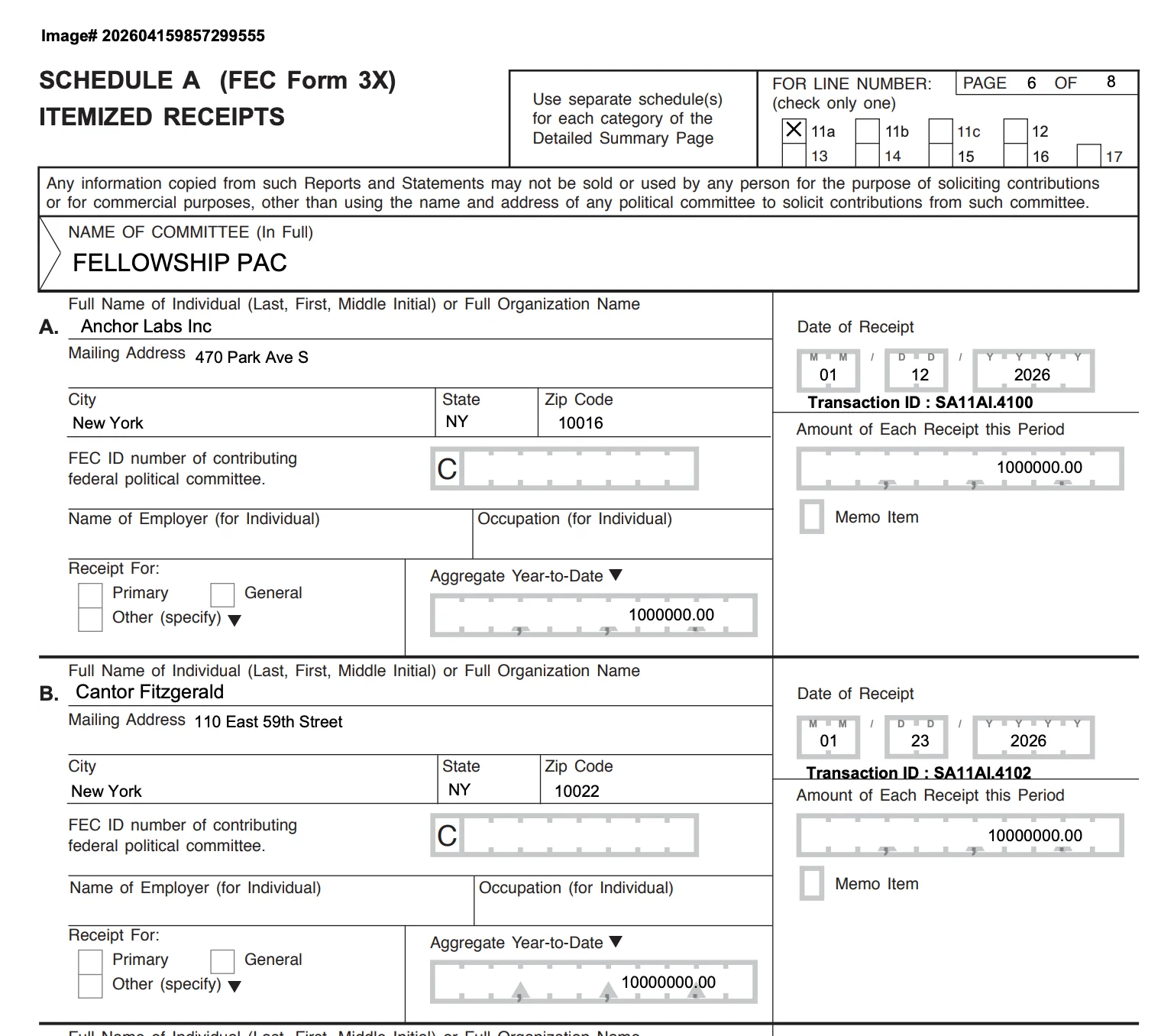
The Fellowship PAC, which operates in the crypto political action committee sphere, recently disclosed a substantial financial inflow of $10 million from Cantor Fitzgerald, complemented by a $1 million contribution from Anchorage Digital. Notably, Cantor Fitzgerald is the financial services firm managed by Commerce Secretary Howard Lutnick, who has shifted control of the firm to his sons upon taking office.
Financial Backing and Influential Connections
The injection of funds into Fellowship PAC, particularly from a financial juggernaut like Cantor Fitzgerald, isn't just about numbers. It reflects a strategic alignment between the financial and political spheres, where significant stakes are involved. The movement of $10 million indicates that Cantor Fitzgerald is actively choosing to shape the political landscape, particularly in areas intersecting with cryptocurrency and financial technology. With Anchorage Digital's contribution adding another layer of support, it's clear that the PAC is not short on resources. This potential for influence could mean substantial lobbying power that extends beyond mere financial clout.
Launched in September, Fellowship PAC announced a staggering $100 million in initial commitments. The PAC is spearheaded by Jesse Spiro, who directs government affairs for Tether, the prominent stablecoin issuer. This is the part most people overlook: the interconnectedness of these players highlights a web of interests that could affect regulatory policies concerning cryptocurrencies.
The Implications of Corporate Donations
The connections between Tether and Cantor Fitzgerald run deep, as Cantor not only holds a stake in Tether but also manages a significant portion of its reserves. Lutnick has publicly affirmed the integrity of Tether’s reserves despite ongoing scrutiny regarding the firm’s transparency. Here’s the thing: such endorsements can lend credibility to Tether, but they also raise a multitude of questions about what this financial backing means in terms of ethical governance.
Further complicating matters, Lutnick’s sale of Cantor Fitzgerald to his children may have been partially financed through a loan from Tether. This arrangement, while aimed at avoiding conflicts of interest, arguably introduces new dilemmas, as legal experts note the complexities that arise from such financial maneuvering. The PAC's funding mechanisms must not only withstand scrutiny from regulatory boards but also public perception, which can be brittle in politically charged environments like the crypto sector.
Political Maneuvers: Endorsements and Expenditures
Fellowship PAC made its inaugural independent expenditure during Georgia’s District 14 special election, investing $300,000 to support Republican candidate Clayton Fuller. The result was a victory for Fuller, who secured 55.9% of the vote. However, it’s noteworthy that he won by a tighter margin compared to previous elections in this Republican stronghold. This signals that even with substantial backing, the PAC's contributions need to be strategically aligned with voter sentiment, something that isn't a guarantee in today's increasingly polarized political climate.
Beyond Fuller, the PAC has also unveiled a slate of endorsements exclusively supporting Republican candidates, including:
- Alan Wilson, South Carolina governor
- Mike Collins, Georgia Senate
- Julia Letlow, Louisiana Senate
- Pete Ricketts, Nebraska Senate (incumbent)
- Nate Morris, Kentucky Senate
- Blake Miguez, Louisiana House District 5
These endorsements aren't just casual affiliations—they represent calculated bets on candidates who appear to align with the PAC’s broader goals. The consolidation of such endorsements among Republican candidates suggests an effort to cultivate a friendly legislative environment for crypto policies. If you're working in this space, this could reshape your understanding of where the real battles will be fought in the coming electoral cycles.
Financial Offensive and Strategic Goals
Since those endorsements, Fellowship PAC has continued its financial offensive, contributing $850,000 to Nate Morris for his contest against Andy Barr in the Kentucky Senate Republican primary, along with another $350,000 to bolster Pete Ricketts' re-election campaign. This illustrates a clear strategy: to not only support candidates aligned with their interests but also to build a formidable war chest for future elections. Such financial commitments can significantly tilt the playing field, especially in crucial battleground states where margins are thin.
In terms of overall spending, the PAC has allocated $4.5 million to NXUM Group, with $3 million earmarked for issue advocacy advertising and another $1.5 million dedicated to producing specific campaign ads for the aforementioned political figures. NXUM Group was co-founded by Bo Hines, a former director of Trump’s crypto advisory council, who now leads Tether US. That kind of pedigree brings a certain level of credibility, but it also puts the spotlight on how closely aligned this PAC is with political figures in the Trump administration, raising questions about how this would play out under the shifting tides of political engagement.
Future Outlook: Navigating the Political and Legal Matrix
The financial inroads made by Fellowship PAC serve as a bellwether for what could follow in the crypto political action committee arena. As corporate interests pour resources into political channels, the lines between political advocacy and corporate strategy are increasingly blurred. What this means for you as an observer or participant in this space is clear: keep an eye on the intersection of financial maneuvering and political action. With legal and ethical standards evolving, the scrutiny surrounding these arrangements is only likely to increase.
As the PAC and its financially influential backers navigate this landscape, the implications for future crypto regulations and campaigns could be significant. Will these efforts yield the desired political climate for cryptocurrencies, or will they backfire under public scrutiny? Only time will tell. But one thing is certain: the stakes are high, and the political implications will ripple far beyond the individual campaigns.


Discussion
Sign in to join the discussion.