David Schwartz argues XRPL’s growth could support XRP demand, while wallet data and price levels offer a separate read on network activity.
XRPL activity and XRP demand
XRPL adoption and XRP demand are linked by the token’s practical roles on the network, Ripple CTO emeritus David Schwartz argued in an October 23 exchange on X. His case rests on XRP’s use in trading, liquidity and transaction fees—not simply on the ledger attracting more activity. That distinction matters: a network can gain users without every user creating equal demand for its native asset.
“The thesis is this: Low fees and reliable operation make XRPL a great place to move and hold value. That drives value flow to XRPL. XRP captures some of that value because of its unique advantages over other assets on XRPL,” Schwartz wrote.
The argument describes a chain of effects, not an automatic conversion of usage into price gains. Low costs and reliable operation may encourage activity, but the XRP demand case depends on what users do once they’re on the ledger. If they trade through XRP, hold it for access, or need it to pay fees, network use has a clearer connection to the token.
Those advantages include XRP’s ability to serve as a bridge between assets, its availability to accounts without counterparty risk, and its role in paying network fees. Schwartz said accounts must hold XRP to cover those fees, giving the asset a direct connection to ledger use. The fee requirement creates a baseline use case, though its existence alone doesn’t show how much XRP users need to hold or how strongly that affects demand.
“It’s the only counterparty-free asset that any account can accept,” he added, saying these features could help drive XRP’s value and demand.
Trading activity could give XRP a wider role
The XRPL’s built-in decentralized exchange can route a trade through XRP when that produces a better rate than a direct swap between two assets. In that case, XRP serves as an intermediary: it connects markets that might otherwise have less direct liquidity. The role depends on the available trading paths and the relative rates, so it’s a mechanism that can support demand rather than a guarantee that every trade will use XRP.
If the ledger adds more markets and tokenized assets, XRP could serve more often as the link between their liquidity. A broader set of assets would create more potential trading pairs, but the practical outcome would still depend on whether routing through XRP is competitive. More listings by themselves don’t establish that users will choose those routes.
Schwartz considers it “very unlikely” that XRPL would become highly successful in financial applications while XRP failed to attract meaningful demand. He allowed for a different outcome if one settlement asset came to dominate, though he views that scenario as unlikely. Even if Bitcoin took that role, he said, wrapped or bridged BTC could trade on XRPL and leave room for XRP to facilitate exchanges.
Here's the thing: that scenario still depends on XRP providing a useful trading path alongside the dominant asset. It illustrates how the token might retain a role even if it isn’t the main store or settlement asset. And yet, the possibility is an argument about how the system could work, not evidence that this pattern is already driving substantial demand.
Wallet growth adds an adoption signal
Network activity offers a separate way to track XRPL’s reach. Santiment reported last Thursday that the ledger had a record 8.24 million non-empty wallets. Daily wallet creation reached 4,772, the fifth-largest spike since March. The figures point to continued participation amid price volatility, though wallet growth alone doesn’t establish how much demand it creates for XRP.
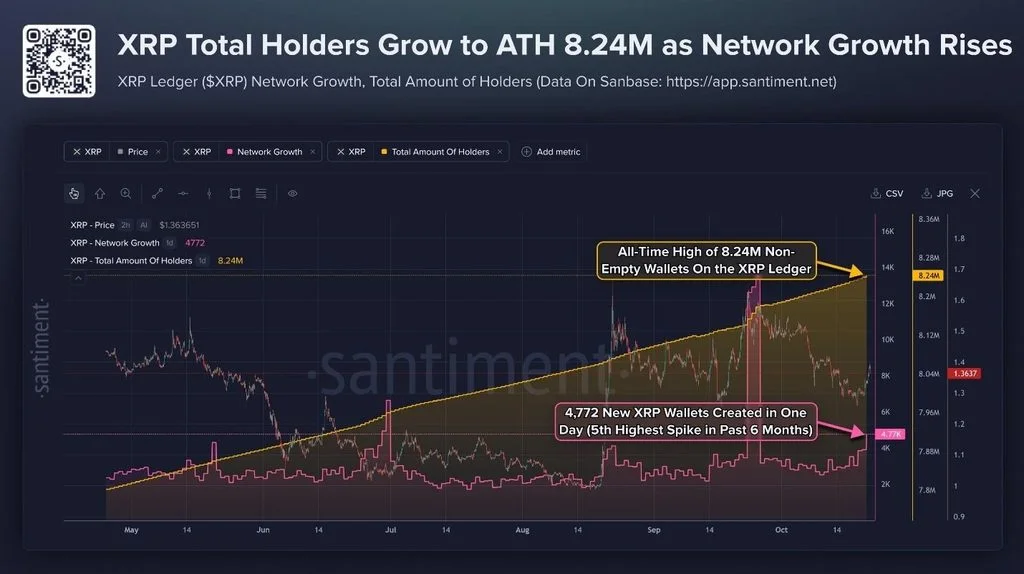
A non-empty wallet is a measure of accounts holding some balance, not a direct count of active people or a measure of transaction value. Wallet creation can signal that more accounts are being established, but it doesn’t reveal whether those accounts are regularly trading, holding XRP for fees, or interacting with other assets. That gap between reach and economic use is the part most people overlook.
Santiment identified $1.40 as a level to watch: a sustained move above it could put $1.50 in view if wallet growth continues. A fall below $1.30 alongside slower wallet creation would weaken the near-term adoption signal. These are conditional reference points, and they leave open the central question of whether activity is translating into durable use.
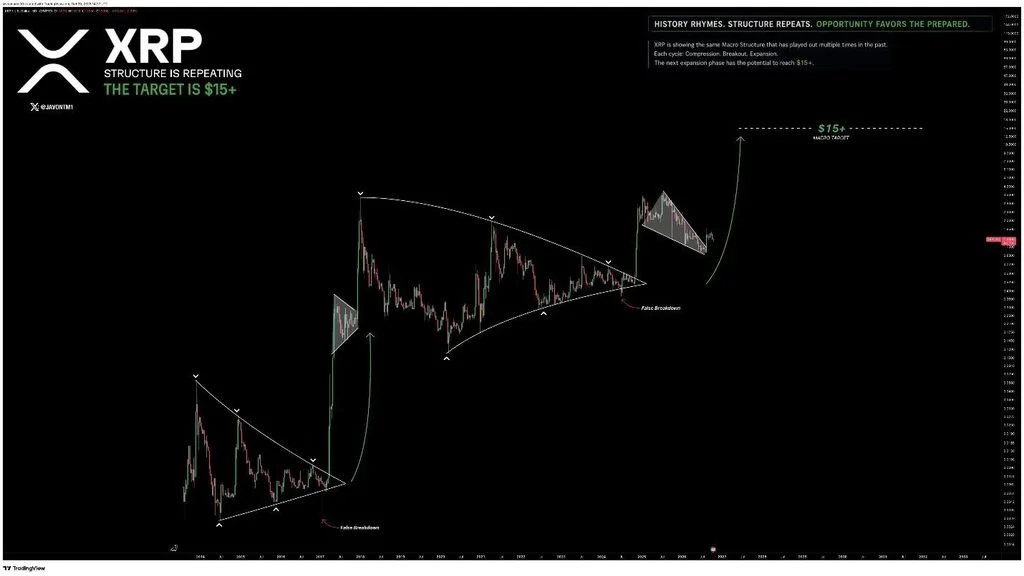
Price forecasts elsewhere are more aggressive. Egrag Crypto said a chart pattern resembling earlier compression and breakout periods could point to a macro target above $15. That projection rests on interpreting a chart pattern; it doesn’t address whether XRPL activity is creating sustained demand for XRP. The numbers here are underwhelming as evidence for that much larger claim.
What adoption would need to show
At press time, XRP traded at $1.31, up 2.91% over 24 hours. A daily price move and a wallet record capture different things: one reflects the market at a point in time, while the other tracks the number of funded accounts. Neither, on its own, shows whether XRP is becoming more necessary to use the ledger.
If you're working in this space, the useful distinction is between more activity on XRPL and more activity that specifically relies on XRP. Sustained use for fees and liquidity would make Schwartz’s thesis easier to assess; wallet growth and chart projections offer context, but they don’t answer that question. The practical test is whether ledger activity repeatedly sends users through XRP.
That’s the question the adoption figures leave open.


Discussion
Sign in to join the discussion.