Hoskinson forecasts Bitcoin at $250,000 within two years, while AI payments and adoption barriers shape his outlook for crypto.
Charles Hoskinson’s $250,000 Bitcoin forecast rests on more than a bullish price call. The Cardano founder sees AI agents conducting economic activity as a potential new source of demand for digital assets, connecting a technology trend to a long-standing crypto argument: networks need useful activity, not just buyers and sellers. He expects Bitcoin to reach that level within 24 months, though adoption hurdles and uncertain market signals complicate the near-term picture. That’s a bold timeline for a thesis that depends on several moving parts.
Speaking with Ana Tutova, founder of AI Crypto Minds, at TOKEN2049 in Singapore, Hoskinson said, “Yeah, I’m still very very bullish. You know, the next 24 months that Bitcoin will reach $250,000,” he stated. The forecast is his view, not a conclusion established by the evidence in the interview. For readers assessing it, the distinction matters: the proposed source of future demand is a possibility, while the price target is a prediction.
AI agents could create new crypto demand
Hoskinson’s broader argument is that autonomous software will need ways to pay for services, transact and take part in online marketplaces. Software agents that act on a user’s behalf could require payment systems suited to digital transactions, and he sees cryptocurrencies, especially stablecoins, as one possible financial layer. “For agents to have agency and for agents to have economic identity has to be crypto,” he said. The claim makes crypto sound like a natural fit, but whether it becomes the preferred option depends on how these systems are built and what payment tools they can use.
That thesis ties AI adoption to practical blockchain use, rather than treating the technologies as separate stories. Hoskinson argued that combining them could lift activity across multiple digital assets: “If we can get AI into crypto in just the right way, uh it’ll 10x or 100x the volume of a lot of these cryptocurrencies, and it’s going to be very good for our prices,” he said. The scale of that claim is striking, but the interview doesn’t establish how such a change would happen or how much activity would translate into lasting demand for any particular asset. More transactions can signal use; they don’t, by themselves, show that prices will rise.
He also called for the industry to put more weight on applications than trading narratives. “We have to move beyond speculation to utility,” he said, pointing to AI and real-world asset tokenization as areas that could produce practical uses for blockchain networks. Here’s the thing: a useful application has to work for the people or businesses using it, not simply generate transactions on a network. The challenge is turning a broad promise into services people choose to keep using.
Usability and privacy remain adoption hurdles
Hoskinson acknowledged that crypto has yet to become part of daily life for most consumers. While user numbers and market value have grown, he said using digital assets remains too complicated for broad adoption. That gap between market attention and routine use is central to his own argument: if crypto is to support economic activity by software agents or people, the experience must make sense beyond the trading community. A system can attract attention without becoming a practical payment tool.
Privacy presents another obstacle for institutions. Public transaction records can reveal sensitive financial information, making openness a trade-off for organizations that may need confidentiality as well as a way to verify transactions. And this is the part most people overlook: usability and privacy aren’t side issues if the intended users include businesses and consumers. They shape whether a proposed application can fit into real workflows.
His view is that the next phase of blockchain development will need to improve usability, identity, privacy and interoperability. These concerns are connected: users need a manageable way to interact, institutions need suitable privacy, and different systems need ways to work together. He expects progress in these areas to help bring crypto into mainstream financial activity before the decade ends. If you’re working in this space, that’s a useful test for the AI thesis too: can the infrastructure handle the practical demands of use?
Market data sends mixed near-term signals
Bitcoin’s price action remains a separate test for Hoskinson’s optimism. Santiment reported Tuesday that the network had lost about 30,000 non-empty wallets since October 16, leaving roughly 59.95 million. The analytics firm said smaller holders may be leaving after a prolonged stretch of stagnant prices, a pattern it suggested could precede a local bottom. Wallet counts can describe participation, but the reported decline doesn’t establish why holders left or prove that prices have reached a turning point.
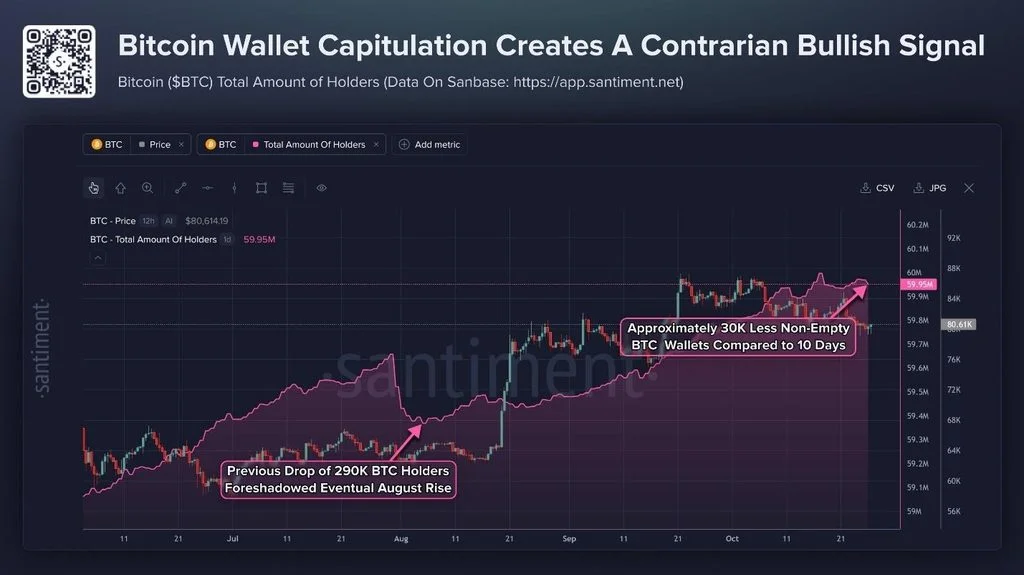
Santiment identified $80,000 as a key level and said a move back above about $82,500 would strengthen its bottom scenario. “Retail capitulation has historically been more constructive for price than a sudden flood of new buyers chasing rallies. Crypto typically moves opposite crowd expectations at emotional extremes, so shrinking participation while BTC struggles near $80K strengthens the case that a local bottom may be forming shortly.” the firm wrote. That reading offers a possible interpretation of current behavior, not a reliable timetable. Markets can remain weak even when a set of indicators looks consistent with a bottom.
CryptoQuant analyst ‘Trader Gemini’ pointed to Bitcoin’s Trader Realized Price, then in the mid-$70,000 range, as another level to watch if the market falls. The metric tracks the average price paid for Bitcoin last moved between one and three months earlier. That makes it a reference point for the cost basis of a particular group of coins, not a guaranteed floor for the wider market. The analyst cautioned that it isn’t a guaranteed floor, though it has served as support in some bullish periods. A level to watch. Not a promise.
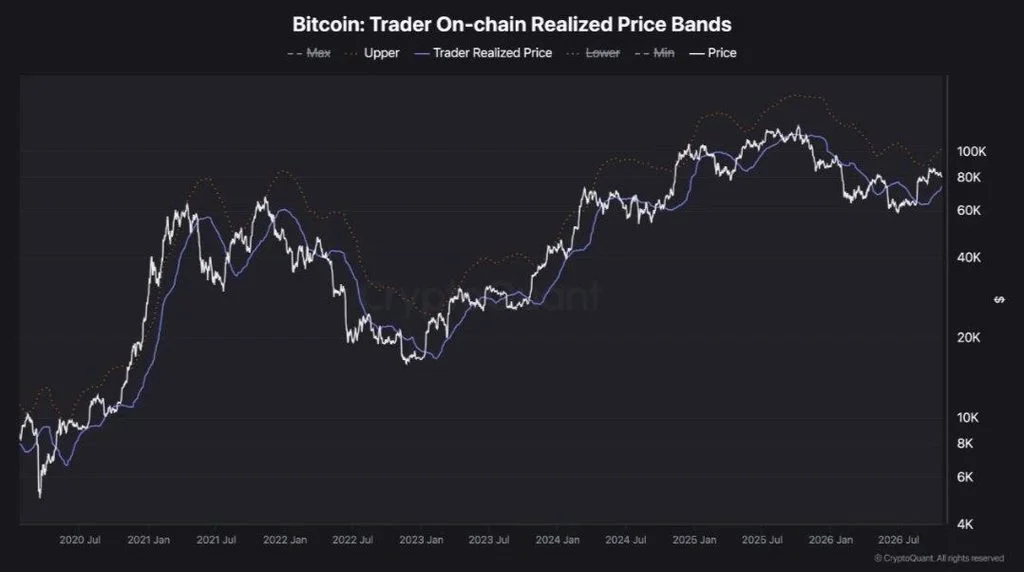
Bitcoin was trading at $80,550 at press time, up 4.14% over the previous 24 hours. A one-day gain gives a snapshot, not an answer to whether the market can sustain a recovery or meet Hoskinson’s much larger target. His forecast therefore hinges on two timelines: whether market momentum can recover from current levels, and whether AI and other applications can make crypto useful to people and businesses beyond trading.
The test is sustained use
The AI argument gives Hoskinson’s forecast a longer-term rationale, but it doesn’t resolve the gap between potential use and demonstrated demand. Similar systems typically need dependable payments, clear user benefits and infrastructure that people can operate without treating every transaction as a technical project. If AI agents do begin transacting on crypto networks, the relevant question will be whether that activity persists and serves a real purpose. That’s more significant than a short-lived burst of volume.
For now, the interview presents a case to watch, not proof that AI will drive Bitcoin to $250,000 within two years. Hoskinson’s own emphasis on usability, privacy and practical applications points to the work still required. The market indicators cited here offer competing clues about near-term conditions, while the larger thesis depends on adoption that hasn’t yet been established in the article. The numbers here are underwhelming as a forecast model: they describe a target and some market levels, but leave the path between them uncertain.



Discussion
Sign in to join the discussion.